Creating Generative Movement Vocabularies
January 26, 2026
An Interview with Alice Sheppard and Laurel Lawson
BY EMMALY WIEDERHOLT
Kinetic Light is an internationally recognized disability arts ensemble. Working in the disciplines of art, technology, design, and dance, Kinetic Light creates, performs, and teaches at the nexus of access, queerness, disability, dance, and race. Alice Sheppard is the Founder and Artistic Director of Kinetic Light, as well as a choreographer and dancer in the company. Laurel Lawson is a founding member, choreographic collaborator, dancer, costume and production designer, and the Access & Technology Lead with Kinetic Light. Here, Alice and Laurel share more about The Next TiMes, Kinetic Light’s new multimedia disability arts experience. They also share recent tech and access developments and what’s next for the company.
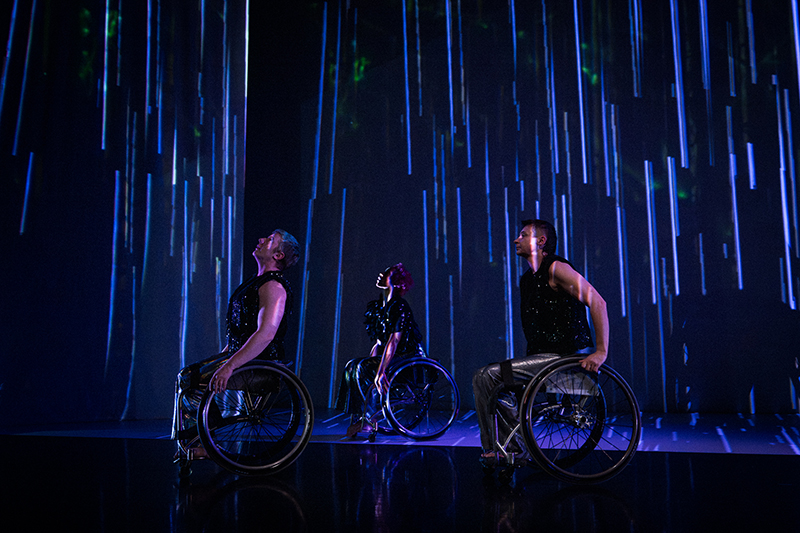
The Next TiMes. Laurel Lawson, Alice Sheppard, and Tatiana Cholewa wheel across the stage, gazing up. They all wear silver pants and shimmery black tops. In the background, a projection of long blue lines and dappled green reflections of light. Photo by Cherylynn Tsushima.
~~
Can you start by telling me about your most recent work, The Next TiMes? What was the impetus behind the piece?
Alice: It was a splatter of ideas that gelled in different ways, lived in different places, and rubbed against each other in a way that generated the work. The piece starts in the pandemic with the idea of survival and with the idea that access is a way of communicating. It grows from there.
Laurel: We took the 2D dance floor into 3D with DESCENT. Wired was a direct evolution or expansion of that in taking the grounded dance space into the full volume of the space. This new piece in part came from asking, “What is the four dimensionality of space? Or, having already used the entire volume of the dance space, what’s next?” We wondered how to make different concepts apparent onstage. That was thinking about the air itself as a choreographic element. That was also thinking about light itself differently, not just cast on the bodies, but how to give light a life onstage. Some early experimentation was playing with feathers and glitter. It’s easy to make that part of it sound like we were having the most fabulous queer time, but it was actually coming from this impulse to further develop ideas of air and light. And then it kept going from there.
Alice: The next layer of this is thinking about disability culture, how we understand each other, what brings us together, what are the stories that bind us, what are the stories that divide us, how do we survive, and in what spaces can we survive? Part of this is the notion of crip futurity. If we were to rebuild the world, what would we build? If we were to depend on each other, how would we live? We would have to build differently with an internal culture that is accessible in a way that the stories we tell about our past and ourselves build the future we want to live in.
Laurel: Perhaps the last big layer was finding the story in there. Because both of us are of a certain age and have a certain penchant for the classical, we had to discover the story we were telling. That particularly came into play when creating work for Kayla Hamilton and Tatiana Cholewa (the other two performers in the work).
Alice: That’s the big story. Their artistry and their experience – what they know, the way they move – helped us build this new world.
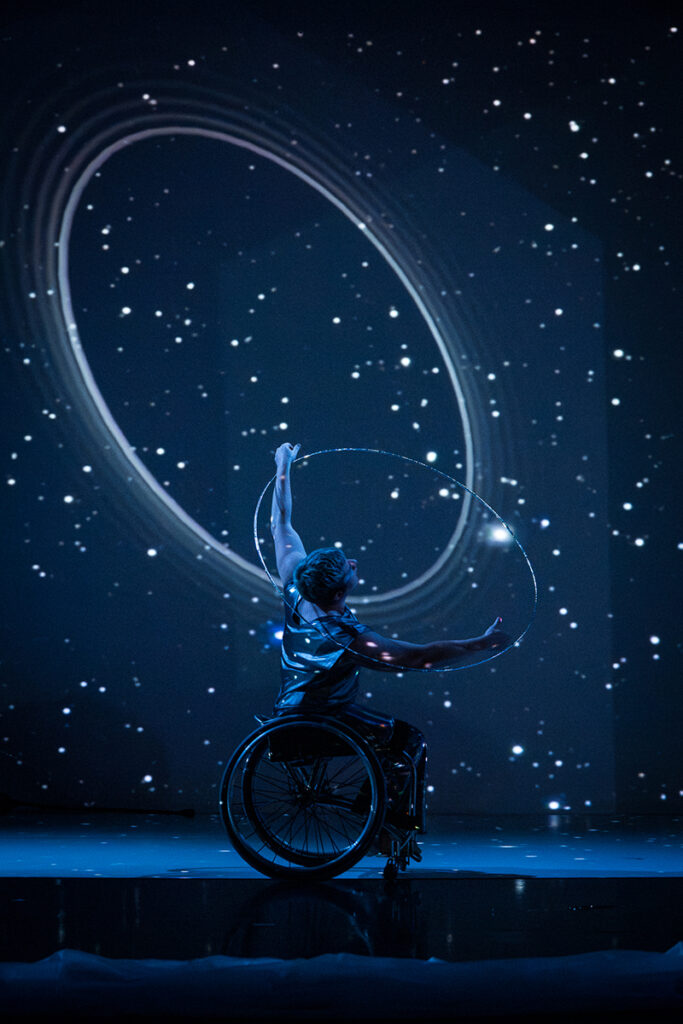
A moment from Kinetic Light’s The Next TiMes. Laurel Lawson glides across the stage, curved arms lifted and mirroring not only the large silver hoop that encircles their shoulders but also the huge ring that appears in a starry sky behind them. Laurel is a white person with cropped hair. Photo by Cherylynn Tsushima.
What was the choreographic process?
Laurel: The final sections of the work are danced with feathers onstage where the feathers deeply influence the movement itself, not in a way of speaking to manipulate the feathers, but in a way of having to create movement that moves the most air possible. It absolutely dictated the kind of movement and the speed of movement we were using. That became a fascinating experiment in stage access with dancers doing fast big powerful movement, crossing pathways in very close proximity, with completely different access needs.
Alice: That’s true of all our work; we have engaged with materiality, performance surface, and environment in everything we’ve done. The movement vocabulary of each work and each section within the work is driven strongly by the environment we’re working with – be that on the ramp in DESCENT, in the air or in the barbed wire coils in Wired, or in TiMes with Laurel’s mylar creations, to hoops that surround the bodies, to bubbles, to the actual feathers. Part of the characteristic movement for the company is that we’ve created a movement vocabulary for each work that directly is created by the environment we’re working in.
Laurel: With the sculptural mylar hats that open the work, we didn’t wind up going with the gotcha approach, which I really wanted. There was this original concept that they were onstage as set pieces, and no one knows there’s a dancer in it. That’s an example of something where the choreography is created by the thing itself and is a way of emphasizing how seriously we engage with the projected environment. You’re seeing the mylar moving and swirling around the stage, but you’re also seeing the projections dancing. The projections aren’t just this image in the back; they are three-dimensional presences. Each section has an element like that. There are only two sections in the work that are stripped back from materiality, which was a choice.
Alice: A lot of what’s going on here is a reckoning with how disabled dancers build, create, and connect dance because we don’t have a history of working with 400 years of ballet. We can learn technique related to ballet and modern, but a lot of what we’re doing is an experiment in disabled embodiment and disabled movement that is coming from these embodiments in relation to materiality. Part of what you’re seeing is the creation of a multilingual lexicon of disabled movements. The choreography of each work, even within the sections of the work, is deep and intentional explorations of disabled embodiments in relationship to the environments. I hope it’s asking us to question the body and to understand the creative process as generative movement vocabularies that will live within dance cannon and dance history, and disability culture specifically.
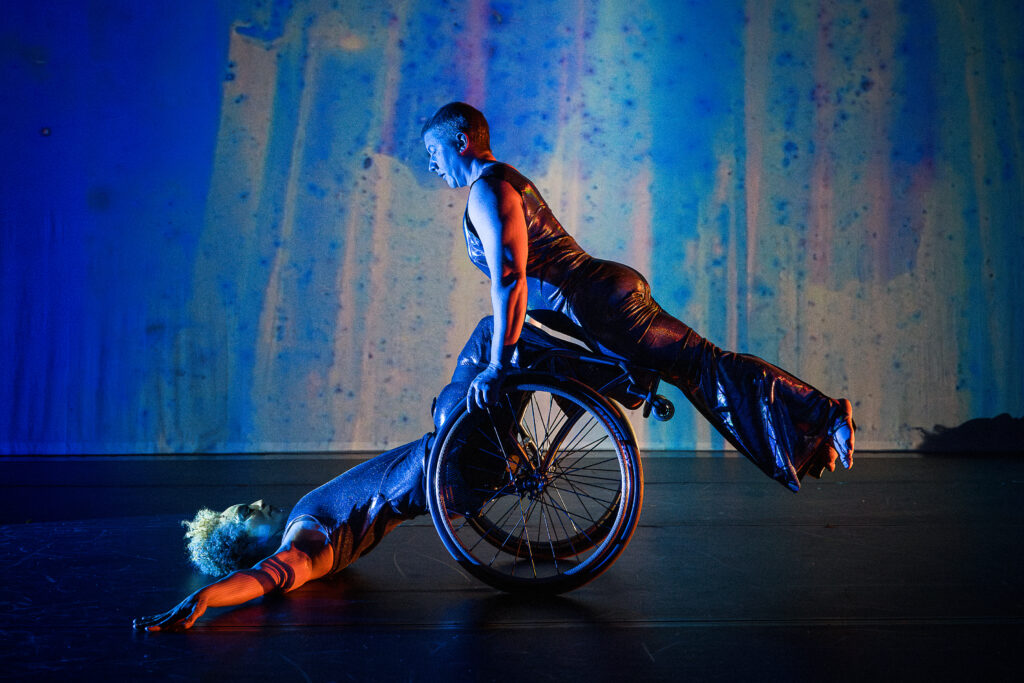
A moment from Kinetic Light’s The Next TiMes. Laurel Lawson holds their body in a diagonal line as they balance atop Alice Sheppard’s wheels and shins. Alice supports from below as they lay back, arms and torso on the ground, hips lifted. Alice is a multiracial Black woman with short curly hair, Laurel is a white person with very short cropped hair; they both wear shimmery sleeveless bodysuits. Behind them, a projection of soft blues, purples, and greens looks like rain on a windowpane. Photo by Cherylynn Tsushima.
Access is central and generative in all Kinetic Light projects and practices. Are there some recent tech and access developments you’d like to share more about?
Laurel: There are several strands of this. We’ve been working intensely on a couple lines of technical development like building hardware, writing software, and printing circuit boards. We’re not just creating the art that is deployed on these devices, but we’re working to create the systems to understand what we’re doing intuitively and through our years of experience creating systems by which people can learn and create in these ways without the investment of research, time, and capacity.
With TiMes, we’re bringing forward our use of haptic composition. Of course, we’ve been deploying haptics for audience access since Wired, but in the past 18 months, we’ve moved into composing directly in vibration as a primary and originating artistic source, instead of using vibration as a means to access sound. That’s where the field still is largely. All the things off the shelf are taking a sound source or taking ambient sound and converting it into vibration. That’s where we began also. Now we’re working to create vibration as its own intrinsic medium. That’s where most of our hardware is going. Our circuit boards are being made for wireless haptic devices.
The other primary line of development is Audimance. It’s less of a change artistically, although we did push the boundaries; for TiMes, we finished with 11 tracks on Audimance, and we found that 11 might have been slightly over the top. We experimented with a lot of different kinds of content. On the technical side, TiMes was our premiere use of the iOS app. We’ll hopefully be launching the Android app early this spring.
There are two more pieces of software that will make it easy for anyone to deploy so that it’s widely adoptable, so anyone can create one or many descriptive tracks for their show, upload it, set their cue points, and off they go. Right now, it takes a bit of hand holding to accomplish.
Alice: Laurel and Colin Clark have been working on these developments. What is important to understand is the necessity of both tool development and artistic creation as the field moves forward into tech. There’s a critical moment where we have a chance to make an intervention, so that disability culture is leading and not add-ons or retrofits in the new world. That’s a critical moment that we’re at.
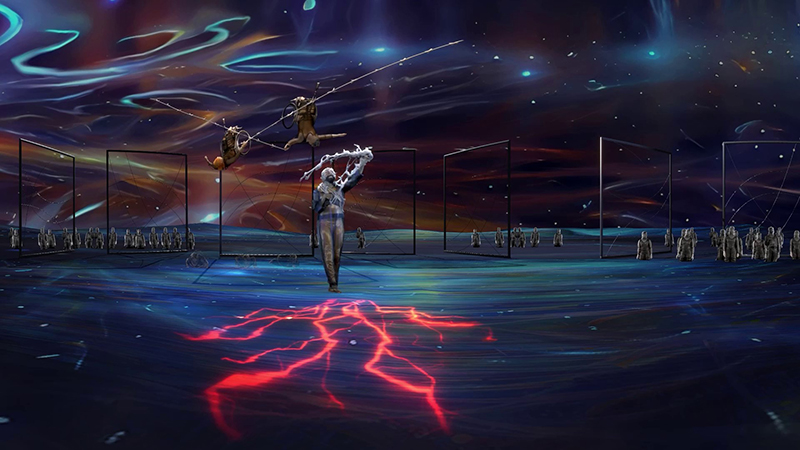
A still from Kinetic Light’s VR experience, territory. In a futuristic realm, a figure whips wire above his head as vibrant red lightning bolts emerge from his feet, scattering across the landscape. Behind him, angular gates separate dozens of kneeling figures; two flying figures swing through the multicolored swirling sky, trailing lines of barbed wire. Credit: Double Eye Studios/Kinetic Light.
What new projects are coming up in 2026?
Alice: It will be a wild ride. We’re looking to international partnerships to expand our culture and our understanding of the way that disability and access appear onstage.
In 2026, Kinetic Light will be 10 years old. At 10 years, we will be thinking of what we’ve learned, and what should we do. The field has shifted. We understand concert dance differently now. The field has choices. You cannot say you didn’t know about disability. That’s always been true, but it’s more obvious now. There’s a challenge to the field and other artists to make accessible work, to imagine disabled artists onstage, and to imagine disabled artists in the work, making the work, producing the work, and designing the work. At this point, you can’t say you didn’t know. If you have not paid attention to the work of disabled artists and technicians, you have a responsibility to expand what you know about the field.
When you mentioned international partnerships, are you referencing parts of the world that have little to no disability access?
Alice: The thing that we are calling disability dance is set in generative but also sometimes tense conversations in what is known as inclusive or integrated dance. This conversation is a North American conversation. Internationally, histories and cultures are different. What we are doing is being in conversation with our colleagues in a way that I hope will increase the general familiarity and expand what we know about the ways disability culture, access, and artistry are represented in concert dance.
Laurel: It’s not just paperwork; it’s cultural diplomacy. We are simultaneously working in places where we have to work at the beginnings, where we’re doing fundamental work to get people’s needs met, as well as entering partnerships in places that have developed their own cultures, practices, and supportive ecosystems in disability arts where we’re coming to learn and partner and be in those conversations. It’s deeply exciting.
Alice: We are slowly and intentionally making a framework in a way we haven’t done yet in writing. Something that is critical and has been critical is the writing. We’re a lot more than a performance company. A lot of what we’re going to release in the next two years is about the thinking of the work.
You recently received the Knight Choreography Prize from the National Center for Choreography-Akron. What does this mean to you and how is it affecting your work going forward?
Laurel: Part of what we set out to do, and I think we have substantially achieved, is to open the space of formal concert dance supported by high production value for disabled artists. Recognitions like this are in significant part a response to that. It’s not really about us though. It’s about a field shift.
Alice: It’s a tremendous opportunity to review creative practice in a new context and format. One of the things that’s so generous about the prize is the space to think and rethink how creative practice might work. I’m excited to see what we create. It could be anything. That’s what the prize offers: A chance to reflect and expand our practice.
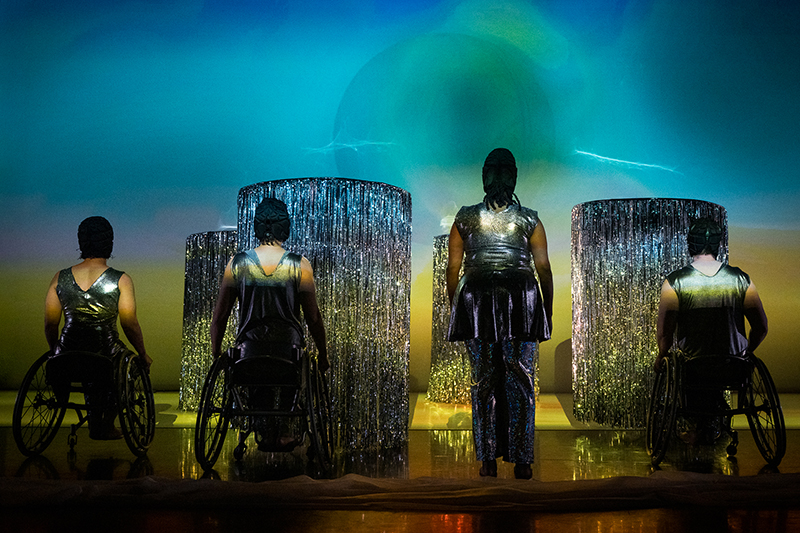
The Next TiMes. Four performers dressed in silver, with black caps, pause with their backs to the audience, three people in chairs and one standing. They gaze at four shimmering towers of silver fringe. Photo by Cherylynn Tsushima.
~~
To learn more about Kinetic Light, visit kineticlight.org.
Responses
There are no comments at this time.
Be the first to start the discussion by filling out the comment form.