Going Back to the Well
November 16, 2026
An Interview with Robert Battle
BY EMMALY WIEDERHOLT
Photos courtesy of Paul Taylor Dance Company
Robert Battle is an iconic choreographer based in New York City. He served as the Artistic Director of Alvin Ailey American Dance Theater from 2011 to 2023. In 2025, he became resident choreographer at Paul Taylor Dance Company. Here, he reflects on that transition and shares his delight at being in the studio as a choreographer again.
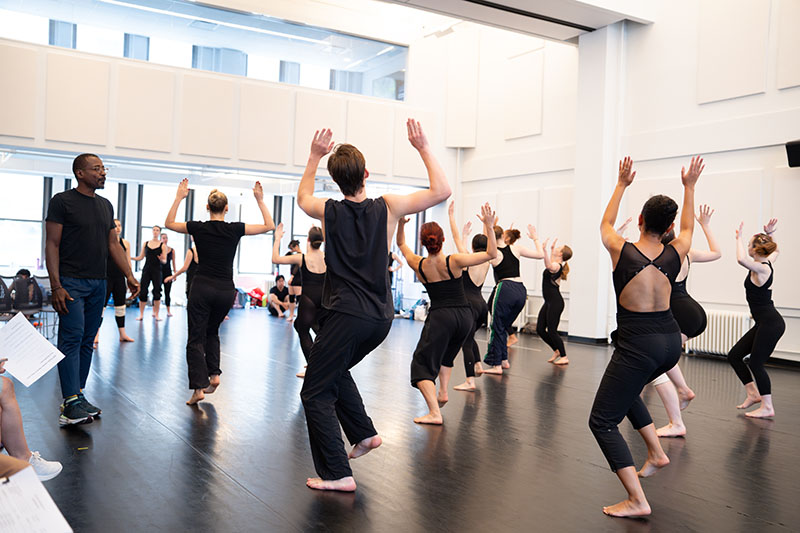
Photo by Becca Marcela Oviatt
~~
What was your transition like from serving as Artistic Director of Alvin Ailey American Dance Theater to becoming resident choreographer at Paul Taylor Dance Company?
My career is all about transitions. My first professional job was with David Parsons’ company, who was a star dancer with the Paul Taylor Dance Company. He allowed me to choreograph with the company, not just dance. I transitioned to starting my own company, Battleworks Dance Company, which I started from the ground up. Of course, the crème de la crème was being appointed the third artistic director of Alvin Ailey American Dance Theater.
That was a huge transition. What I found in that transition was less about choreographing and more about being a figurehead, the person who oversees everything. My choreographic voice was necessarily silenced so I could focus on the job of a lifetime, in terms of choosing choreographers, choosing dancers, and maintaining all the parts of that organization. But Taylor was always somewhere in my orbit. My teacher Carolyn Adams from Juilliard, who remained a great friend, was the inspiration for a lot of Paul’s masterpieces. When I started at Ailey, I brought in the first Paul Taylor piece to the repertoire, and I got to know him because of that.
When I left Ailey, thinking I’d take a nice long break, the Taylor company came back into focus when they asked me to do a tribute for Carolyn Adams. They were celebrating her for a gala a couple years ago. Being in the studio felt so natural there. It was evident to the dancers, to Michael Novak, the artistic director, and to John Tomlinson, the executive director. They asked me to be a second resident choreographer, because they already had Lauren Lovette as their first resident choreographer, who is doing a great job. It’s been a wonderful transition. I love the dancers and the organization. I have a personal feeling about Paul’s work in relation to my career. To be asked to do the thing you love to do and nothing else is more a measure of success than I might have thought many years ago. The thing that is natural for me to do is the thing I get paid to do. Isn’t that great?
Directing a major dance company has a lot of responsibility beyond making dances. What has the shift been like for you from artistic director to resident choreographer in terms of your creativity?
Being an artistic director is a huge responsibility. Ailey means so much beyond dance to people who look like me. The call to service is huge. You don’t know until you’re in the role that you won’t have as much time to think about making dances, which is ironic because making dances is why I got chosen in the first place. I didn’t realize how much I was missing that part of my life. That’s the honest truth. At one point I said, I guess I’m done choreographing. That never set well with me. I was trying to find my way to that truth, and that truth was never true to me. Transitioning from all the things you have to do as an artistic director – the responsibilities of human beings and their feelings and being sensitive to that – of course that keeps you up at night. Now what keeps me up at night is: What is the title of my new dance? That’s fun. I watch Michael Novak do the job I did, and he looks really happy in that role, and I’m really happy for him in that role. It’s a relief in a lot of ways, and I don’t mean that in a negative way toward my former job, just where I am in my life.
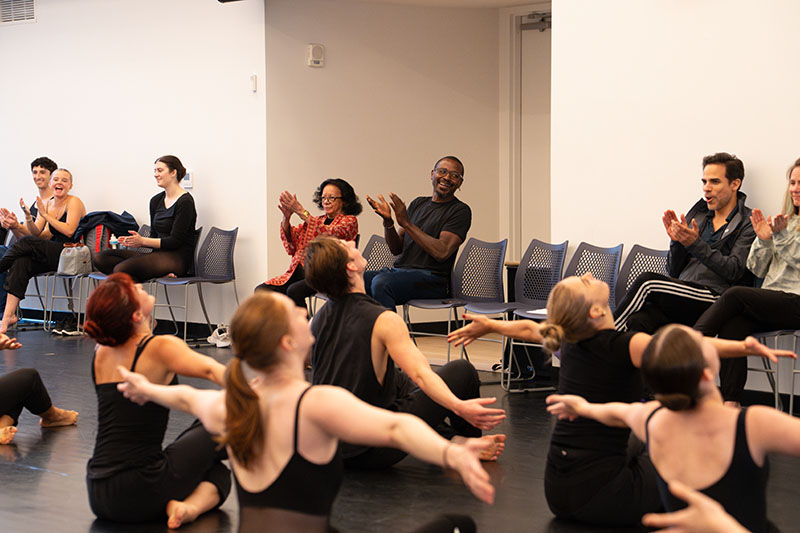
Photo by Becca Marcela Oviatt
What are you currently working on? Do you have any specific projects you’d like to share more about?
This is my second season as resident choreographer in November at Lincoln Center. We’re doing an older large work I choreographed on Juilliard in 2007 called No Longer Silent. What’s profound about bringing this work back right now is the story of this work. The music is by a composer named Erwin Schulhoff. He created this score in the early 1920s. He was silenced as an artist during the Nazi regime. Like many artists, his work was considered degenerate. He was eventually arrested and put in a concentration camp and died in the 1940s. He was silenced twice – first his artistic voice and then his actual voice. A conductor named James Conlon brought his work back to life. In times like now when the threat of that couldn’t be more real in the world we’re living in, we look back at history and wonder why people let something like the Nazis happen. If you look around, now we know. I think it’s a profound time to bring this work to life and hold this mirror up to society.
I also made a new work called A Starling. A great friend of mine, John Mackey, has created a beautiful orchestral score. A Starling is loosely based on the bird and their murmurations. They are mysterious and magical, but the piece is really about people and the individual in context of the group. When you think of a starling, you only think of them in terms of being in a big group, but what does one starling have to say? It’s abstract to balance out No Longer Silence.
We’re also bringing back my first work as resident choreographer called Under the Rhythm that is based on jazz music that has meant a lot in my life. It’s a tribute to people like Ella Fitzgerald.
You’ve had a long and very successful career as a choreographer. Are there any through-lines in your work?
Someone asked me the other day if my work was political. I didn’t know how to answer it because I don’t go around defining my work as political. But I suppose by if political you mean it attempts to challenge some of the notions of what it means to look at our common humanity, the things that unite us, even if those things are sadness, anger, or being forgotten, or joy and laughter… If that’s politics, then sure. That’s always been a curiosity of mine. What makes someone who doesn’t come from where I come from have a commonality that we look at something onstage and maybe I laugh or you laugh and we acknowledge each other’s humanity in that moment. It might sound cliché but it’s what moves my work. Sometimes I think I’m making an abstract dance, but it always ends up being about an experience I’ve had or has a narrative somewhere. It brings me back to artists who have inspired me, like Maya Angelou and Toni Morrison and other artists who speak to our common humanity no matter what color, race, or creed you are.
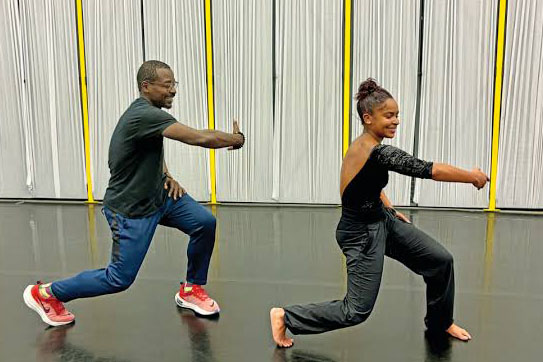
Robert Battle and Jada Pearman, Photo by Noah Aberlin
As you’ve gotten older, do you think about your work or the audience’s response to it differently?
Yes. I’m more confident that what I have to say needs to be heard. I’m more confident that my voice matters. I think that takes time. First, you choreograph out of sheer guts: “I’m going to make something.” You’re almost screaming it out. Then you get “successful,” and along with that success brings criticism, doubt, disappointment, a lot of “no’s” before you get to a yes. You’re going to always have questions, but I think I can now go beyond those questions and celebrate that I have something to say, and someone still wants to hear it. I love when audience members share with me what they saw in the work, sometimes something that I didn’t even see in the work. That lets me know that I’m right where I’m supposed to be.
Most dance artists don’t have the resources or infrastructure of major institutions like Alvin Ailey or Paul Taylor. Do you have any reflections or advice from your own experience for dance artists who don’t have institutional levels of support? What can your career teach others?
You start where you are. It’s always been my mantra. When I first started to learn dance, I taught my neighborhood friends. I always wanted to teach it to somebody else; I couldn’t keep it to myself. I think that passion of wanting to share was the motivator for what became my career as a choreographer and dancemaker. It’s about getting in front of the room and trying to inspire others by what inspired you. If you can, remember that core value and try not to look at the career as check marks. I never thought I wanted to run Alvin Ailey. I just thought, “I love being in the front of the room. I love teaching and making dances.” If you can keep centering yourself in that core value, so when the noise starts and you move up in the world and all the things pull you and attempt to change you from your core value, you keep returning to that center that you like making up dances. Sometimes you have to be in the present space with what feeds your ambition and always honor it. Even when you hit successful moments. Go back to the well that feeds you and remain authentic to yourself. Those are things that have sustained me and I think people recognize that and want to be around me because of that.
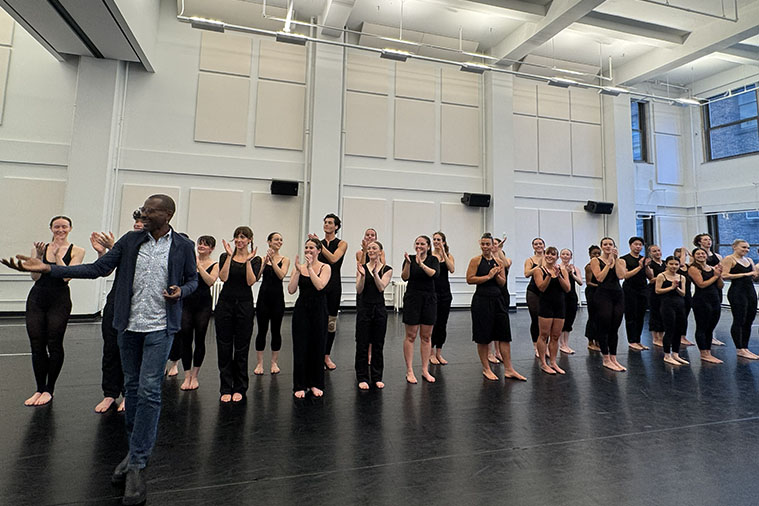
Photo by Julia Lawton
~~
Responses
There are no comments at this time.
Be the first to start the discussion by filling out the comment form.