Juxtaposing Impairment with Superhuman Capacity
October 5, 2026
An Interview with Erin Clark
BY EMMALY WIEDERHOLT
Erin Clark is a Canadian artist with a slew of descriptors to her name: aerialist, performance artist, author, producer, and world champion pole dancer. Here, Erin describes how she came to aerial dance and how it uniquely appealed to her physicality. She shares how she added pole to her repertoire, and why her celebrity as a pole dancer has less to do with her own interest in pole and more to do with the pole community’s sense of itself. And she reflects on how her writing practice informs her movement practice, especially as she explores aging in a disabled context.
Note: This interview was published in Stance on Dance’s Fall/Winter 2026 print issue. To learn more, visit stanceondance.com/print-publication.
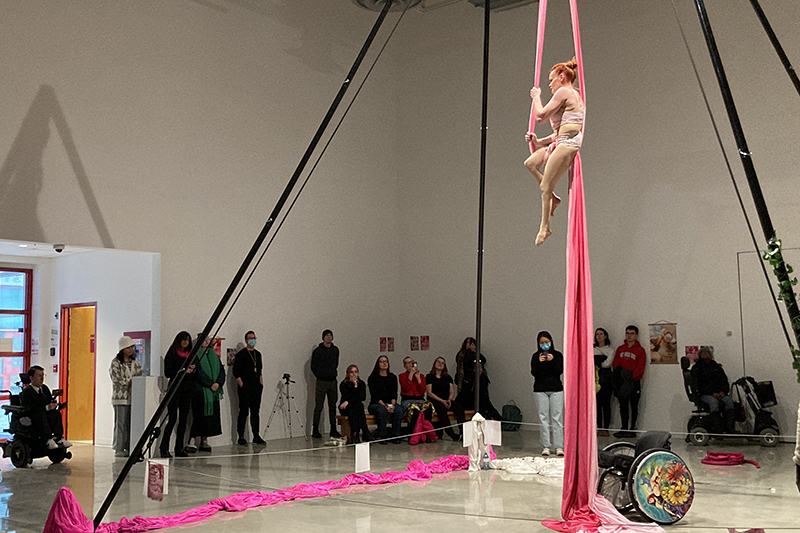
Photo by Bizz Varty
~~
How did you get into dance and what has most shaped you as an artist?
I’ve always been physically oriented in quite a rugged way. I was born in Northern Ontario near the Canadian Shield, and my favorite form of play was to crawl around on those ancient rocks softened by lichen and moss. And monkey bars. I had an animal way of moving my body.
In my wheelchair, I couldn’t get enough speed. At one point we lived at the top of a hill with a path down which I would launch myself at full speed. Momentum, exertion, and physicality were primary in shaping my sense of self from the beginning. And so was performance. I was in gymnastics and plays. I did dance routines with my friends.
When I was 13, I had surgery to fuse my spine. It changed my mobility dramatically. I had always used a wheelchair, but I started using one full time. I was born paralyzed; my body being different wasn’t new to me. But the changes meant I had different sensations when I moved and it disrupted my relationship with performing. I turned to music where I could express myself without needing to address my wheelchair.
When I was in my late 20s, a friend hosted an aerial silks workshop. When an activity is new to me and will require a lot of exploration and adaptation, feeling compatible with the instructor is essential. I had never even seen aerial silks, which meant I couldn’t mentally prepare. But because it was my friend’s studio, I was invited to observe.
The basis for beginner moves is being able to stand in the silks and control your feet, which I can’t do, so at first I was glad I hadn’t paid to join in! Then, during the break, one of the instructors did a move called the iron cross where you’re standing in the silks with the tails coming up toward the ceiling from between your legs and you twist your arms around the silk and grasp around your knees and release your feet. Your arms open wide to make a T-shape with your body hanging down the center. You are suspended entirely by your arms. And it clicked: “I could do that.”
We experimented a little, and I just took to it. The lead instructor, Allison Williams, told me at the end of the workshop that I had a great performance and movement quality and that she could see me doing aerial dance professionally. That was that. I quit music and joined the circus.
I spent a year trying to figure out my basic building blocks in lieu of foot locks. It’s astonishing in retrospect that it took that long to realize I could use my knees and hip lock instead of my feet. Once I figured that out, I exploded into my choreographic style.
During that same time, I was taking acting classes and actively nurturing how to use my body to express myself as a performer. Then I moved to New York, trained all the time, and started performing.
On social media, you are well known as a pole dancer. How did pole dancing enter your practice?
The fact I’m more well known as a pole dancer has more to do with the pole community and the internet’s relationship to the symbolism of disability than with me.
I honestly thought pole was boring compared to rope. The silks and rope, they move around my body, they accommodate me, they don’t ask me to have a different shape because they can take whatever shape I choose to give them. The pole is rigid and I can only bend one way. I just wasn’t inspired by it.
I was living in Spain and the studio I trained in was the same place the Spanish National Pole Sport team trained. The owner of the studio, Salima Peippo, was also on the IPSF committee and kept encouraging me to compete. I eventually relented, more because I was making friends and enjoying the camaraderie.
When Salima nudged me to join them in a competition, I told her that I believed the organization was inviting me to compete to use me to make them look good and weren’t actually prepared to meaningfully include and support me. She suggested that I was being untrusting, because I didn’t feel that way about the members of the Spanish team. So we met in the middle. I outlined what it would look like and sound like when I was being tokenized. And, I was proven right. There were no accessible changing rooms or hotel rooms, so I had to book far away from everyone else. In the end, they attempted to give me a ‘special award’ that they’d invented the night before the award ceremony, even after I told them not to. Salima understood immediately, and when we saw each other after, her first words to me were, “How do we fix it?”
It was her response that inspired me to stay in the competition circuit to help improve it for other disabled competitors.
I don’t love pole the way I love aerial dance, but I cherish my time with Salima and the Spanish team and the world record I set (and still hold).
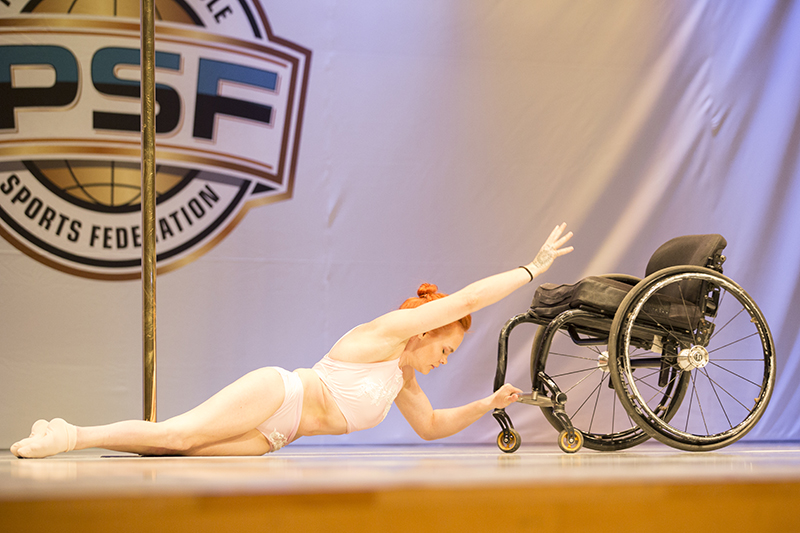
ISPF (2018), Photo by Eli Mora
Have you not had parallel experiences of tokenization in the aerial community?
Most of the attention I receive for my pole dancing feels like it has more to do with the pole community’s perception of itself. Online, I am frequently used as a symbol to reinforce their beliefs, often saying things like, “If she can do it, what’s your excuse?”
What’s funny about it is that I couldn’t care less what excuses people make. If I can do it, then I can do it. I’m a bit weirded out by non-disabled people’s preoccupation with each other’s motivation when it comes to fitness.
That, along with pole’s intrinsic tie to sex work juxtaposed with the desexualized disabled body is fascinating and shocking to people.
In the aerial world, there are less of us. It’s physically harder to do than pole, and we need very specific types of buildings and rigging in order to be able to learn or train. People do take aerial classes as a hobby. But once you get into aerial rope at a mastery level, the artists are focused on attaining and developing new movement pathways. I’m not saying no ableism exists in the aerial world, but the adaptations I’m making don’t stand out; it’s the same process for them as for me. It’s more likely that a professional aerialist would ignore me entirely, or see me as a peer in the profession, than repost me as inspiration porn.
Is there a show from your career that you’d like to share more about?
When I lived in New York, I was in an aerial comedy duo called Flaming Mermaid Broken Star with my friend Laura Von Holt. The joke was that we invented aerial feminism — and friendship. Our show was based on a circus cabaret format, but we would host and do all the acts.
The persona I played was an international sex icon. Instead of referencing my wheelchair, we created this metaphor of mystique and sex appeal to address the curiosity people have about my body. It allowed us to acknowledge people’s curiosity but also redirect it in the way we chose for our show. People can sometimes get really caught up in figuring out how I am in a wheelchair but can do aerial. I believe that they don’t need my medical information to enjoy the show. It’s okay for that to be unknown and just take my performance at face value. And, at the same time, as the performer, I bear responsibility for building the bridge between my intentions and their expectations. We experimented with the sex icon premise and it worked!
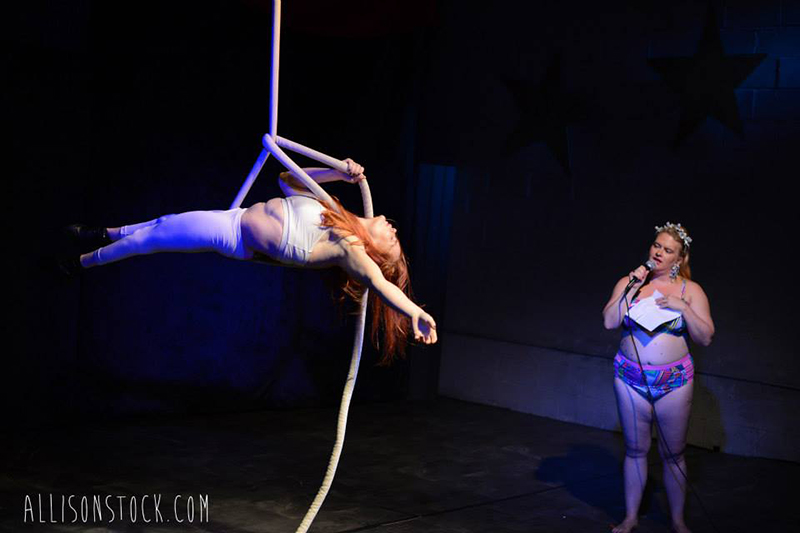
Flaming Mermaid Broken Star, Photo by Allison Stock
You are also a writer. How does your writing inform your dance, and vice versa?
My physicality informs my writing because I tend to write through my senses. And that’s also how I choreograph. In the past, I have used text as a way of making space for me to perform onstage without having to explain myself.
I had a virtuosic aerial show a couple of years ago where I was a peony and I didn’t speak at all, just danced. There’s this expectation that a disabled person onstage is an educational opportunity. To shine light on those anticipations, I had a friend who was a disability scholar give a lecture on the ableist gaze while I was moving through the lifecycles of a peony in aerial form. And when he was done with the lecture, I did all the routines again, but in silence. This allowed the audience to feel more fluent in my movement vocabulary. Now they could compare me to me.
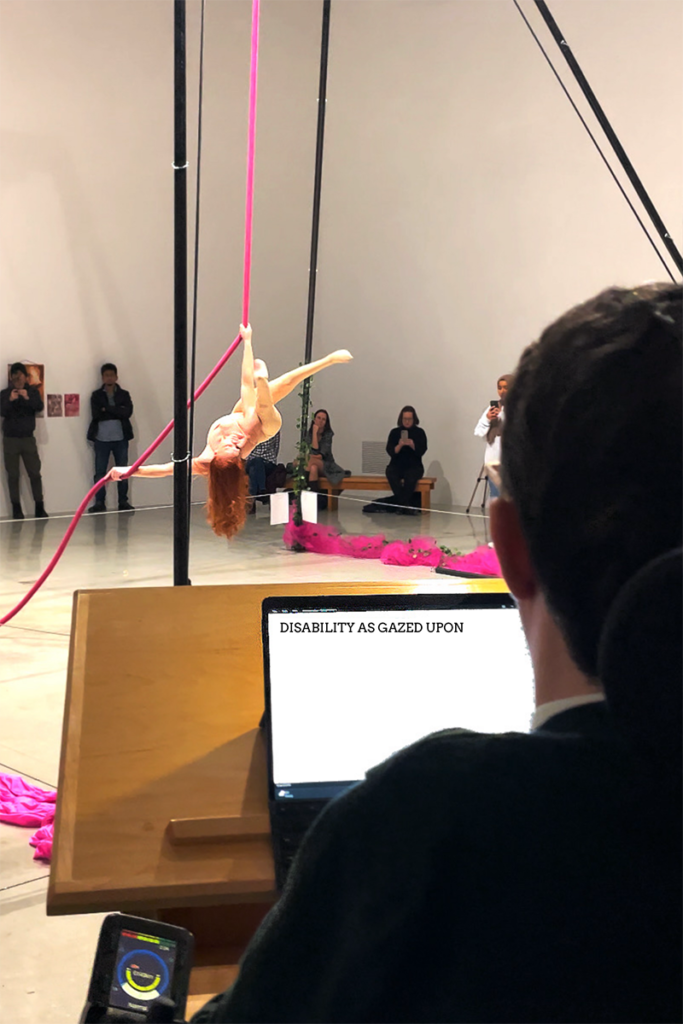
Erin in Visual Pleasure, photo by Mariam Waliiji
Then I had a stroke, and I couldn’t continue with that show. During my recovery, I was really contemplating what the desire to be a peony expressed for me, and how I could still express that with a new set of limitations. It’s a work in progress. I’m currently calling it An Aerial Dance Show from Bed Instead. Part of the challenge is using text in a way that complements the themes of the performance without explaining the dance. It’s not exposition; it’s another form of movement.
You describe yourself on social media as an aging aerialist. What are some ways you are thinking about aerial dance differently as you age?
As a disabled person, I don’t have a strong frame of reference for how we age. Often disability is presented as the result of aging, but not the vehicle through which you get to age. We don’t see our aging process the way nondisabled people can watch their parents or grandparents or neighbors, or even people on TV and in movies, age.
At age 35, despite feeling no sense of decline, I started to prepare myself for it based on people older than me reflecting on being my age and feeling ‘age’ kick in after 30. But it didn’t hit.
I was 43 and more graceful than I’d ever been in the air when I had a stroke. That decline was sudden, incomplete, and not final. And now, even with the changes from the stroke, I’m still very strong, and regaining graceful movement in the air every day.
Even though a stroke is a seismic shift, my body has always contained a juxtaposition of impairment and superhuman capacity. I think able-bodied people have a particular set of expectations of their body based more on norms than individual felt sense. But norms never applied to me, so I’ve always gone by feel and intuition. It means I don’t have the same long-term orientation, but to some extent that long-term orientation can become a hindrance when new limits are introduced. I don’t struggle as much when my limits shift because I wasn’t ignoring my limits to begin with. They’re baked into my capacities and they have always shifted. I feel what I can do, and so I do it. Aging feels like the best word available to describe this juxtaposition in a more future-oriented way.
~~
Follow Erin on Instagram @erinunleashes.
Responses
There are no comments at this time.
Be the first to start the discussion by filling out the comment form.