Exploring Embodiment
September 21, 2026
An Interview with Amber Ortega
BY EMMALY WIEDERHOLT
Amber Ortega is a choreographer, director, writer and educator based in San Antonio, TX. She serves as the coordinator for the International Folk Culture Center at Our Lady of the Lake University. Amber shares how performance, film, and writing intersect for her, how she explores embodiment across her work, and how the International Folk Culture Center serves as a locus for many kinds of dance and embodiment research in San Antonio.
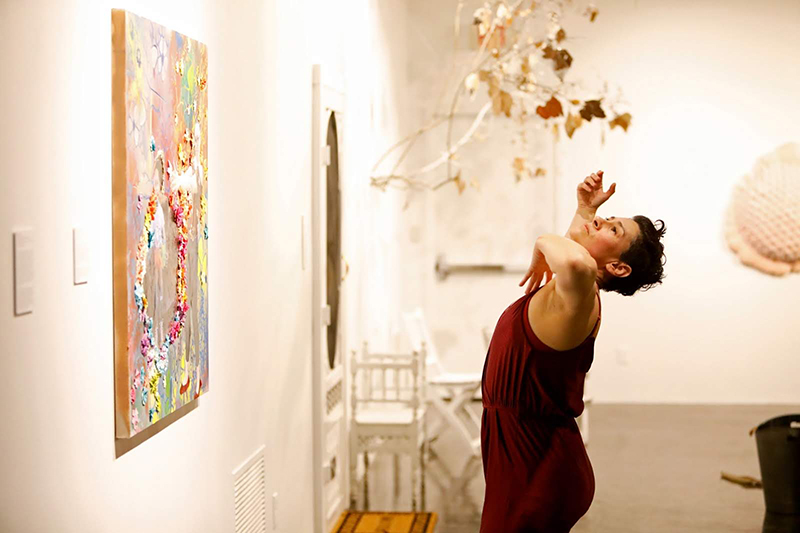
Photo courtesy Amber Ortega
~~
Can you first tell me a little about your dance history and what shaped you?
I’m from San Antonio, TX. In the late 80s and early 90s, there wasn’t a lot going on in terms of dance opportunities. There was folklorico, flamenco, ballet, and a little bit of jazz and tap. I started my dance training at 17 years old with ballet. As I became more proficient, I felt like I needed more, so I started exploring modern and contemporary dance. I didn’t even know what modern dance was; I just knew it was something different.
Fast forward, I went to Ohio State University. That’s where I got the bulk of my knowledge and understanding of contemporary dance. I only had enough money to pay for one audition, and I knew I had to make a wise choice, so I chose Ohio State. The day before the audition, they had open classes. I took the modern dance class since I had never taken modern. The next day when we were checking in for the audition, a professor asked me, “How many years of modern have you had?” I told him I’d taken it one time. He asked where and for how long, and I told him I took the class offered yesterday. He looked at me and said, “You do realize this is a modern dance program?”
Ohio State is where I became interested in composition, where I felt like I landed. There were so many opportunities to work with grad students and incoming artists. Seeing them work through the beginning stages was invaluable. I learned that you could build a work from just a notion or idea. That’s where I learned you don’t have to know exactly what you’re choreographing or composing when you start. You can go in with a general curiosity.
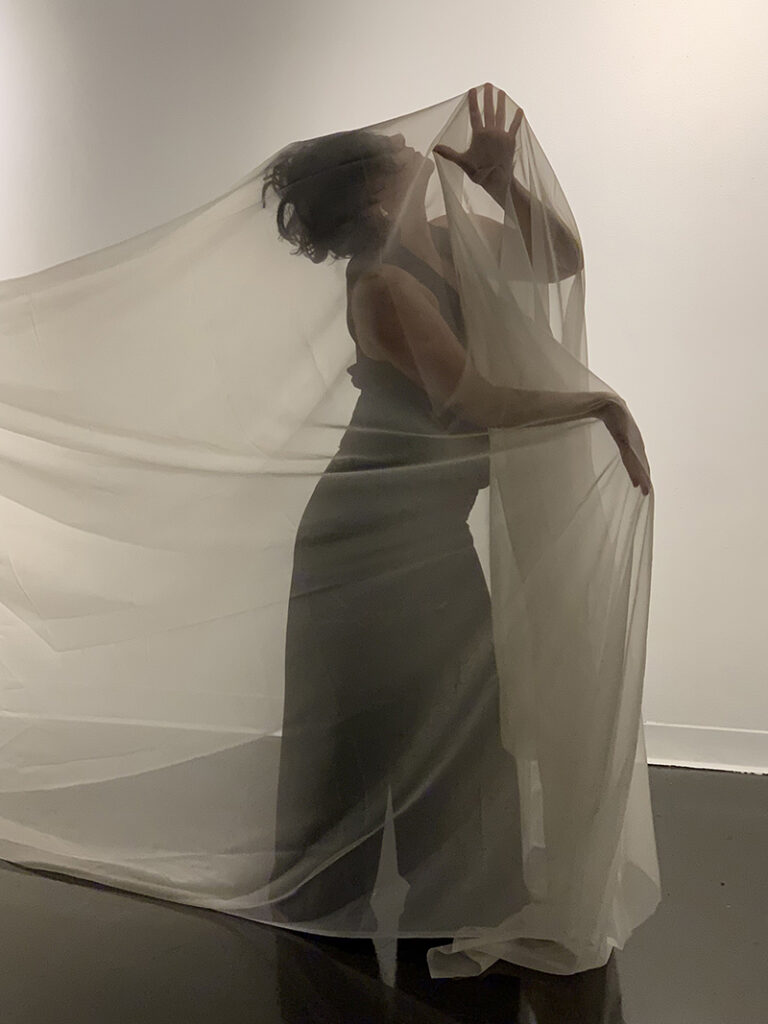
Photo by Barbara Felix
I left Ohio and came back to San Antonio in 1998. I started teaching and dancing with a small modern dance company called Georgina Morgan and Company. That’s where I started sharing some of my choreography. Later I started a cooperative called Modern Dancers Co-Lab. It was an invitation for all contemporary dancers from San Antonio to be in community with other contemporary dancers. It went on for four or five years. At the same time, I created my own company called SpareWorks Dance. We did mostly commissioned work and evening-length performances. I folded that in 2016 when I began my position at Palo Alto College organizing their dance program, and I wasn’t able to continue doing both. When the pandemic hit, it was a struggle to keep the dance program open, and our funding was reduced. I lost my dance practice completely and experienced a deep time of mourning, having recently lost my father to cancer as well. I came back into my compositional practice through writing in 2023. Since then, I have focused on writing, collaborating on research, and film. Creating film is something that doesn’t have a due date or performance night, so I can take as long as I need to in the process.
How would you describe your choreography to someone unfamiliar with it?
I’ve been told by previous dancers who have danced in my work that my process was something they had never experienced before. That was interesting to me, because I didn’t know any other way to make dances other than through experimentation, play, and found movement practices. My work is about relationships; I’m curious how people build and make choices in relationships. I broaden the idea of relationships to include the relationship to sound, landscape, and other visual elements. Rehearsals were built around having conversations. We would experiment. It was much like a lab. Dancers would come and think it would be “5678.” They weren’t expecting that they would build the ecology of the composition. I don’t necessarily make ensemble work anymore, but the work I made with dancers was heavy with space to continue evolving the composition, so there were always places for choices to happen.
You are also a filmmaker. What draws you to the dance film medium?
I always found dance film interesting. I have a weird fascination with technology. I started doing film during a time in my life here in San Antonio when I got frustrated with the dance community. I was tired of having to prove that my dance practice was valid. I started reaching out to local musicians and visual artists who thought contemporary dance was fascinating. It was interesting to find a home for contemporary dance outside the dance community. San Antonio has a vibrant contemporary arts community and infrastructure. It was easier to work as a collaborative partner. That broadened my scope and I started working with filmmakers, musicians, and visual artists. This is when I began working with film, most notably with filmmaker Erik Bosse. And then I started experimenting with augmented reality where someone scans a visual marker with a smart device and it enables them to see a video. When I got my MFA in Choreography, I continued to look at the intersection of dance and technology.
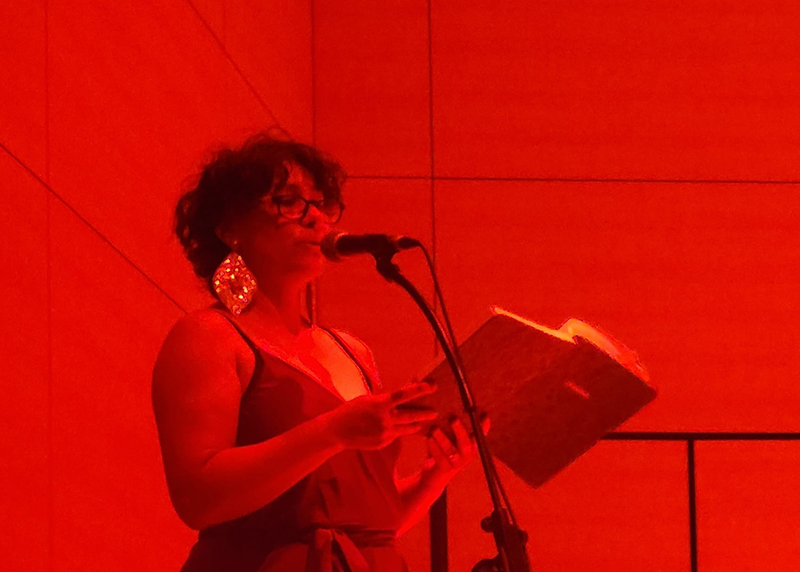
Photo courtesy Amber Ortega
Are there some pieces from your repertoire (film or performance) you’d like to share more about?
WATERHEATDREAMPLACE is a poem I wrote, one of my embodied works, that I ended up making a film on the fly for. I tried to work with ways of embedding visual markers in the poem so readers could read the text or scan it and see the film. It was my first hybrid poem, and it was published by OyeDrum, an intersectional feminist online magazine. It was nominated for a Best of the Net award and Pushcart Prize. I enjoyed the entire process; it spoke to what I aspire to, which is to make work that is simple, in the moment, and doesn’t require a huge budget.
When I started choreographing at Ohio State, I was in a different culture where I needed to feel a sense of belonging. I used choreography as a way to tell stories relevant to me culturally. I have a solo work called Lastimada about my grandmother. It was one of the first solos I created. I saw a flier in the basement of the dance building calling choreographers for a showcase. I ended up showing two works. I didn’t know what I was doing, but I just did it. I’m not an extroverted person and I didn’t feel like I belonged in that community, but there I was, 20, with all these older and more adept choreographers. That was how it started. I knew I had to choreograph for the rest of my life.
I enjoyed doing group work because I like seeing people interrelate and how they make choices. Space Light Modulate was a piece with two dancers and two boxes that lit up. It was about language and verbal communication. It juxtaposed what the dancers were saying against what they were doing.
Manifesto, commissioned by the McNay Art Museum, was a Bauhaus-inspired dance work about the broadening of the idea of what art is. We used a lot of film and objects in that work. It was a duet with text.
And then Man Made Man, also commissioned by the McNay Art Museum, was a piece which thought about how artists over the years and centuries of human existence have glorified the architecture of man. We used aerial silk work in that piece, which at the time I was dabbling in. It was a beautiful trio.
You are also a writer. How does your writing practice inform your dance practice, and vice versa?
I’ve always been a writer, both poetry and prose. When I was in elementary school, I wanted to be a writer, but it scared me, so I didn’t pursue it seriously until recently, like in the past eight years. I’ve always used text in my dance work in some way, including my very first choreographic debut in Columbus, Ohio. I like the rhythm of text and following that as some sort of guide or framework. As I’ve started entering writing spaces, I realize my practice is different from most writers, because I employ my choreographic process. I don’t incorporate outside inspiration such as music, or artifacts of another’s work. My writing comes from what’s internal and in my body at the moment. This is something I’ve honed as a dancer, a deep and intentional communicating with the body in real time; it’s what dancers are trained to do.
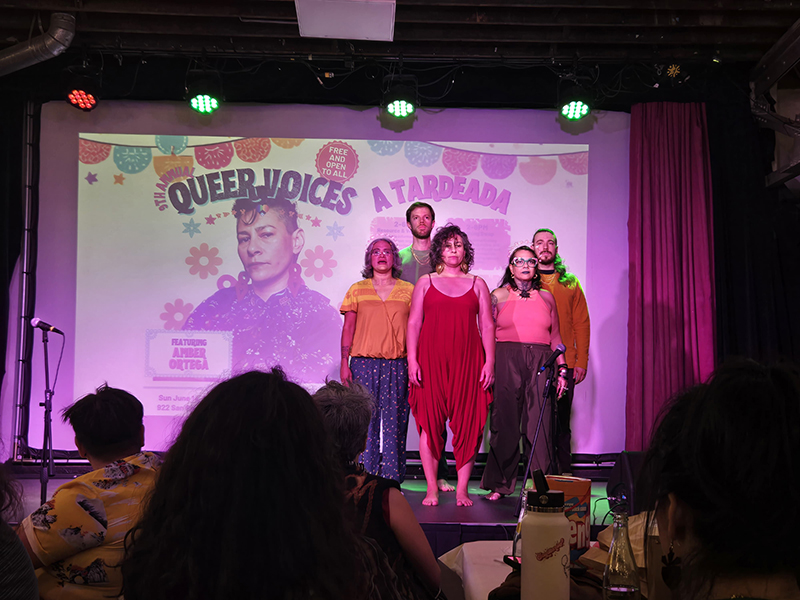
Photo courtesy Amber Ortega
I’ve realized my definition of embodiment is different from other writers as well. I was on a podcast with a local writer who asked about my process. I was boggled by the question. She asked me over and over, “What do you do?” I thought about it afterward and realized I need to be more specific. I’ve been asking myself, “What is it I’m doing as a dancer that informs my language? How can I share it with people who don’t have this background of an embodied practice?”
You are the coordinator for the International Folk Culture Center at Our Lady of the
Lake University in San Antonio, TX. Can you tell me more about the International Folk Culture Center and your goals for the center?
The center is an endowment by the late Dr. Janice Mendelson. She loved folk dance and traveled the world connecting to communities through folk dance. She was from San Antonio and wanted to do something to support folk dance locally.
Our Lady of the Lake University historically is a place where dancers have come to dance. It doesn’t have a dance program; there was just a space where people came to dance. From Filipino dancers and German dancers to Mexican folklorico dancers, people have been coming to the OLLU campus to learn and share their dances. Dr. Mendelson brought her endowment here for the sharing of culture through dance. I always have found it interesting that she didn’t put the word “dance” in the name of the center, which I think was genius. When you put the word “dance” in something, people think they are not dancers and don’t want to have anything to do with it. We do so many things besides dance, which I love, because it allows me to bring my understanding of embodiment to the conversation of culture and folk way.
We have three goals for the center: we preserve its history by documenting, archiving, and storytelling. We remember Dr. Mendelson, the dancers who have danced here, the communities they built, and how important that is for the neighborhood and city.
The second goal is that we prioritize cultural dance. That is our biggest priority. We live in a historic side of town, the West Side of San Antonio, a Mexican, Chicana, and immigrant neighborhood. It is one of the most underfunded and marginalized in the city. A priority is to center practices that are relevant to this community: Mexican American, Chicano, Latino, and any practices from the African diaspora.
We prioritize cultural dance in general, from Scottish dance to Irish dance. Dr. Mendelson believed that if people shared each other’s dances, we would better understand each other. It’s a big piece in the conversation about decolonizing dance study, which is something I’m passionate about. We want to be able to restore cultural dance practices to and for whom those practices originated.
The third goal we prioritize is the interdisciplinary/transdisciplinary aspects of dance, which is the piece I’m so passionate and fascinated by: How can dance be a pedagogical model for any kind of learning? You don’t have to be a dancer to understand composition and use it as a framework for doing things like engineering. Dancers have been studied for years; scientists study the force, effort, and torque of our battement. They also study our minds for how quickly we can make decisions when we perform. How can dance as an epistemology of knowledge be used and shared with other areas of study? We collaborate with other departments, like the religious studies department or the education department. Collaborating across disciplines and departments is an important aspect of what I do as the IFCC Coordinator.
We’re open seven days a week and have classes every day. A lot of those are cultural dance classes. We have Mexican folklorico, Scottish dance, Contradance, fusion belly dance, Zumba, Qigong, and other meditative practices. We also have more codified dance techniques like ballet and modern. I have also offered my tuning and embodied writing workshops on occasion.
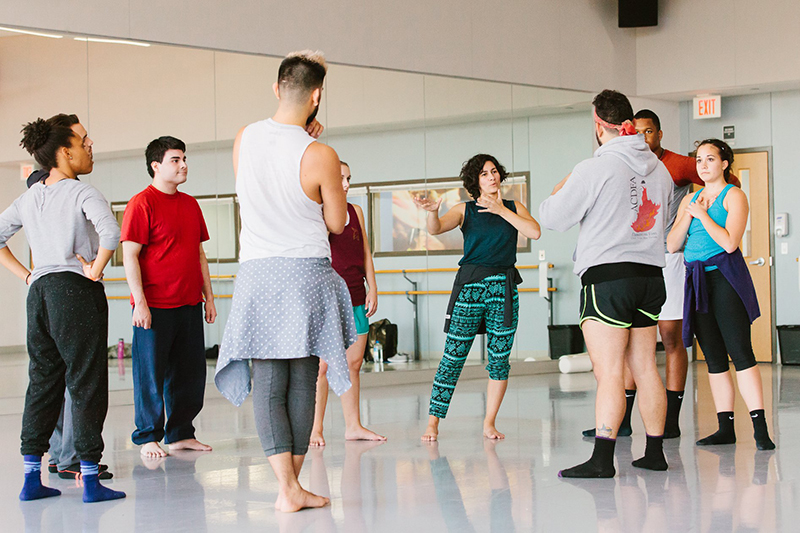
Photo by Lynn Lane
We have an artist-in-residence program that brings in an artist of any medium who understands and works with embodiment. We give them space and connect them with different departments at the university. They stay for the entire semester and we’re always bringing in guest artists to lead workshops.
We also mark the most important times of the year, like Dia de Los Muertos where we construct an ofrenda for the dancers from this part of town who were impactful in building this neighborhood. We commemorate the signing of the treaty of Guadalupe Hidalgo, which is the reason we have a border along the southern part of the US, during our El Segundo De Febrero community conference. We do extensive research and collaboration with community members and our OLLU library archive. Our university has historically been involved with many social justice initiatives.
We are currently working on offering hybrid transdisciplinary classes so people outside San Antonio can participate. Our first one will be Eco-Choreographies with professor Niurca Márquez out of Florida International University.
What’s next for you? Do you have an upcoming project or focus you’d like to share more about?
I have a new work coming out soon. I wrote a poem called Mycelium which was included in the anthology, Somos Xicanas, published by Riot of Roses Press. I’m making this poem into a film which will debut this fall in Florida. There’s a wonderful visual artist and choreographer in Florida, Damaris Ferrer, who is constructing an evening-length performance called 39 Zeros. My film is going to debut in her work.
I’m also working on my first manuscript of published poetry. It will focus solely on my embodied writing.
~~
To learn more about Amber’s work, visit amberortega.my.canva.site.
Responses
There are no comments at this time.
Be the first to start the discussion by filling out the comment form.