Dancing the Stories of Water
September 7, 2026
An Interview with Liquid Spine Director Katie Pustizzi
BY EMMALY WIEDERHOLT
Katie Pustizzi is the director of Liquid Spine, an eco-dance company based out of Boston, MA, that reveals environmental needs and stories of water systems through movement, community, and international exchange. Here, Katie describes why Liquid Spine focuses on water ecology, some of the ways the company addresses water systems through film and live performance, and how the company aims to have a positive impact on such a huge issue.
BYCATCH, Photo by RjlPhotography
~~
Can you tell me a little about yourself and your dance history?
I have an MFA in Choreography from Wilson College and I have my undergrad degree in Dance from Salem State University. I was always really interested in improvisational dance forms as a way to build individuality, authenticity, and movement vocabulary. I started to play with improvisation as a performance medium in high school. I developed my own youth dance company called Aurora Borealis Dance Company in Boston where kids learned about improvisational dance forms and performed it. I ran that company for 10 years and am very proud of the dancers who came out of it. That was a big part of me growing into being a choreographer and director.
What was the impetus behind Liquid Spine?
I have always been interested in contemporary dance addressing the now of social inquiry or political investigation. Around the time of COVID, I was so abundantly overwhelmed by what I could create about. I decided it was best for me and my mental health to pick one topic and dive in, and hopefully I could generate or spark the most positive change if I focused on one thing. I picked the environment and specifically water systems because I was teaching contemporary dance through the lens of water-based imagery. The term “liquid spine” came from my own educational pedagogy, teaching students to undulate, move their spines freely, and connect top with bottom half. I also feel very comfortable in the water and have found a sense of safety being in the ocean. I was born in the Marshall Islands and feel this rooted connection to the water from my early years. I think about water as our spine. It quite literally connects different parts of the world as the spine connects our top, bottom, left, and right. That’s how Liquid Spine was born. The company is four years old.
Katie Pustizzi, Photo courtesy Katie Pustizzi
Liquid Spine creates and offers films, live performances, intensives, workshops, and an eco-arts festival. Can you share more about all these facets of the company?
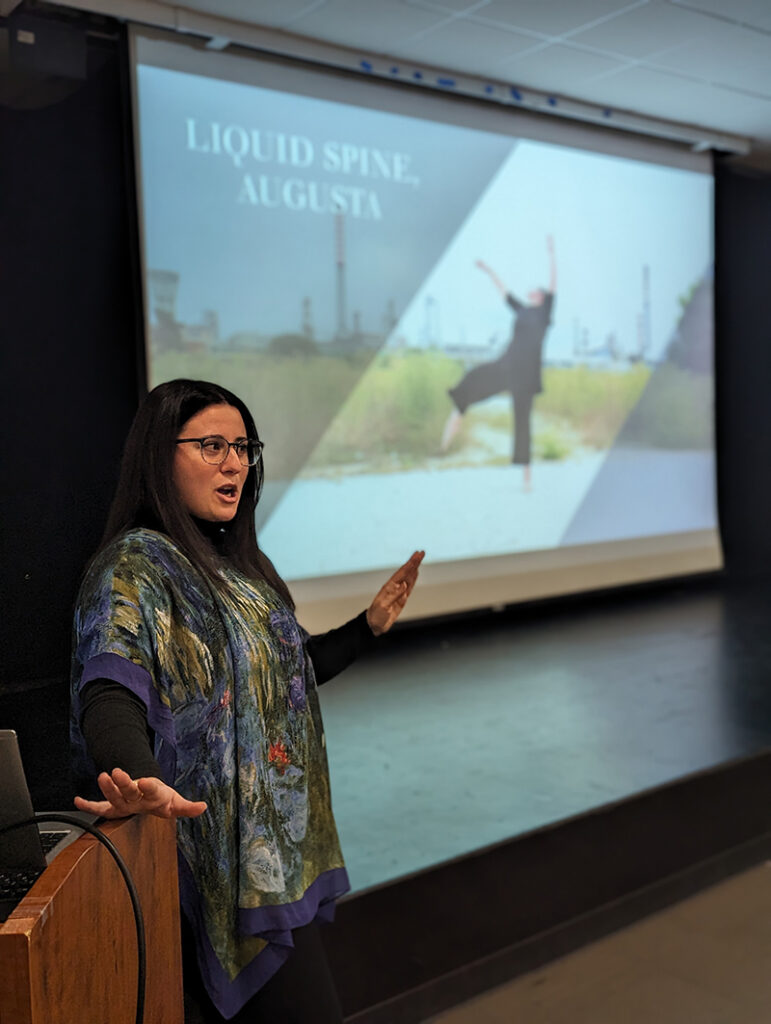
We started with dance films made in very site-specific locations. I call them site-sensitive dance films because we directly react to an environmental need in that bio region. One notable film is Augusta based in Augusta, Sicily. I danced in front of a petrochemical complex that is leaking mercury into the ocean and air. It’s actually the only Liquid Spine project I’ve danced in. I worked with Sicilian collaborators and had music made by a Sicilian artist. I lived with family I have in the area. Augusta is where my grandparents grew up. We dove into all facets of the filmmaking process through a site-sensitive lens. That’s what we try to do with each film. We tell a very specific story and the land directs us.
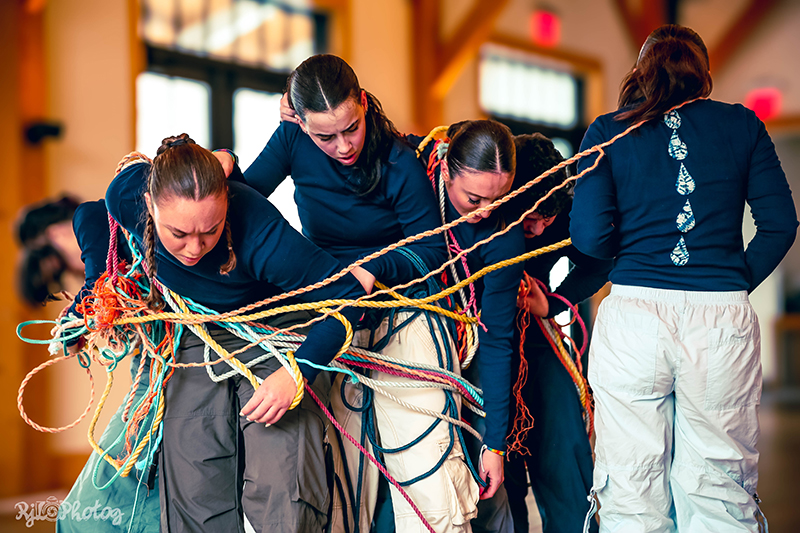
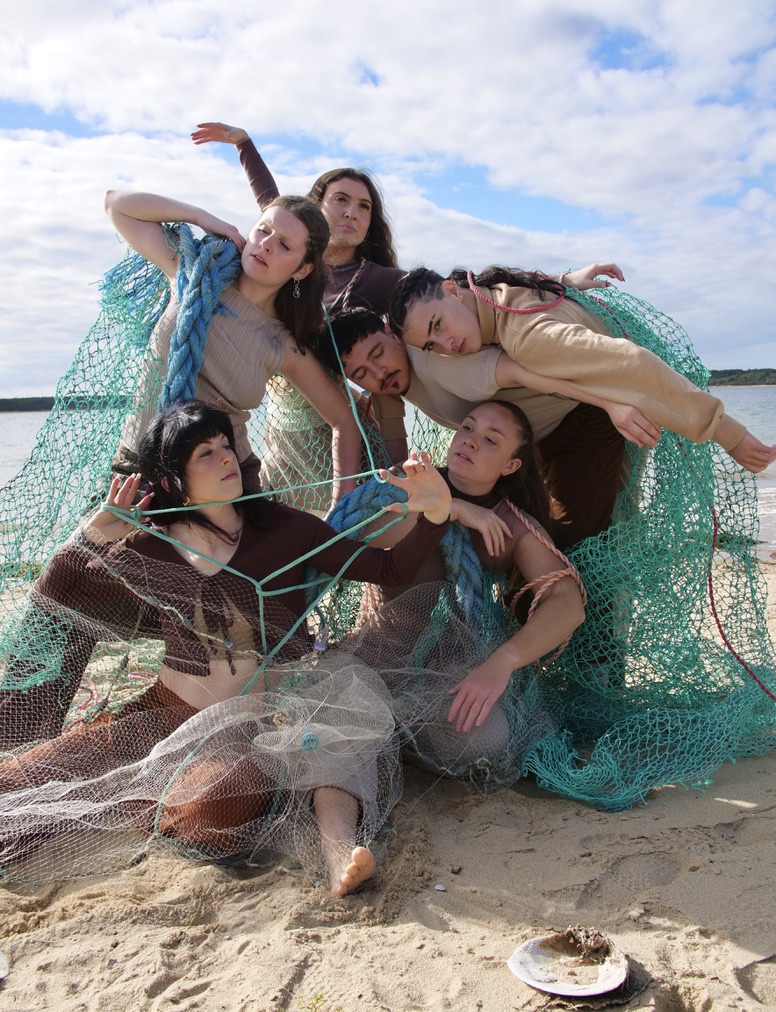
In the past year, we’ve broadened beyond being a small project-based company. I work every week with six company dancers: Jami Adams, Brianna Antaya, Victoria Bocchino, Nicholas Giannino, Bridget Nicolo, and Lindsey Zuccaro. Right now, we are touring our full-length piece, BYCATCH. It embodies and illuminates the challenges in the ocean related to over-fishing, ghost gear, and challenging gear that captures animals not meant for the net. We started this piece by going to Cape Cod and doing a five-day residency. On the first day, we went to the Center for Coastal Studies and learned about their whale disentanglement program. Specifically, we learned about a whale named Spinnaker who was disentangled four times before her death. We walked out into the lobby and saw her skeleton with the rope still embedded in her jaw. Spinnaker influenced BYCATCH greatly. We dance with marine debris that was collected from the coastlines of New England by one of our collaborators, a marine debris artist named Rebecca McGee Tuck. We move with a big green net in a piece about bottom trawling. We dance with ropes that represent active fishing gear and how it can entangle and get exacerbated with movement and struggle. And we dance with a throw-fishing net for a piece about ghost gear and how that gear can entangle animals even though it’s no longer active. The piece isn’t even a year old, and we’re already touring it in New England and internationally.
BYCATCH, Photo courtesy Katie Pustizzi
We also try to meet the needs of our community. We do workshops where we bring different perspectives within the Liquid Spine bubble of contemporary dance and improvisational dance. We also just started doing workshops for younger movers where they learn about the ocean or migratory birds through our current works and through improvisational exploration.
Finally, the Eco-Arts Festival is different every year. It always includes a screen dance festival where we highlight environmental site-specific dance films from around the world. One year, the festival was in Italy and was outside. One year we had visual eco-artists who did pop-up installations. The goal is to elevate eco-artists in all forms.
Are there any other projects of Liquid Spine you’d like to share more about?
The film we’re currently screening is Liquid Spine Great Marsh. We filmed in all four seasons on the Great Marsh to highlight how the marsh changes, specifically to show it’s an important stopover for migratory birds. The marsh is a haven for birds that travel vast distances. We aligned the film’s narrative with dual symbolism: The piece addresses the need for safe spaces for all who have to travel, whether that’s because of war, violence, or sea levels rising. Birds might have to migrate, and sometimes people might have to migrate: How can we learn from each other?
That’s something we do in all our work. It’s not environmental to the point it feels othered. We use empathy as a tool to remind people we are part of the environment and we are nature.
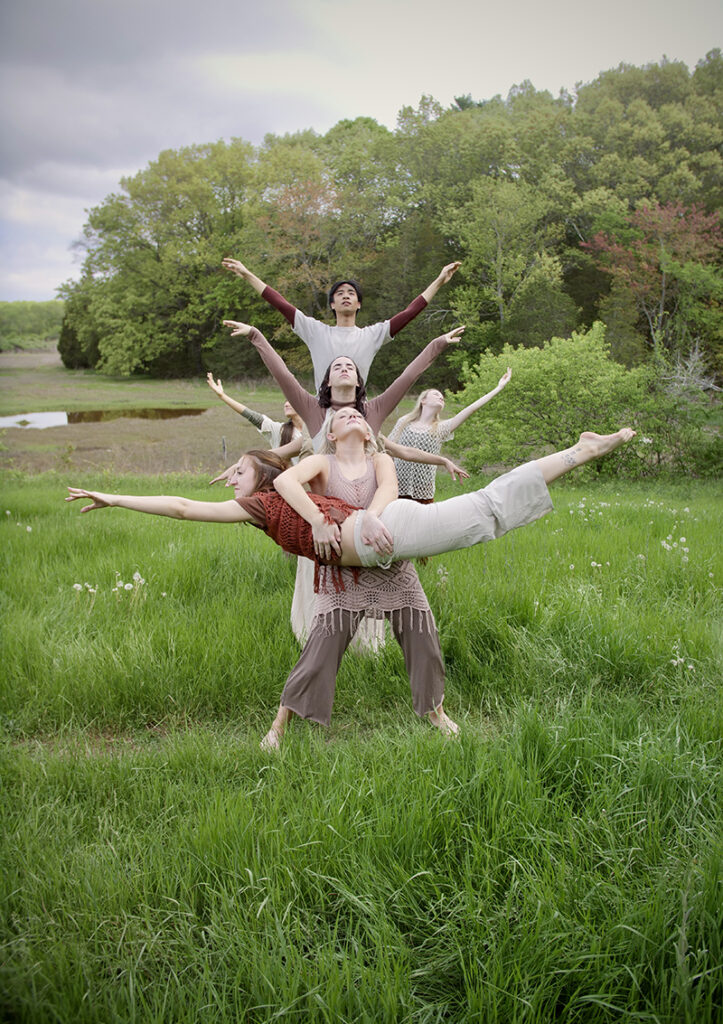
Liquid Spine Great Marsh, image courtesy Katie Pustizzi
What impact do you perceive Liquid Spine has had?
I directly get a lot of individual feedback from people about how our performances, films, and workshops have impacted them in an emotional way that they look at the environmental challenge or site differently and it sparks them to act. For example, someone who watched our Great Marsh film told me they walk the filming site every day, and now they will see Liquid Spine’s dancers in nature and be reminded they must take care of the site.
With BYCATCH, people are interested in learning about policy and are eager to support policies that advocate for a sustainably fished ocean. Audience members are also excited to help get Liquid Spine to other coastal communities so our work can reach other fishing communities and people who can help put policies into practice.
We also do our own volunteer work with beach clean ups or helping different environmental organizations. Last summer we helped release baby turtles back into the ecosystem. Starting soon, we are hosting a Listen & Learn Series with local fishing communities. Our goal is to learn what they need to safely and sustainably do their job and then to support their endeavors, while helping to mitigate bycatch and pollution.
What’s next? Do you have an upcoming project or focus you’d like to share more about?
We’re hoping to continue touring BYCATCH. That’s our number one focus. We’re taking it to the ARIA Performing Art Festival where we’ll perform it at an eco-amphitheater in Sardinia, Italy. We’re also building a site-specific work in Sardinia while we’re there at a UNESCO World Heritage Site.
After that, we’re eager to tour the work to other New England states, as well as coastal communities and beyond. Other than that, we will be participating in Global Water Dances next June. And eventually, we’ll make another dance film. We are hoping to make our next film in Ireland.
Any other thoughts?
Our work is so improvisational-forward, it can be shocking to people when they see it for the first time. It feels so connected and authentic that it can feel almost unbelievable that it is improvisational. That’s an important piece of what we do; we are constantly reacting to the environment we’re in or the narrative we are embodying. I feel like improvisation as performance doesn’t get as big a platform. It should; it’s so exciting. I feel called to share it’s a big part of how we work and it has been highly successful.
~~
To learn more, visit www.liquidspine.org.
Responses
There are no comments at this time.
Be the first to start the discussion by filling out the comment form.