Between Butoh and Bharatanatyam
August 3, 2026
An Interview with Brenda Polo and Nicole Tenorio
BY LORIEN HOUSE AND EMMALY WIEDERHOLT
Photos by Ernesto Monsalve Pino
PARA LEER ESTA ENTREVISTA EN ESPAÑOL, ¡POR FAVOR MIREN HACIA ABAJO!
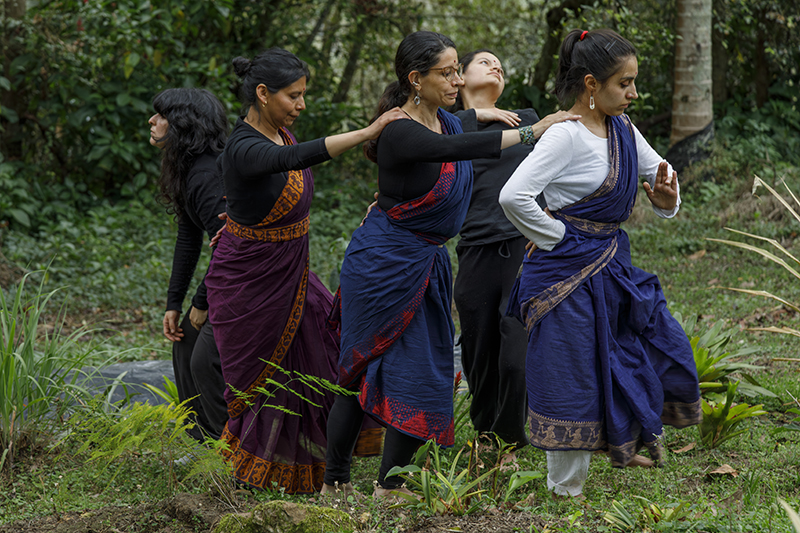
Brenda Polo is a butoh dancer and the founder of Manusdea Antropología Escénica in Bogotá, Colombia. Her daughter, Nicole Tenorio, is a Bharatanatyam dancer and the current director of Manusdea. Brenda and Nicole’s recent focus develops dialogue between Butoh and Bharatanatyam, approached through a neurosomatic perspective that explores the resonances between body, memory, and consciousness. Here, they share their findings on the intersection of these disparate traditions and perspectives.
~~
Nicole, can you share a little about yourself and your dance history? What shaped you as a dance artist?
Nicole: I was influenced very early by my mother, Brenda Polo. In 1997, when I was seven years old, she traveled to India for the first time to study Odissi, a classical dance of North India. When she returned, she carried in her the fire of someone who has encountered the discipline of classical Asian dance and wants to transmit it to occidental bodies. During that time, I often accompanied her in her training sessions early in the mornings. That’s where my path in dance started. I joined my mother in training, and also helped her in classes, and onstage with costumes and the technical aspects of performance.
When I turned 16, I started performing as a dancer. That year, I performed my first solo with a grant that we received, a prize for world dances concentrating on the characters of the Ramayana, specifically Sita, or “Mother Earth.” Sita is Rama’s consort.
After nine years of performing as a dancer, I received a grant to go to New Delhi to study with my guru, Guruji Saroja Vaidyanathan. She was a highly respected guru of Bharatanatyam in India, well-recognized for the contributions she’d made to that art. She was also a great source of wisdom, not only in dance but in life, and one of the most important influences in my own life. That is how I began to deepen my connection with the ancient tradition of Bharatanatyam.
Now, Bharatanatyam is my principal form of dance—the form I’ve studied the longest and deepest. But I’ve also danced Butoh. My exploration of Butoh is more “sound-based,” which is to say that although I’ve worked with Butoh from the point of view of the body, I’ve also explored the more musical aspects of the dance.
I also dance Bullerengue—which is an Afro-Columbian dance. This is another line of investigation which interests me a lot: connecting us with our African ancestors. Bullerengue and Bharatanatyam connect in my body, but, they are very distinct techniques. What converges in me in particular is the rhythmical and vocal work. Both traditions work with rhythm, but also with the voice. I have no doubt that both feed my artistic development, but each has its own place.
Brenda, for readers unfamiliar with your work, can you share a little about Manusdea Antropología Escénica?
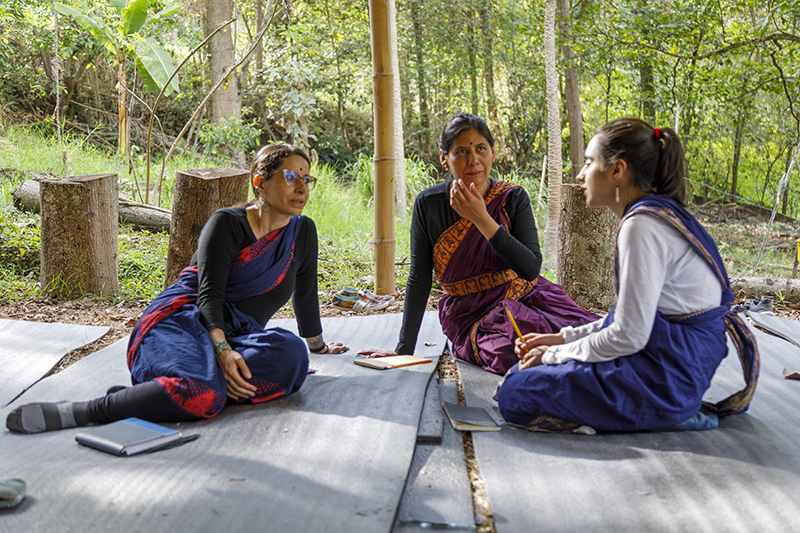
Brenda: Manusdea is a profoundly personal search. At the same time it is a search on a wider level—that of the human. More than a conventional artistic project, Manusdea works at the level of the encounter between the human and the sacred—that everyday human experience, which is actually a thread that runs through all existence. From this perspective, we’ve created a platform which encompasses creation, research, laboratories, academic and pedagogic encounters, and spaces of cultural and interdisciplinary interchange where investigation is central to the work.
Now, we see that this hybrid of intercultural and interdisciplinary work has opened a possibility: that of understanding the holobiont. A holobiont is a biological unit comprised of many different organisms that are evolutionarily interdependent. This is how we conceive art and culture: an ecosystem that is deeply connected, with living relationships of coexistence. From there, we can perceive how the creation of art, and cultural and interdisciplinary dialogues intertwine.
The metaphor of the holobiont is very apt for the exploration of Butoh and Bharatanatyam from a neurosomatic focus. This is an exploration that seeks to generate sensory experiences and spaces that permit us to inhabit our bodies more consciously, and with more presence.
In terms of different focuses such as the stage or pedagogy, we don’t discriminate—we work with diverse focuses. We don’t want to focus on only one path, and we want to have a more open field of cultural relations. So, as I said, from one point of view, research and investigation is central, and is the center of the axis, but from that center comes academic work, pedagogical development, and the events that we create in order to demonstrate these investigations—like performances. We also invite dancers from other cultures to join the dialogue, as well as people from other disciplines, like neuroscience, quantum physics, sociology, anthropology, and the plastic arts, among others. We look at how these disciplines together can begin to have a dialogue.
Our platform works with this whole spectrum!
Butoh dance and Bharatanatyam have such different histories and aesthetics. What was the impetus to create a dialogue between these disparate dance forms?
Nicole: As Manusdea, Brenda and I are pioneers in these practices in our country. We are also ambassadors, and creators of spaces where it’s possible to see these dances, think about these dances, and learn these dances here in Colombia. We also investigate: How is the body in each of these different cultures? What does it mean to learn the principals that manifest in each distinct culture, and to create comparative studies that are actually performed onstage?
We started thinking it would be interesting to see what would happen if we combined these two dances that are so different, almost opposites in fact. What would happen from the point of view of the somatic, and of applied neuroscience? This has been an investigation that reveals the emotion generated or inherent in the movement of each technique. How do our nervous system and our perception of our body and our emotions react with the meeting of these two practices? This is pretty daring. It’s a challenge to put two opposite forces into a dialogue.
How do these two traditions relate in terms of rhythm, for example?
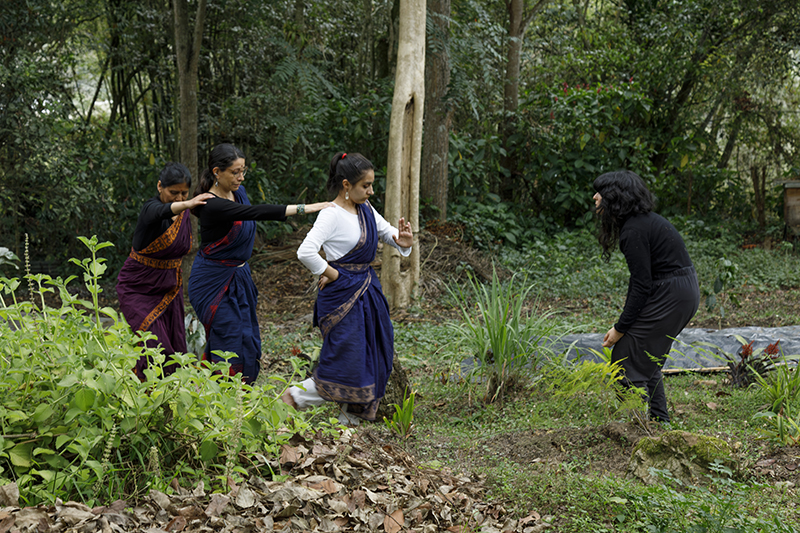
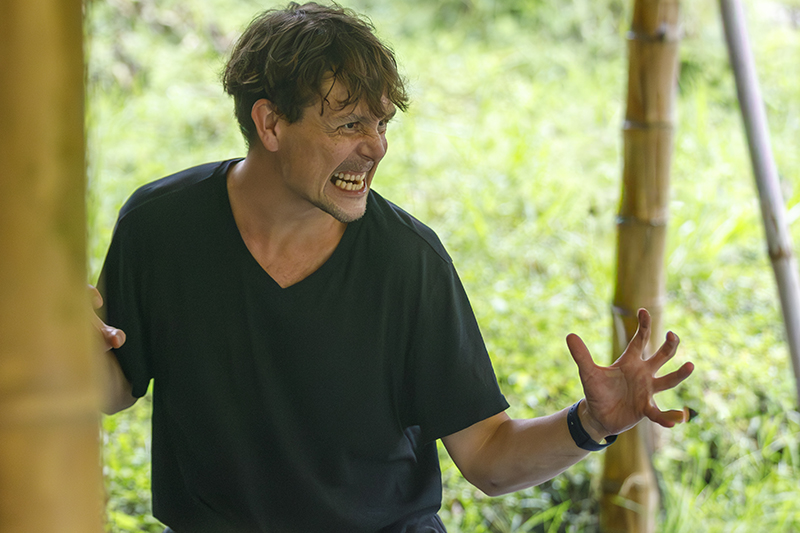
Nicole: Within our group investigations, some people practice Bharatanatyam only, some Butoh only, and some do both—migrating from one energy to the other. One of the themes of conversation has been about how the structural and vocal comprehension of rhythm (which is how we learn Bharatanatyam), can help us to understand the internal rhythm of Butoh. Butoh’s rhythm can be very prolonged or slow, but it can turn frenetic and structured, responding to precise patterns in the dancer’s body. But this rhythm is not particularly in the eyes, hands, or feet, as it is with Bharatanatyam. There is a different expression in the Butoh dancer’s body—but there is a rhythm. So, exploring the very structured rhythm of Bharatanatyam can help the Butoh dancer to understand the internal rhythm of Butoh, and express it more clearly.
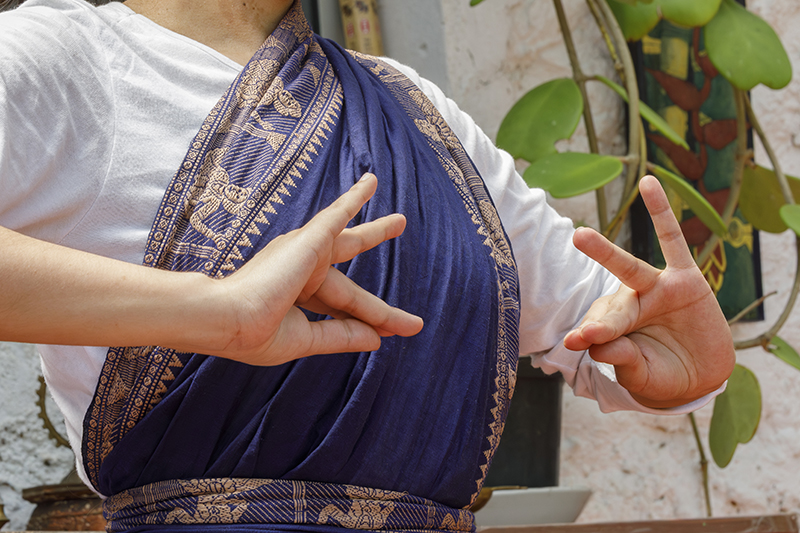
Brenda: Yes, this has been a very interesting question—including for me personally. I practiced Odissi, a very stylized and classic Indian dance, before I encountered Butoh. When I began to practice Butoh, it was an almost nuclear shock. Master Ko Murobushi wanted to topple all the structure that Odissi had created in my body—a very clear structure of mudras, consisting of lines and perfect curves that the dancer makes with her eyes, face, and hands. He was like a samurai. He said: This has to die, has to fall. The Butoh dancer has to become a “tabula rasa.”
The question then becomes: From those ashes, can one begin to comprehend a structure? From the ashes of my own Odissi practice, I began to see that there were very clear resonances between the two. The deeper I got into Butoh, the more I saw that, for example, what corresponds to the beautiful or poetic in classical dance, may become in Butoh the grotesque, the irreverent, something outside the social canon—something socially disruptive. In those things one also keeps, or finds, the poetic.
There is always a constant though. Theatrical anthropology helps us to understand that there is a connection with breath and respiration in each practice. There is also a connection in how each manages oppositions. And of course, there is physical consciousness in both. For however much we want to throw out all technique, Butoh requires it! So it’s not really about throwing out all structure. Butoh, like other practices of dance, requires that connection with energy and breath, and also the consciousness and physical presence that classical dance requires, even though it uses it in a very different way.
I began to understand that these two practices share not only a theatrical aspect, but a spiritual and/or philosophical aspect. The dances of India are very influenced by the Indian cosmology that is always present: the gods, the philosophy. Butoh has a very profound connection with Shintoism and the practice of Zen. For example, Ko Murobushi was a monk. From my perception, he incorporated some of the Yamabushi practices into his personal style of Butoh.
Tatsumi Hijikata (creator of Butoh), wanted to explore dance in an interdisciplinary manner, including practices and ideas of cosmogony and philosophy. Being Japanese, this included Shinto. So when we talk about the roots of Butoh, we have to include the mystery of Shintoism, in which spirits, ghosts, apparitions, and natural forces come into play in the dance, and in the body of the dancer. This is very important.
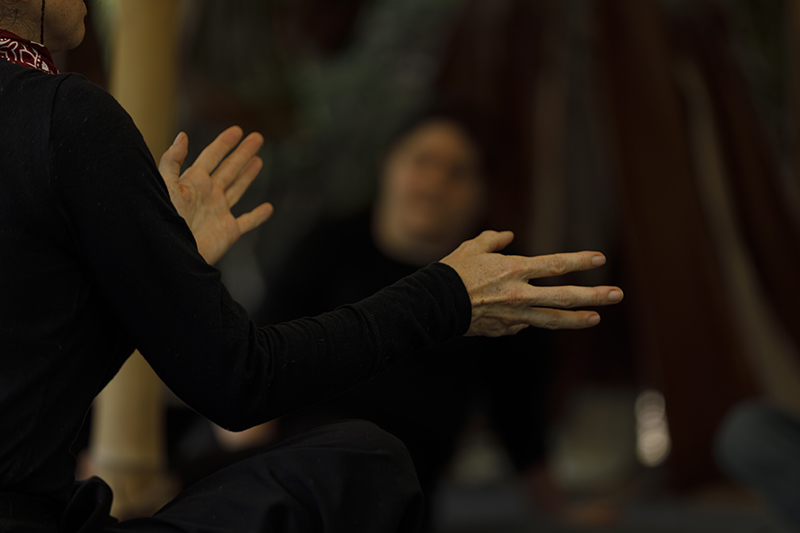
What has been your process dialoguing Butoh dance and Bharatanatyam?
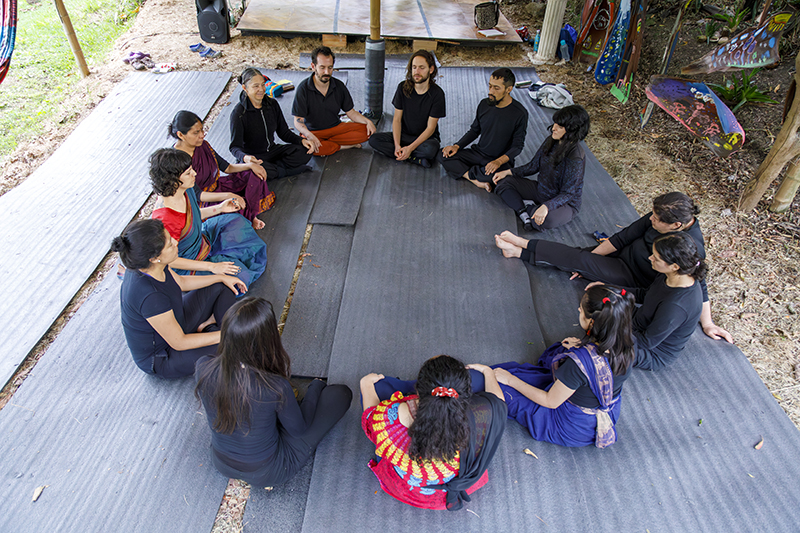
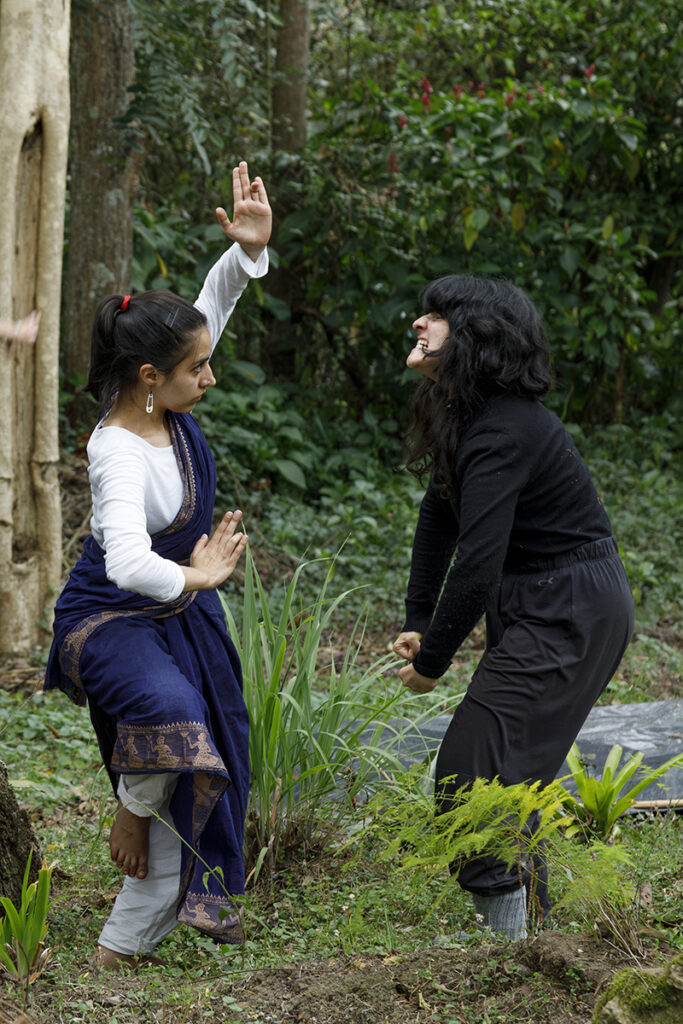
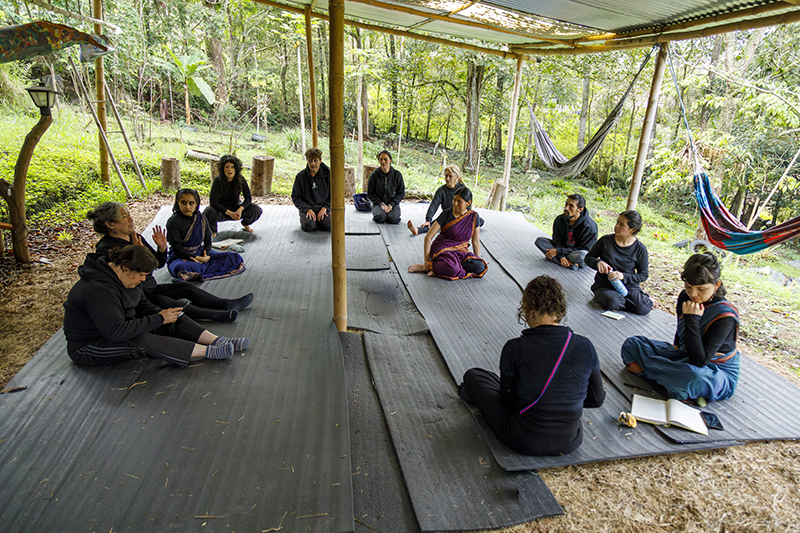
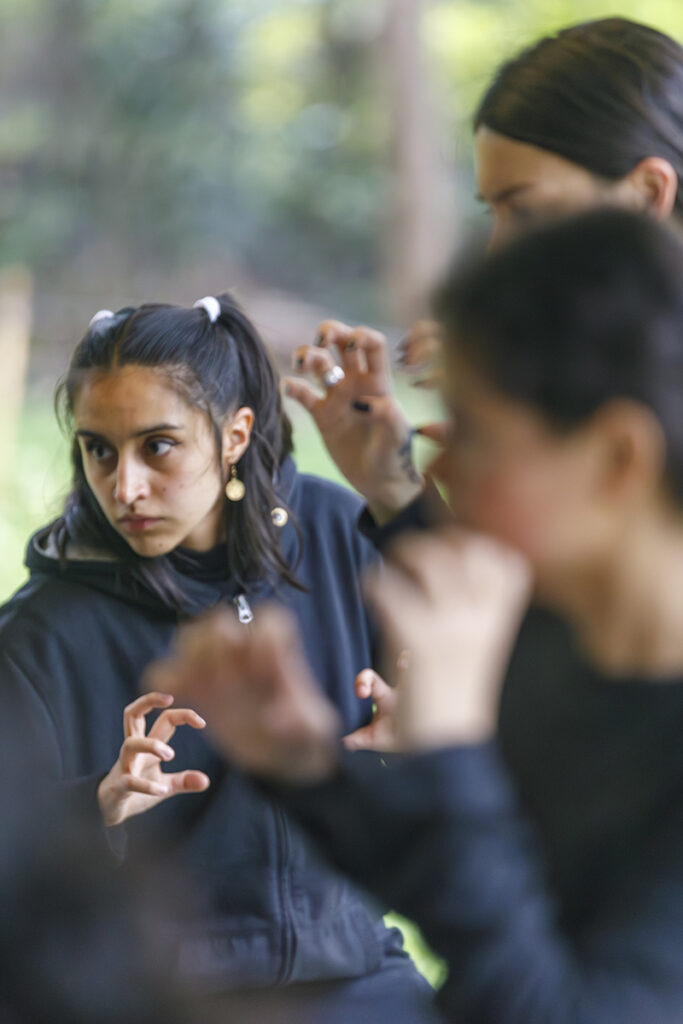
Nicole: This year, we started a monthly intensive. Once a month, we meet in Choachi in the sanctuary Alta Gracia, which is where Manusdea has its rural center. There, we have a space that’s intimately connected with nature, which we feel is very important to include in the investigation. It’s very different to learn a technique and share the dance with other people in the middle of trees and the green and colors of nature than in a studio.
In the intensive, we have groups that emphasize one technique, and mixed groups. We have blocks of time dedicated specifically to each dance—Bharatanatyam and Butoh. At the end of the intensive, there are three periods of focus: a focus on mixed dance, a focus on one technique, and in the third focus we get together to share dialogue about one or another principle of theatrical anthropology—for example “precarious balance.” How is precarious balance expressed in Butoh and in Bharatanatyam? From these dialogues, ideas and aesthetics reveal themselves about how the principle manifests within the tensions of each different technique.
We also look at the sensations that travel through the body. From the nervous system, from the perception of surroundings, from the relationship of one dancer to another. How does it impact us to see someone doing a completely different dance, or how does it affect us to be in a dance dialogue between two different forms? There’s an aesthetic impact based on what we see, but also an energetic impact. All kinds of ideas, phenomena, and points of impact come from these sessions.
Do performances or events come out of this research? Or do you consider it more as pure investigation?
Nicole: Actually this idea came out of a performance we did a while ago: “Butoh/Bharatanatyam.” In this recital, each of us performed an example of our particular dance, and then we closed together in a dialogue between styles. While I kept the tala (Bharatanatyam rhythm) with the ghungroos, which are small bells on the feet, Brenda repeatedly fell to the floor in Butoh style, increasing her impact incrementally each time, as I continued dancing Baratanatyam and increasing the intensity of the tala. Our colleagues and the audience later told us that they wanted to see more of this dialogue between Butoh and Bharatanatyam. So, from there came the idea to do more with this.
Now, we have the interest and the possibility to do more performing—to reopen this onstage encounter and develop it further.
Brenda: This is the idea. In June of this year (2026), we had a showing in Bogotá in the Centro del Japón (Universidad de los Andes). Each year, we honor Ko Murobushi and his legacy here in Colombia; how he formed a space for Butoh in Bogotá. As Nicole mentioned, there was no space for Butoh in the city. We’re creating and expanding that space, and the Centro del Japón has been a great ally. This year, they hosted our event, where we shared our investigations with the public.
Nicole: The event is called “Krudo” and is an experimental encounter with Butoh. It’s a space for “Butoesque” convergences which we’re now creating. (See: https://centrodeljapontest.uniandes.edu.co/kobai/reportajes/krudo)
What have been some of your most important findings so far?
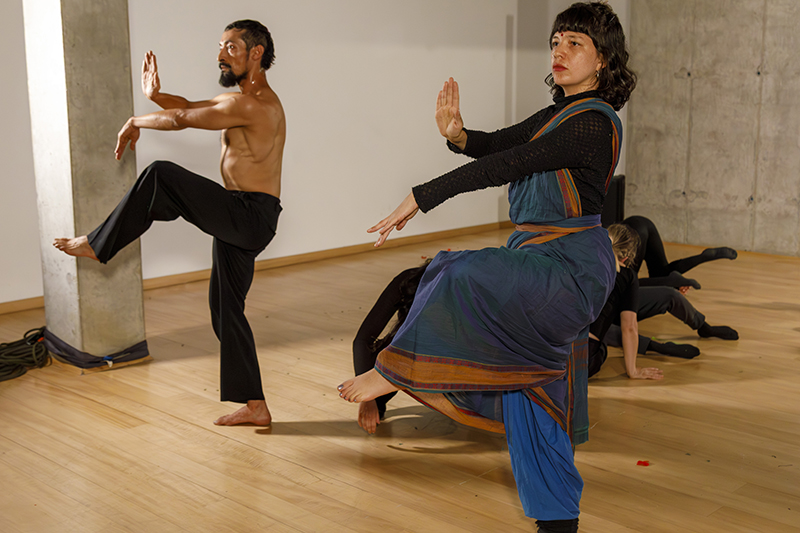
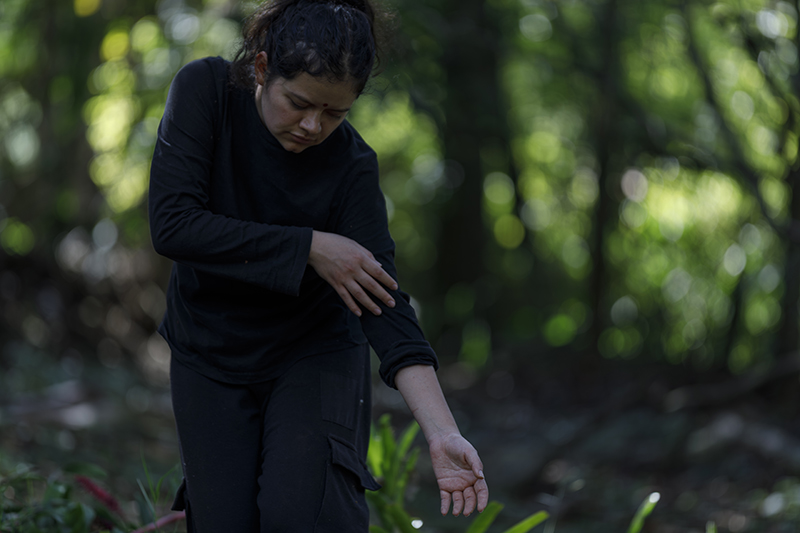
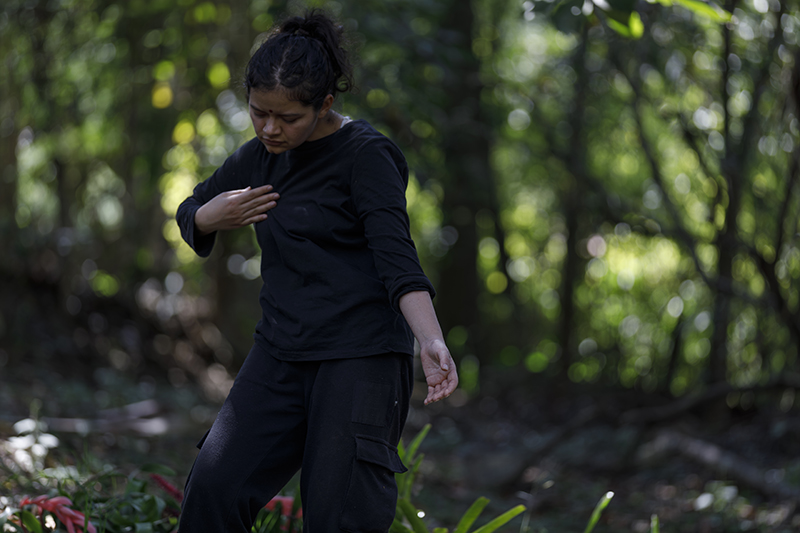
Brenda: One of the most interesting developments has been the understanding that the body functions not just as a physical structure, but as a sensitive ecosystem which is in constant relation with its surroundings. For example: how does it affect me to see someone near me, or to be in a dance with him or her? We’ve mentioned neurosomatic effects, and we’ve invited participants to leave the city and come to a place in nature, because we know that the body forms part of these different surroundings. We see that we move and act very differently in natural surroundings than in a studio constructed entirely of concrete in the middle of a city. Our sensitivity expands. If a butterfly goes past, if it starts to rain, if there is sun—sometimes two people will be dancing and the birds start to sing their songs—in these moments we’re dancing with all that, it becomes part of the choreography.
We explore this natural environment in order to transform our attention—discover proprioception and exteroception—speaking from the point of view of neuroscience. We begin to see that we don’t have five senses, but seven! Proprioception is how my brain perceives the body—what posture or position I’m in, what am I feeling, what emotions arise and how am I dealing with all of that. For example if I’m in a painful position, how am I acting, what am I doing about it. Exteroception is the relation of my body with the surrounding environment; for example if there are other dancers around me, how am I taking into account those other bodies.
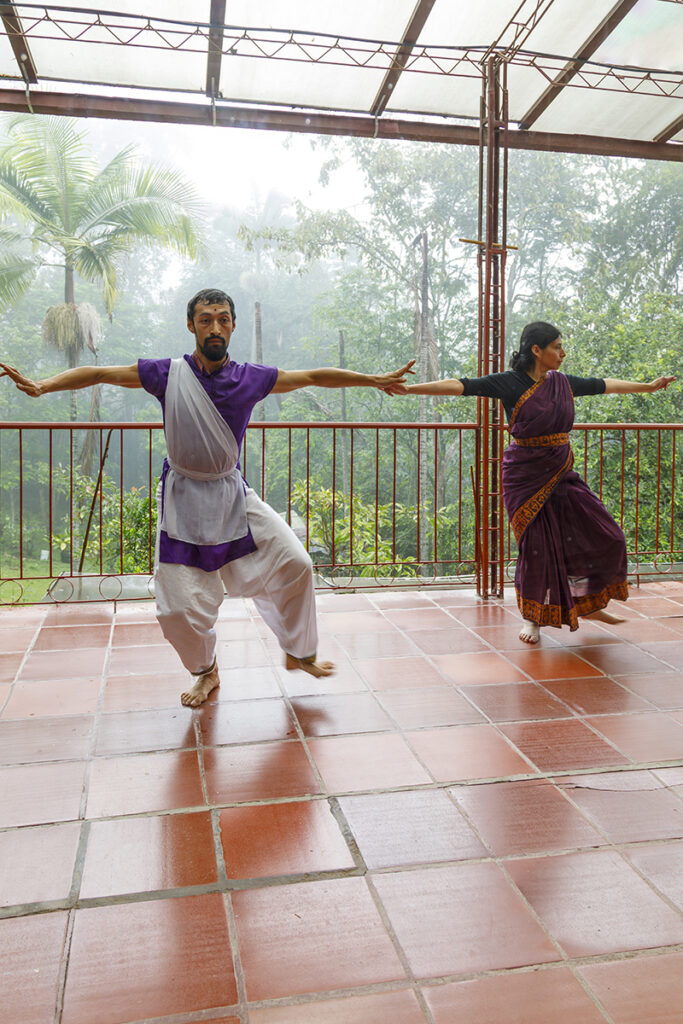
Nicole: We’ve talked about other things we’ve encountered, for example, rhythm. But there’s also a poetics. For Butoh, this concerns the Kairos archetypes: How time, character, the sacred combine into circumstances that are perfect for something to happen. That is Kairos, which is distinct from the Chronos of Bharatanatyam, which is precise, rhythmic, strategic, and measured time, expressed in distinct forms and geometries.
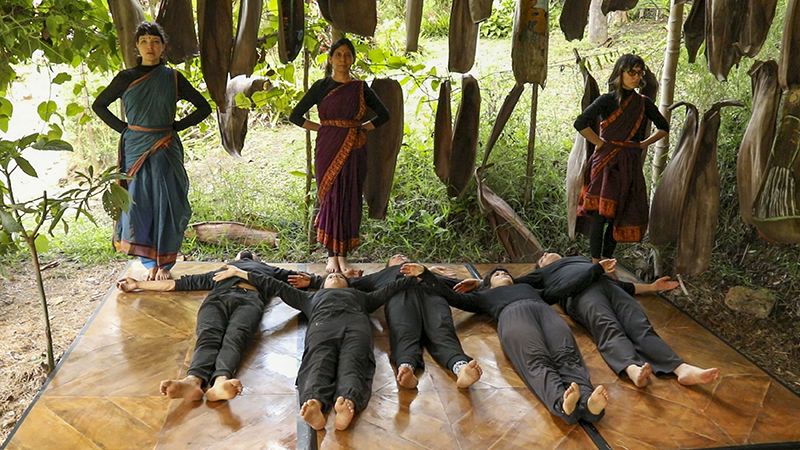
We’re paying more attention to how this affects us onstage. What internal tensions and aesthetic experiences does this provoke? For example, the Butoh dancer might find it difficult to ground herself in her technique while there are three Bharatanatyam dancers doing a fast and complicated rhythm. It has been very interesting to see how each dancer responds to these provocations.
Brenda: And, how Bharatanatyam dancers react when confronted by Butoh’s silence. We’ve seen how, at times, the very dense silence of Butoh makes velocity difficult. It’s powerful to see how these two forces relate while each dancer tries to maintain the technique integral to each.
How do you each plan to carry this work forward?
Nicole: The first thing is to sustain the investigation, because this is a vast, deep world and we’ve just started! So: keep investigating and dare to do more. In this work, it’s worth it to be daring and to go wherever we can with it. This is our challenge.
I also must mention that for me, as a Bharatanatyam dancer, we have to care for tradition. As a person who is not from that tradition, I am always very conscious of the need to respect it. That respect is always in my head and my heart. So when I do something that’s not in line with the dictates of the tradition and technique, it always impacts me with an “Oof! How do I do this? How do I break this tradition in a way that’s not violent, but is actually nourishing?” Because there is that possibility. So we work with this idea and this consciousness, but at the same time challenge ourselves to make this dialogue possible. I would very much like to share this work in India alongside this question: What has come out of the contact between Bharatanatyam and Butoh?
Also, there are possibilities made possible by writings and archival material. With photographs, videos, and writings, we can also keep the investigation grounded.
Brenda: I agree, this is only the beginning. What happens now is that we deepen our investigations, not only with participants, which has been the seed material, but now also at a professional level. How Nicole and I can create a theatrical work. And through this dialogue, amplify and do more with cultural exchange—by going to India and Japan to see how our work resonates there. It’s important to realize that Hijikata, for example, had many influences—film, photography, occidental art, especially Expressionism. He explored and understood ballet and tap very well.
So this is the beginning. The seed.
Do you plan to work with musicians—live music—at some point?
Nicole: It would be very interesting to work with live music. But right now, this project is a baby that is just beginning to crawl. So: little by little! In Bharatanatyam we work with the tala, using a wooden instrument that marks the rhythm. That has been our music, as well as silence.
But certainly we’d find it interesting and maybe even a bit hallucinatory to work with musicians, maybe Carnatic music or other forms for Butoh.
~~
To learn more, visit www.manusdeaweb.wixsite.com.
~~~~~~~~~~~~~~~~~~~~~~~~~~~~~~~~~~~~
ESPAÑOL:
Entre Butoh y Bharatanatyam
Entrevista con Brenda Polo y Nicole Tenorio
De LORIEN HOUSE y EMMALY WIEDERHOLT
Fotos: Ernesto Monsalve Pino
Brenda Polo es una bailarina de Butoh, y la fundadora de Manusdea Antropología Escénica en Bogotá, Colombia. Su hija, Nicole Tenorio, es una bailarina de Bharatanatyam, y dirija Manusdea. Brenda y Nicole estan desarrollando ahora un diálogo entre el Butoh y el Bharatanatyam, desde la perspectiva de lo neurosomatico. Este diálogo investiga las resonancias entre el cuerpo, la memoria, y la consciencia. Aqui, ellas comparten sus descubrimientos sobre cómo relacionan estas tradiciones y perspectivas tan distintas.
~~
Nicole, ¿puede contarnos un poco de su historia personal, y su historia como bailarina? ¿Cuáles fueron las influencias que le formaron como artista?
Nicole: Desde muy pequeña tuve la influencia de Brenda, que es mi mamá. Cuando yo tenía siete años, en 1997, Brenda hizo su primer viaje a la India para estudiar Odissi—una danza clásica del Norte de India. Al regresar, ella trajo ese fuego de quien conoce la disciplina de Oriente, y quiere instalarla en el cuerpo Occidental también. Durante este tiempo, yo solía acompañarla a entrenar muy temprano en las mañanas. Pues, allí empieza la influencia.
Así que, desde muy pequeña, empecé a acompañar a mi mamá en ese camino, con el entrenamiento. También yo la asistía en las clases y en el escénico, ayudándole con el vestuario y los aspectos técnicos.
Cuando yo cumplí 16 años, empecé a performar como bailarina. En ese año yo hice mi primer solo con una beca que ganamos—un premio de danzas del mundo sobre personajes del Ramayana, especificamente Sita, o la Mujer Tierra. Sita es la consorte de Rama. Luego, después de nueve años de performar como bailarina, yo gané una beca para ir a Nueva Delhi, a estudiar con mi gurú—Guruji Saroja Vaidyanathan. Ella era un gurú muy reconocida en la India por los aportes que hizo en el Bharatanatyam . Era una de las más conocidas fuentes de la sabiduría, no solo en el baile sino también en la vida. Para mí, es una de las influencias más importantes en mi vida, y como bailarina. Así es como empecé a profundizar en la tradición milenaria del Bharatanatyam.
Ahora, el Bharatanatyam es mi danza principal—lo que yo he estudiado más largo y amplio, y en el que he profundizado más mi conocimiento. Pero también he bailado el Butoh. Mi exploración del Butoh es más “sonoro.” Es decir que mi trabajo con el Butoh ha sido con el cuerpo por supuesto, pero también he explorado los aspectos musicales de esa danza.
También bailo una danza Afro-Colombiana que se llama Bullerengue. Es otra línea de investigación que me interesa mucho—conectando con nuestros ancestros del territorio de África.
El Bullerengue y el Bharatanatyam se conectan en mi cuerpo—pero como dos prácticas y técnicas distintas. Lo que converge en mí, particularmente, es el trabajo rítmico, y vocal. En ambas tradiciones trabajamos mucho con el ritmo, por supuesto, pero también con la voz. No dudo que ambas técnicas nutren mi desarrollo artístico, pero cada una tiene su propia orilla.
Brenda, por favor, para la gente que aún no tiene familiaridad con su obra, puede hablar un poco sobre Manusdea Antropología Escénica?
Brenda: Manusdea es una búsqueda profundamente personal, pero al mismo tiempo es claramente humana. Más que un proyecto artístico convencional, Manusdea evoca el encuentro entre lo humano y lo sagrado. Es la experiencia cotidiana que atraviesa la existencia. Desde esta perspectiva hemos consolidado una plataforma de creación, de investigación, de laboratorios, de encuentros académicos, pedagógicos, de espacios de intercambio cultural y también interdisciplinario, donde la investigación ocupa el lugar central.
Ahora concebimos que este cruce intercultural e interdisciplinario nos abre la posibilidad de comprender el holobionte. Un holobionte es una unidad biológica compuesta por muchos seres evolutivamente interdependientes. Así es como concebimos el arte y la cultura: un ecosistema que está profundamente conectada, con relaciones vivas de coexistencia. Desde allí, nosotras también percibimos la creación y el diálogo cultural e interdisciplinario.
Esta metáfora del holobionte es muy apto para la exploración del Butoh y el Bharatanatyam desde un enfoque neurosomático. Es una exploración que busca generar experiencias sensibles y espacios que permitan habitar el cuerpo con major consciencia y major presencia corporal.
Hablando de los diferentes campos del escenario versus la pedagogía y las investigaciones, nosotras trabajamos con la diversidad. No podemos enfocarnos en solo una cosa, y queremos tener un espectro más amplio de relaciones culturales. Entonces: por un lado, la investigación y la creación es central, y esta es, desde luego, la matriz del eje, pero de ahí surgen los encuentros académicos, el desarrollo pedagógico, y los eventos que se hacen para difundir estas investigaciones, como los performances. También, invitamos a bailarines de otras culturas al diálogo, e invitamos a personas de otras disciplinas (como la neurociencia, la física cuántica, la sociología, la antropología, y las artes plásticas entre otras) a investigar cómo las disciplinas empiezan a tener un diálogo.
Todo este espectro es lo que ¡nuestra plataforma hace!
El Butoh y el Bharatanatyam tienen muy diferentes historias y estética. ¿Por qué ustedes decidieron crear un diálogo entre estas formas? ¿Qué fue lo que provoca este diálogo?
Nicole: Nosotras, como Manusdea, somos pioneras en el país en estas prácticas, y además, embajadoras y gestoras de espacios donde sea posible ver estas danzas, pensar sobre estas danzas, aprenderlas; aquí en el país. Estamos investigando: ¿cómo es el cuerpo en estas culturas? ¿Cómo es aprender estos principios que se manifiestan en estas distintas culturas, y hacer estudios comparados en un estado de representación—en el escénico?
Entonces, cada una de nosotras, desde su búsqueda estética, pensaba: puede ser muy interesante trabajar con estas danzas, que son tan distintas, casi literalmente opuestas. ¿Qué pasaría si nos juntamos, y hacemos una investigación con enfoque somático, y la neurociencia aplicada en el movimiento? Y ésta ha sido una investigación que revela la emoción en el movimiento; en este encuentro. Así mismo, cómo nuestro sistema nervioso, o cómo nuestra percepción del cuerpo, y la emoción, reacciona ante estas dos prácticas. Es algo atrevido. Es un reto poner en diálogo esas dos fuerzas opuestas.
¿Cómo se relacionan estas dos tradiciones, especialmente hablando del ritmo?
Nicole: En el grupo que conforma esta investigación, hay personas que practican solo el Bharatanatyam, y personas que practican solo el Butoh, y personas que practican ambos—migrando de una energía a la otra. Y una de los temas de conversación ha sido cómo el entendimiento estructural y vocal del ritmo (que es cómo se aprende el Bharatanatyam), puede ayudar en la comprensión del ritmo interno del Butoh. El ritmo del Butoh puede ser, en ocasiones, profundamente dilatado; sin embargo, también puede tornarse frenético y estructurado, respondiendo a patrones precisos en el cuerpo del bailarín. Pero el ritmo interno del Butoh no es particularmente un ritmo en los ojos, pies, manos, como lo es en el Bharatanatyam. Él tiene otra expresión en el cuerpo, pero no es que no esté. Y acercarse al ritmo muy estructurado como en el Bharatanatyam, ayuda a los bailarines de Butoh a comprender este ritmo interno y a identificarlo más claramente.
Brenda: Sí, esta cuestión ha sido muy interesante, y especialmente desde mi experiencia personal. Yo practicaba Odissi—una danza refinada y clásica de la India—y cuando me encontré con el Butoh, fue un hecho casi nuclear. El maestro Ko Murobushi quería derribar toda la estructura que el Odissi había construido en mi cuerpo, que es una estructura muy clara de líneas y curvas perfectas con que el bailarín hace los mudras con el rostro, los ojos, y las manos. Él fue como un samurai. Dijo: todo eso tiene que morir, tiene que caer. El bailarín del Butoh tiene que ser una “tabula rasa.” Y la pregunta fue cómo, de esas cenizas, fue posible comprender una estructura. Y, de esas cenizas, me di cuenta que, de todos modos, había resonancias muy claras. Al profundizar en el estudio y la práctica del Butoh, me di cuenta que, por ejemplo, lo que en la estética de la danza clásica es hermoso o poético, es en el Butoh lo grotesco, lo irreverente, y también lo que sale del canon social: lo disruptivo social. Y se puede conservar o encontrar la poética desde estos lugares también.
Por otro lado, hay algo que siempre prevalece. Y allí nos ayuda la antropología teatral, y cómo muestra el manejo de la energía y la respiración. El manejo de las oposiciones. La consciencia corporal. Y por más que quiere tirar todo esto, y tirar la técnica—el Butoh lo requiere totalmente. Así que, no se trata de tirar toda la estructura, porque tiene cosas que se sostienen para la danza Butoh: la energía y la respiración, y también la consciencia y presencia que requiere la danza clásica aunque se use de forma diferente.
Lo que empecé a entender con el tiempo, fue que las dos técnicas comparten principios. Una cosa esencial de ambas prácticas es el aspecto teatral, pero además de eso, hay una esencia espiritual y/o filosófica que es comparable entre las dos. Las danzas de la India, tienen una relación estrecha con esa cosmología que está tan presente con sus dioses y su filosofía. Y el Butoh tiene una profunda conexión con el Shintoismo y la práctica de Zen. Ko Murobushi por ejemplo fue monje. Y desde mi percepción, él transmite las prácticas extremas de los Yamabushi en su estilo personal del Butoh.
Tatsumi Hijikata (creador del Butoh) quería explorar el mundo de la danza de una manera interdisciplinaria, con un diálogo con las cosmogonías y las filosofías. Siendo un japonés de raíz, cuando se refiere a las raíces del Butoh, se refiere a reconocer este misterio que tiene el Shintoísmo, en donde los espíritus, los fantasmas, las apariciones, y las fuerzas naturales entran a jugar en la danza y el cuerpo del bailarín. Y eso es muy importante.
Pueden hablar un poco de su proceso de crear este diálogo entre estas dos danzas?
Nicole: Este año abrimos un espacio mensual intensivo. Yo no vivo en Bogotá, entonces es difícil mantener más frecuencia. Así que nos encontramos una vez al mes en Choachí en el refugio de la Altagracia, que es la sede rural de Manusdea. Tenemos allí un espacio que dialoga con la naturaleza, que es algo que nos parece importante poner en la investigación. Es distinto aprender una técnica y compartir con otras personas la danza en medio de árboles y colores verdes, que en un salón en la ciudad.
Nos juntamos toda una jornada, en grupos de énfasis, y en otros grupos mixtos. Tenemos bloques de entrenamiento específicos en las danzas Bharatanatyam y Butoh. Al final de la jornada, tenemos tres momentos: un momento de mixto, un momento de énfasis, y en el tercer momento nos juntamos para compartir y dialogar desde los principios de la Antropología Teatral. Por ejemplo, como principio, podríamos dialogar sobre el equilibrio precario—cómo se expresa el equilibrio precario en el Butoh y cómo se ve en el Bharatanatyam. Desde este diálogo, empiezan a surgir o revelarse unas estéticas muy interesantes de los dos bailes con esa misma premisa, pero con las tensiones distintas que cada estética trae.
Estamos también preguntándonos sobre las sensaciones que atraviesan el cuerpo. Desde el sistema nervioso, la percepción del entorno, y la relación con los demás: ¿cómo nos impacta ver otro cuerpo en otra danza, o estar con otro cuerpo en este diálogo entre formas? Entonces hay un impacto estético desde el punto de vista de lo que vemos y percibimos, y también un impacto energético. Así, empiezan a surgir ideas, fenómenos, puntos de encuentro de este diálogo.
¿De estas investigaciones, surgen obras o eventos? O se trata más de la pura investigación?
Nicole: De hecho, esta idea nació mucho antes, en un recital que hicimos: “Butoh/Bharatanatyam.” En este recital, ambas hicimos una muestra de nuestra danza por separado, al final cerramos juntas en diálogo cada una con su estilo. Mientras yo hice la tala con los ghungroos, que son cascabeles en los pies, la tala, Brenda caía repetidas veces incrementando el impacto del cuerpo con el suelo en el estilo Butoh, mientras yo con el Bharatanatyam marcaba ese ritmo de forma intensa. Y nuestros colegas y el público nos dijeron que les había gustado ver más de este diálogo entre el Butoh y el Bharatanatyam. Y de ahí surgió la idea del encuentro que hacemos ahora.
Y ahora tenemos el interés y la posibilidad de compartir los eventos escénicos, retomar este encuentro que tuvimos, y desarrollarlo más.
Brenda: Ésta es la pretensión, en junio de este año, tenemos un encuentro en el Centro del Japón (Universidad de los Andes) en Bogotá, Anualmente honramos a Ko Murobushi, y cómo él sembró el legado de Butoh entre nosotros, queremos un evento anual para el Butoh en la ciudad de Bogotá, como lo mencionó Nicole, no hay un espacio específico para este género dancístico en la ciudad. Así que lo estamos gestando con el apoyo del Centro de Japón, que ha sido un gran aliado. Este año, ellos son los anfitriones en donde vamos a llevar este evento y compartir con el público nuestras investigaciones. Vamos a ver qué opinión nos deja el público.
Nicole: El evento se llama “Krudo” y es un encuentro experimental de la danza Butoh. Un espacio de convergencias Butohkas que estamos ahora apostando. (Ver: https://centrodeljapontest.uniandes.edu.co/kobai/reportajes/krudo)
¿Cuáles han sido sus descubrimientos más impactantes hasta ahora?
Brenda: Uno de los más interesantes desarrollos ha sido comprender cómo el cuerpo funciona no solo como una estructura física, sino como un ecosistema interdependiente, sensible, que está en una relación constante con su entorno. Entonces, cómo me afecta ver al otro o estar en una danza con él. Hemos mencionado el enfoque neurosomatico. Invitamos a los participantes a salir de la ciudad para venir al campo abierto, en medio de la naturaleza, porque sabemos que el cuerpo también forma parte de esa naturaleza, y se comporta muy distinto en un entorno natural que en un salón hecho totalmente de bloques de concreto en medio de la ciudad. La sensibilidad se expande en un campo abierto. Si hay lluvia, si hay sol, si atraviesa la mariposa—hay momentos en que dos cuerpos están bailando y los pájaros emiten sus sonidos y hacen parte del baile, como una coreografía.
Así que, desde la neurociencia, exploramos el entorno natural para transformar la atención, descubrir la propiocepción y la exterocepción. Y ver cómo ya no tenemos cinco sentidos, sino siete! La propiocepción es la forma en que mi cerebro percibe mi propio cuerpo—en que postura estoy, que estoy sintiendo, qué emociones están surgiendo dentro de mí, cómo estoy agenciando estas emociones, etc. Por ejemplo, si estoy en una posición dolorosa física, cómo me estoy agenciando ésta sensación. La exterocepción es la relación de mi propio cuerpo con el entorno que tengo alrededor. Por ejemplo si hay en el espacio otros bailarines, cómo yo tengo en cuenta esos cuerpos que están allí conmigo.
Nicole: Hablando de otras cosas que hemos encontrado, por ejemplo, con el tema del ritmo. Llegamos también a una poética. Para el Butoh: sobre los arquetipos de Kairos. Cómo se expresa el tiempo, el carácter, lo cualitativo sagrado en el que las circunstancias están perfectas para que pase cualquier cosa—está es la cualidad “Kairos,” a diferencia del “Cronos” del Bharatanatyam, que es el tiempo rítmico, preciso, y estratégico, expresado en las formas, las geometrías muy llamativas y muy claras.
Estamos dándole más atención a cómo estas ideas nos afectan en la escena. Qué tensiones internas, pero también estéticas, provoca. Eso ha sido muy interesante. Cómo por ejemplo los bailarines de Butoh pueden encontrar dificultades localizando en el encuentro, cuando hay tres bailarines de Bharatanatyam haciendo un ritmo rápido y complicado. Cómo cada bailarín responde a esas provocaciones.
Brenda: Y también: cómo los bailarines del Bharatanatyam reaccionan ante el silencio del Butoh. Porque hemos visto que a veces, el silencio denso del Butoh hace mucho más difícil la velocidad. Es impactante ver cómo estas dos fuerzas se relacionan mientras tratan de mantener la técnica íntegra de cada uno por su lado.
Pueden hablar un poco sobre cómo quieren continuar este trabajo con sus obras y prácticas respectivas?
Nicole: El primer plan es sostenernos en la pregunta, porque es un mundo muy vasto, muy profundo, y apenas estamos empezando el camino. Así que: sostenernos, y atrevernos más. Yo creo que en este experimento, vale la pena ir donde podemos llegar. Es un reto.
Y para mí, como bailarina de Bharatanatyam, nos enseña mucho el cuidado de la tradición. Como persona extranjera de esta tradición, siempre hay que tener mucho cuidado y mucho respeto, y ser muy consciente de lo que implica esto. Este cuidado siempre está en mi cabeza y mi corazón. Por eso, salirse de lo que dicta la tradición es algo que me interpela como “uf! ¿Cómo lo hago? ¿cómo romper con esa tradición sin que sea algo violento? Y más bien, que sea algo nutritivo?” Porque tiene esa posibilidad. Pues: cómo trabajar con esa prevención poco a poco, pero atreviéndose a hacer posible este diálogo. Me gustaría mucho poder compartir en la India este trabajo, y esta pregunta: ¿Qué ha venido del contacto del Bharatanatyam con el Butoh hasta ahora?
Además, hay la posibilidad de la escritura: una forma más intelectual de archivo. Con las fotos, los videos y la escritura, podemos ir aterrizando la investigación también.
Brenda: Yo estoy de acuerdo: este diálogo apenas comienza, y lo que sigue ahora es profundizar, de una manera vigorosa, no solamente con los participantes, que es un semillero de investigación, sino más a un nivel profesional. Cómo Nicole y yo podemos construir una pieza. Y a través de este diálogo, ampliar y convocar el intercambio cultural. Podemos ir a India y a Japón, a ver cómo, en estos encuentros, resonarían las cosas que hemos trabajado. Entendemos, por ejemplo, que el señor Hijikata tuvo muchas influencias de todo tipo—el cine, la fotografía, entre otras cosas. El arte de occidente influyó bastante con el expresionismo. Él exploró el ballet y entendía muy bien el ballet, e incluso el tap.
Entonces esto es el inicio. La semilla.
¿Ustedes piensan en trabajar con músicos, o tienen planes de hacerlo?
Nicole: Sería muy interesante trabajar con la música en vivo. Pero, ahora, este es un bebe que apenas empieza a gatear. Así que: poco a poco. Trabajamos en el Bharatanatyam con la tala, usando un instrumento de madera que marca el ritmo. Y esa ha sido la música que nos ha acompañado, más el silencio.
Pero sin duda encontraríamos muy interesante y casi alucinante trabajar en diálogo con la música Carnática tal vez, o con otras formas de música para el Butoh.
~~
Para obtener más información, visite www.manusdeaweb.wixsite.com.
Responses
There are no comments at this time.
Be the first to start the discussion by filling out the comment form.