Following the Aesthetic
July 6, 2026
An Interview with Douglas Dunn
BY EMMALY WIEDERHOLT
Douglas Dunn is a dance artist and choreographer based in New York City who has been presenting work in the US and internationally since the 1970s. Here, he reflects on his career and the many great names in dance who have shaped him, how his focus as a choreographer has always been informed by aesthetic choices, and how the dance field has evolved during his career.
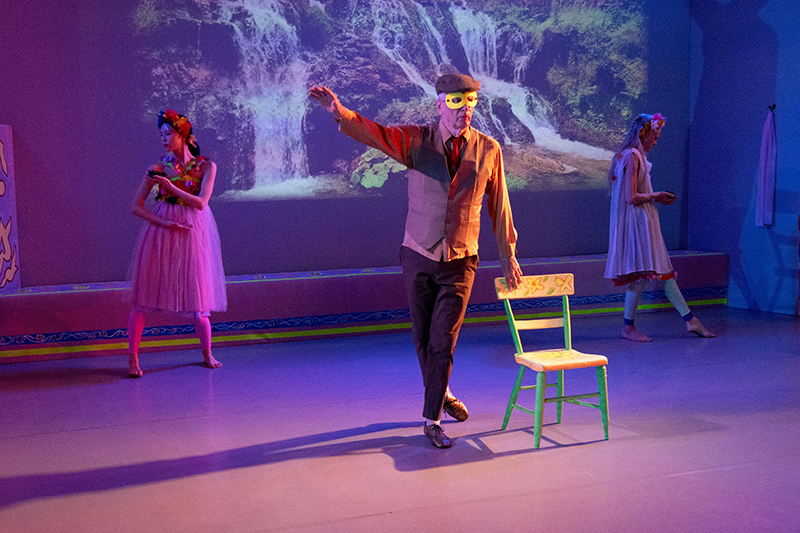
Douglas Dunn (center), Dongri Suh, and Janet Charleston in Hesperides, Photo by Jacob Burckhardt, 2026
~~
How did you get into dance and what has shaped you as a dance artist?
There I was in the hills of Palo Alto, California, with no playmates. I didn’t play well with my sister, and my parents were very busy and somewhat aloof. Our property abutted the Stanford property of 2,000 acres that is never allowed to be built on. I was completely outdoors, running around climbing trees. Then my parents got divorced and we moved to San Francisco for a year before moving to downtown Palo Alto. By that time, I was into sports. I was physically talented.
I went to college at Princeton. I gave up athletics, which was terrible for me. I became depressed because I didn’t have a physical outlet. I was overburdened by my studies. In my junior year, it was suggested that I take a ballet class. The Princeton Ballet Society had its studio right on the campus. I thought it was a weird idea, but I did it and liked it. As a hobby, I took modern and ballet classes for a number of years, never imagining becoming a professional dancer. It was not part of my cultural background to imagine doing that. But the Princeton Ballet Society had no males, so I was performing instantly in shows. They brought in guest artists to be the leads, and I was the sidekick. I was completely untrained, but there I was onstage. I kept this up for a while. After school, I went to New York for a year and took ballet classes. I was doing other work and just enjoying dancing on the side.
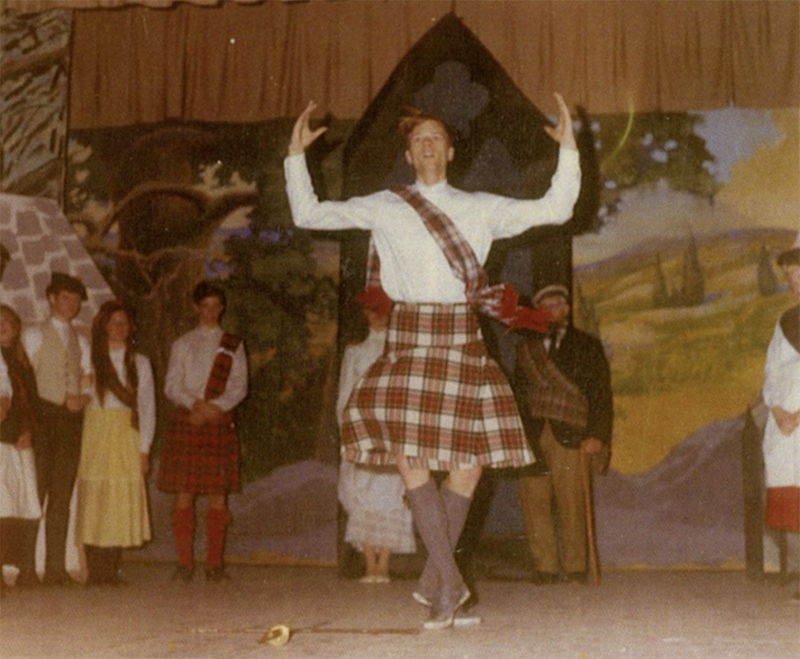
Douglas Dunn in Brigadoon, 1966
I thought I was going to have an academic career. I went and taught Spanish at a prep school in Connecticut for three years. That wasn’t very satisfying, so I came back to New York. With nothing to do for a summer, I decided to take more dance classes and went to the Cunningham studio. At my first Cunningham class, something changed. I identified with the movement being elegant and difficult, but it wasn’t trying to be meaningful. I wasn’t asked to feel anything or project anything. I was just dancing, and that was so much a part of my background running around the hills in Palo Alto where I wasn’t trying to prove anything.
I stuck around the Cunningham studio for a year, and I was just about to pick up my academic life when Merce asked me to join the company. That was a transformational moment in my life. I was in the company for a few years from 1969 to 1973. Right away, I was also working with Yvonne Rainer. She invited all the Judson dancers, but they needed some new blood. They liked me because I was untrained and raw. I joined her group from 1968 to 1970. Then Grand Union formed in 1970 when Yvonne retreated from being the leader and that lasted until 1976.
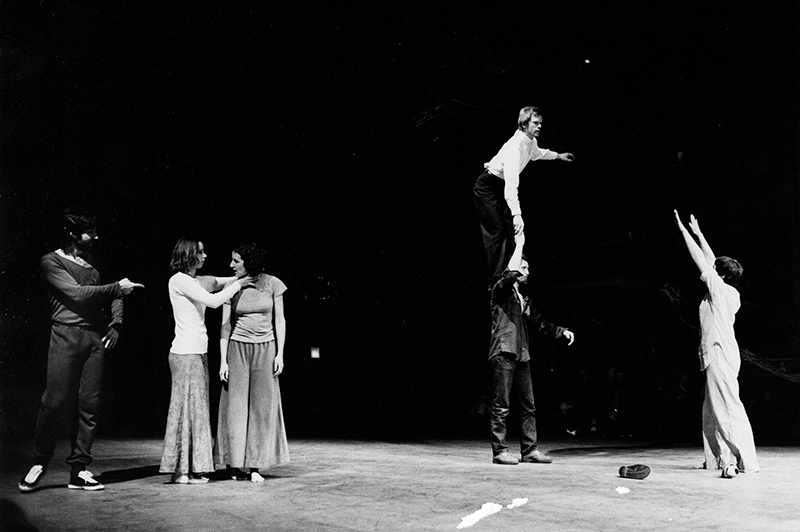
Douglas Dunn in Grand Union at La Mama, Photo by Mangolte, 1976
How did you get into choreography?
I was impatient because I’d been so independent in my life up to that time. I started making my own work in 1971. I presented a piece with Sarah Rudner, who I was living with at the time. We did two shows at the Laura Dean loft.
I just kept doing my own work. I did a lot of solos. In 1976, I started a group piece called Lazy Madge. I worked on the piece for two years. I called it a project, but it was an evolving situation where I made work all the time on the dancers, but they couldn’t all be there all the time. My take on dance at the time was it was too neat. I wanted to make messy dance. So when we performed, I told the dancers they could do any of the choreography they wanted facing any direction, so they had some choice. It was always different and messy. There were never any unisons.
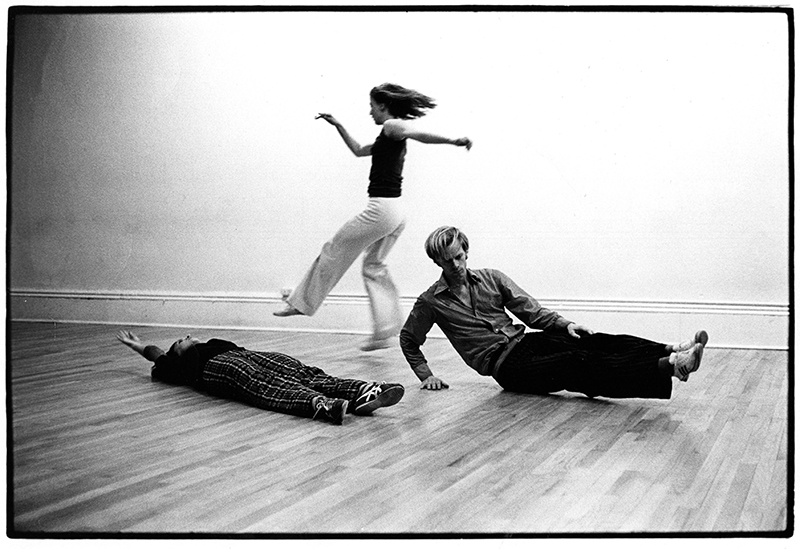
Lazy Madge, Photo by Tileston, 1976
In 1978, one of the people in New York who had supported Cunningham invited me to France. From 1978 to the early 1990s, I had a lot of work in France because of Michel Guy. He was a cultural power guy who liked my work and supported me. After one piece in Nancy, the man who was the boss at the company walked me up the stairs of this beautiful state theater and said, “It’s a good piece but it’s not for a large audience.”
The next gig I was offered, to my surprise and trepidation, was to choreograph Stravinsky’s Pulcinella on the Paris Opera Ballet. This was a period where if a producer or place was interested in you, they invited you to do something; they didn’t tell you what to do. Whereas by the mid-1980s, they would ask for a video. That was a huge change for the dance world in terms of respecting the artist.
So there I was making something to Stravinsky. The music is very sweet, not at all harsh, and full of short sections. There are 19 sections during the 40-minute piece. Short bits are exactly how I work anyway; it’s hard for me to make work that doesn’t stop and start. The Paris Opera gave me three months and 40 dancers. I’m still happy with the final piece. It’s been performed again a few times.
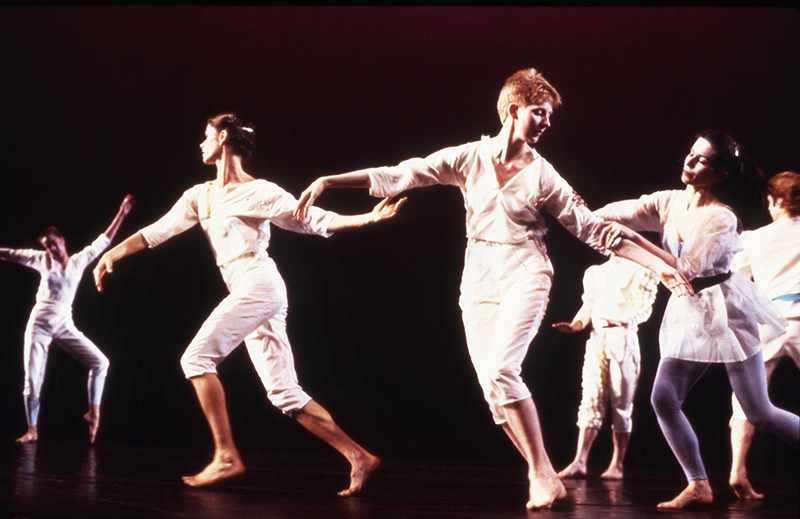
Pulcinella, Photo by Schiller, 1984
I just have a huge appetite for making things, despite stumbling through the grant getting and other things that get in the way of being a choreographer. I feel incredibly grateful that my life took these strange turns at the beginning which brought me back to my origins running around the hills. In a way, I’m more that person than any in between because I’m independent and I get to choose what to do.
I also want to add that when I taught school in Connecticut, I loved teaching, but I didn’t like motivating the students. I know that’s something teachers should be able to do, but it wasn’t me. I needed to be in a situation like dance where the people who are in the room are extremely motivated. We all want to be doing what we’re doing. That has provided a context of support.
That brings us to now. Can you share more about Douglas Dunn + Dancers and the salons you host?
For quite a few years, Douglas Dunn + Dancers was a dance company in the sense that it was more or less ongoing. By the mid-1990s it was getting tricky. France had fallen away and grants had been getting difficult. I just kept going one way or another.
I’ve been in my current loft since 1982. Because I have this beautiful loft space, I started using it for shows and salons once the gigs started not happening as much. I also have a system where I can project on the wall so there can be mixed media.
Two years ago, I did a piece called Garden Party. Mimi Gross, an artist I’ve worked with for many years, painted the whole room to look like a garden. It was post-pandemic and I wanted to make a beautiful happy piece. And then more recently I had this other urge. I made the whole room gray with the help of Mimi for a new piece called Hesperides, which I hope is ironically sad instead of ironically happy.
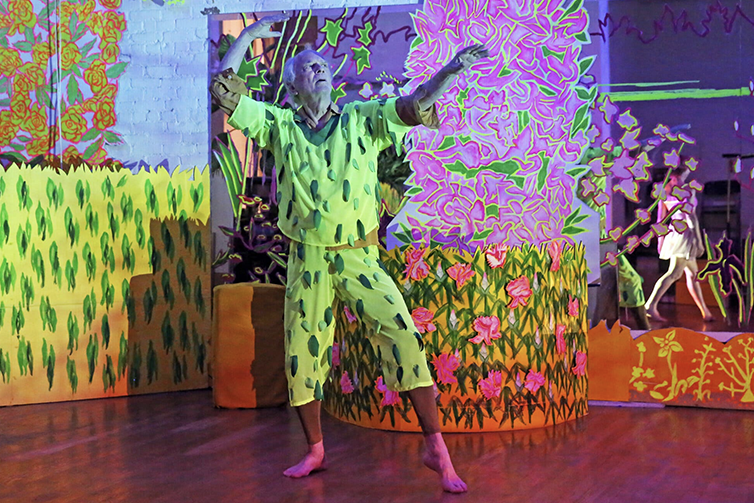
Douglas Dunn in Garden Party, Photo by Mohin, 2023
Between Garden Party and now, I made two large pieces presented at Judson Church in the round with more than a dozen people. They were very expansive and formalistic. It contrasts with Garden Party and Hesperides. In my studio, we’re dancing right up to the toes of the people in the front row. I would still love to do stuff in a big theater, but I very much like the intimacy of my situation.
You’ve been at the forefront of so much influential dance in the latter half of the 20th century and this century. What are some evolutions or trends in dance you have noticed?
The obvious trend is personal; I can’t get funding the way I used to because of my straight whiteness. It’s hard but I understand why and I’m sympathetic to the idea that we’re trying to be inclusive. In the 1980s, after one of those long two-week meetings for the National Endowment for the Arts where I had to make judgements about other people’s dances, which I found very painful, I justified it for myself by saying, “At least we’re giving money to somebody.” There was a shift from judgements being made about aesthetics or other criteria. I’m all about the aesthetics of dance. That is my rather narrow focus, and I don’t want to apologize for it.
My mother was artistically inclined, and it’s through her I have some sense of art and music. In college, my major was art history, so these two aspects of my life produced this being who was first attracted to ballet. The classical tradition is appealing to me. It is my sensibility. All the dancers I’ve invited to work with me, I want them to be able to do anything, but I want them to have a classical underpinning. As the years have gone on, there aren’t as many dancers who have come up through ballet into modern. They are not necessarily including that classical line underneath what they are doing, which I so find interesting.
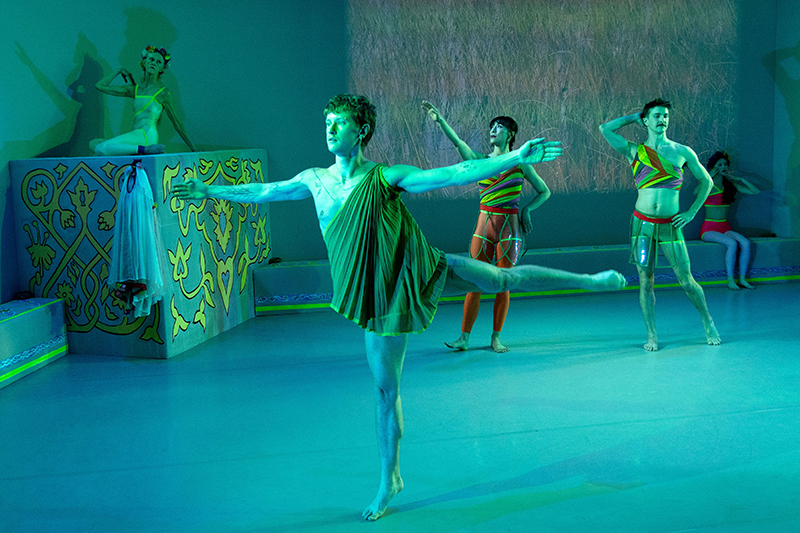
cove barton (center), Janet Charleston, Jin Ju Song-Begin, Tim Ward, and Dongri Suh in Hesperides, Photo by Jacob Burckhardt, 2026
To torture myself, I went to a concert based on historical political dance. Political dance is not interesting to me because it’s political. I love America because we can protest, we can vote. And then we have the arts. Especially dance, I find it is an awkward form for making statements. I don’t think it does it well. To lay politics over dance brings my mind from appreciating the dancers. The concert wasn’t as tortuous as I thought because it had a lot of good movers in it, even though it was derived from choreographers thinking about other things than the shape and the tempo and the rhythm of the dance.
What can I do? I just go on with my sensibility and hope I can make something fresh for myself and the dancers and the audience.
What’s next?
Believe it or not, even though every time I’ve done a concert in the past ten years I’ve said it’s my last, and my wife, who has danced with me since 1980, says she doesn’t want to dance in it this time, as the weeks go by she relents and we both dance in the concert. The same has been true for Hesperides.
Only in the last week have I thought of another thing I want to do. In 2010, I developed a piece called Vain Combat, an outdoor piece for six to twelve dancers that can ebb and flow depending on who is available. For Lazy Madge I added material over the two years of the project. For Vain Combat, begun in 2010, I kept adding over the first ten years or so. For fun I’m considering adding more as we head into the work’s grand finally: five showings over five days in October, with a larger than usual cast, probably in Washington Square Park. When we perform it, we decide which sections to do. We wear street shoes. It’s kind of rough. When I had the audition for it, I wanted acrobatic potential and daring. A lot of the people who came to the audition were not only good for the piece but ended up in my company as dancers in other works.
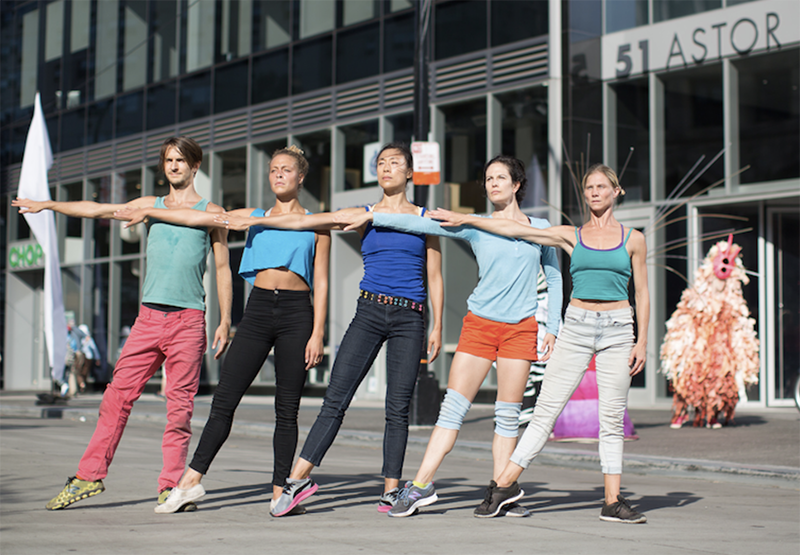
Vain Combat, Photo by Lin, 2016
Now I want to do an extravaganza. I want to have the largest number of dancers I’ve ever had and over a week do all the sections in various orders in Washington Square Park. I hope to do a circus-scale of this piece with some dancers who know it and with some new dancers too.
~~
To learn more about Douglas, visit www.douglasdunndance.com.
Comments are closed.
Responses
Thanks David!
I am a 85- year old blast from Doug’s boyhood past wishing he and his sister as good as possible the best health, vim and vigor. Great reading about your present life. I have some snapshots from that past.
David