Hitchhiking to Ecstasy
June 15, 2026
BY RASHIDA ALISHA HAGAKORE AND KATHRYN DICKASON
Contemporary ecstatic dance is now a global phenomenon, but few people know that its early DNA was shaped by a woman holding Sunday morning dances in Hawaiʻi.
Note: This article was published in Stance on Dance’s Spring/Summer 2026 print issue. To learn more, visit stanceondance.com/print-publication.
On Sunday mornings near the turn of the millennium, a woman in her early 40s would leave Hilo, Hawai’i, before dawn, stick out her thumb, and trust the Big Island to carry her to the dance. She never envisioned that this intimate dance gathering would morph into a worldwide practice, now thriving in most cities and on six continents.
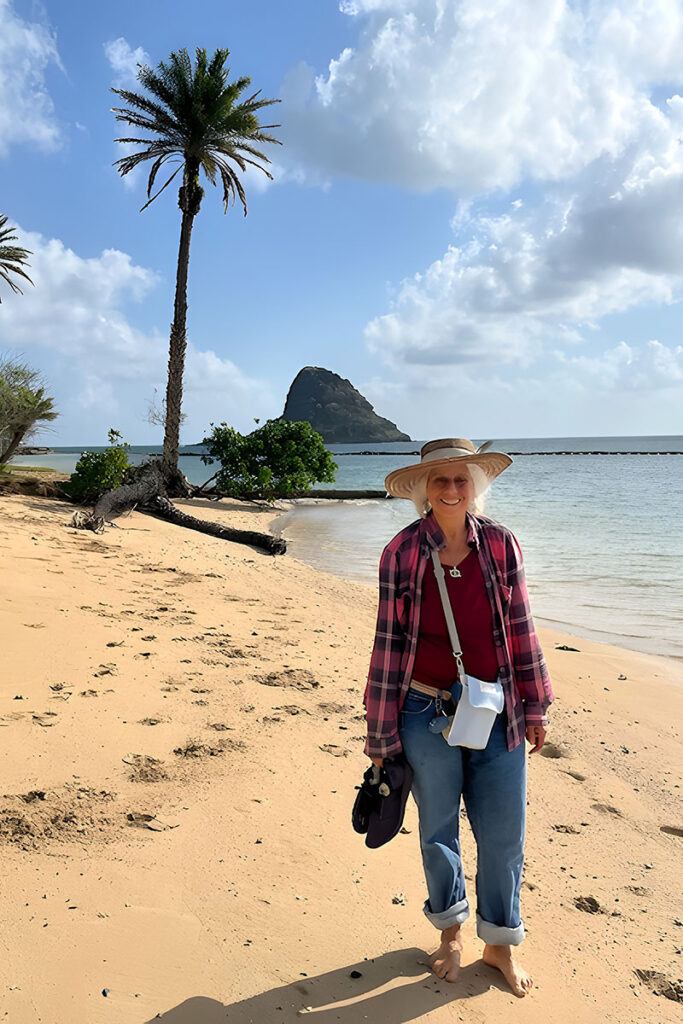
Photo by Molly Carney
Early Years of Dancing and Seeking
Born and raised in Brooklyn, New York, Bodhitara Diane Searles (hereafter Bodhi) began dancing at age four. One of her teachers, the legendary Marjorie Mazia, a former dancer with the Martha Graham Dance Company and mother to Arlo Guthrie, proved a formative presence in Bodhi’s youth. Mazia encouraged students to explore the creative mimesis of dance. “Be a butterfly, be a cloud, be the color blue,” she instructed them. Bodhi continued her training with some of the finest schools in the country, including the Joffrey Ballet School and the Ailey School.
Alongside her passion for movement, Bodhi yearned for spiritual exploration. As a Baby Boomer and self-identified “seeker,” she traveled to India, where she studied different forms of mindfulness. At the ashram of Osho (1931–1990), an Indian mystic known for his dynamic meditations, she entered a spiritual community and retreat setting where she found a visceral template to “let go and trust.” “Osho’s deep influence in my heart and spirit is really the throbbing pulse of this movement in my own life,” Bodhi shares, a current she feels still underlies how ecstatic dance lives in her.
Dance remained a steadfast source of inspiration and practice for Bodhi. She experimented with contact improvisation, breathwork, and active meditations. She came to luxuriate in improvisational movement. “The let-go experience was not foreign to me,” she says, “I loved it.”
In the thick of a midlife crisis, Bodhi went to Portland, Oregon, to stay with her sister. “I was going through a huge, tumultuous, emotional time. I was in one relationship or another, and things were falling apart,” she recalls. “I was seeking emotional healing that would bring me through a threshold that required not only going into it emotionally but also somatically.” As she told her sister, “‘I basically need to die and be reborn, energetically.”
In the Pacific Northwest, Bodhi entered the world of conscious dance through a studio called Body Moves. Conscious dance denotes varieties of dancing that privilege mindfulness and transcendence over aesthetics and technique. Gabrielle Roth’s (1941–2013) 5Rhythms®, in which dancers explore different avenues of consciousness to five successive “rhythms,” is one of the first formalizations of conscious dance. Specifically, Bodhi participated in Soul Motion™, one of many offshoots of Roth’s 5Rhythms®, led by Vinn (Arjuna) Martí (né Vincent Martínez-Grieco).
In addition to conscious dance immersion, Bodhi practiced Nia, yoga, and other movement classes. “It was a soul-saving time for me to connect with dance and movement,” she says.
The Dawn of Ecstatic Dance
After this period of psychosomatic rewiring, Bodhi felt ready to bring what she had learned to the Big Island. Her principal aim was to create a conscious dance practice of her own. “Originally, this [ecstatic dance] was my heart song.” She considered it an offering to the community and something personally meaningful to her.
As for the venue, Bodhi gravitated toward the Kalani Oceanside Retreat Center in Pāhoa, nestled in a jungle-like area and near an active volcano. In a conversation with Kalani’s co-founder and then owner Richard Koob, she asked to lead a Sunday morning dance group, and he agreed. The practice’s first name was Sun Dance, but recognizing the risk of cultural appropriation of Indigenous ritual, Bodhi changed the name to ecstatic dance.
The dance group at Kalani consisted of freeform movement situated within a judgement-free space. The participants typically danced inside Kalani’s Rainbow Room. “The theme was always to trust the opening that happens when you drop inside your own internal experience, and allow that to guide you,” Bodhi says.
Unlike later ecstatic dance facilitators, Bodhi used pre-recorded cassette tapes to accompany the dance. She curated a variety of devotional music (e.g., shamanic, earthy, didgeridoo, tribal, and Osho/Sannyasin contemplative tracks). She selected music that “would lend itself to a very deep inner dive within,” she says.
These early gatherings were intimate. Anywhere from five to 20 people gathered. There were no required fees. Bodhi sometimes received coconuts and bananas as offerings in lieu of a cash donation. “The master in the space was your own deep listening,” she says, emphasizing inner guidance.
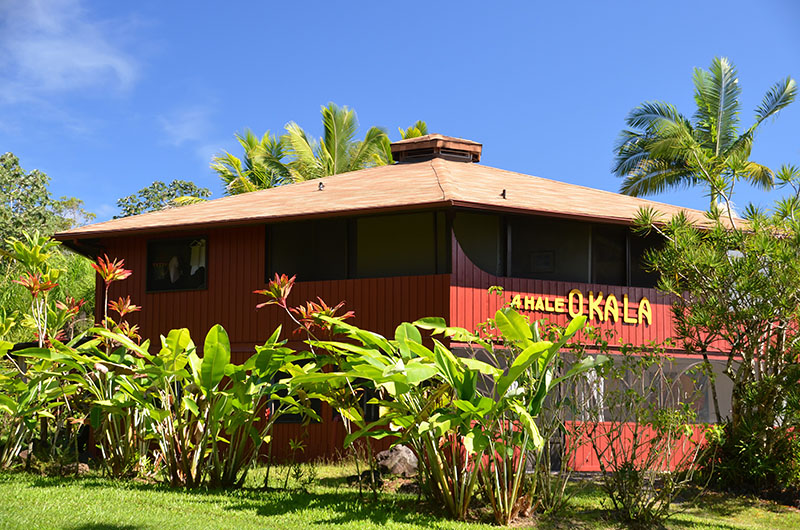
Photo by Thomas Tunsch, courtesy of Wikimedia Commons and Creative Commons
A Magnetic Space
The spiritual energy emanating from Kalani played a pivotal role in the early days of ecstatic dance. “I would not exactly call it the Esalen [Institute] of the Big Island, but it definitely had a magnetism,” Bodhi reflects. “And it definitely said, ‘If you are going to push the paradigm, then chances are you will come to Kalani.”
In those days, Koob helped make Kalani a sanctuary space. As a gay man during the AIDS epidemic, he wanted to create a haven for LGBTQ+ and other marginalized individuals. “He wanted to create a zone where men and women could feel open, free, relaxed, and not judged,” Bodhi says. Ecstatic dance became an extension of Kalani’s mission to heal and commune, and its alternative spirituality mirrored Kalani’s queer sanctuary.
When Bodhi held her group at Kalani, the space was “in the throes of transformation.” That is, it was lively and experimental, and not yet an affluent tourist resort. The space attracted yoga instructors, artists, musicians, and permaculturists. Kalani also had a special relationship with locals and built bridges with Indigenous Hawaiians.
One of Bodhi’s favorite memories at Kalani was when her ecstatic dancers danced naked in the rain. “It was your quintessential Hawaiʻi moment of rain and rainbows and friends and the glory of opening without any sense of limitation,” she recalls.
From Heart Song to Rock Stars
What held ecstatic dance at Kalani together was less a formal structure than a shared trust that each body knew what it needed. One participant, somatic therapist Elizabeth “Betwixt” Corrigan, recalls, “The way that she [Bodhi] was creating a space was more like she was offering exploratory themes in the movement. Bodhitara brought somatic exploration, essentially.”
Eventually, the same inner guidance that led Bodhi to start ecstatic dance also told her it was time to step away. “I realized that I was not a DJ,” she says, laughing. “I really had no interest in going into the DJ thing and the whole experience in that way. As much as something tapped me on the shoulder and said, ‘You do this,’ something tapped me on the shoulder to say, ‘It’s ok, let go of it. Support it. Just run with it.’”
Bodhi first handed the Sunday morning slot to a community member named Paul, who held the space for a time before passing it on to Max Fathom. Under Fathom’s care, ecstatic dance at Kalani grew into a larger weekly ritual of around 200 participants per session, with poetry, intention-setting, and a robust closing circle. From Bodhi’s vantage point, the practice she had seeded took on wings.
“I’ve probably gone to two or three ecstatic dances with Max where he was leading,” she recalls. “By that time, I was already deep into permaculture. I remember feeling like, ‘Wow, this is awesome.’ It just took on wings when it was really handed over to someone who had a skillset like Max. He’s beyond brilliant and talented in his capacity to hold space for community and be a transformational facilitator, artist, mystic, and poet.”
Looking back, Bodhi is careful not to cast herself as the sole inventor of a now global form. “I think we were swimming in a collective soup,” she explains. “I don’t think anybody in that period could say, ‘Wow, I really came up with this on my own.’”
At the same time, she is equally clear that women’s contributions to ecstatic dance’s early DNA should not be erased. “It feels important for me to say that in this movement out of ecstatic dance from Kalani, a woman started this thing,” she offers. “Because a woman did start it, and Max took it, just ran with it, and did amazing things with it.”
Today, the story of ecstatic dance at Kalani is often associated with charismatic DJs and “rock star” facilitators. Bodhi is quick to praise their artistry, but notes that her own orientation was different. “I really wanted to stay away from too much organization and too much, ‘I am the leader of this,’” she says. “I felt like dance was the leader of it. The impulse from the center of the earth was the leader of it.”
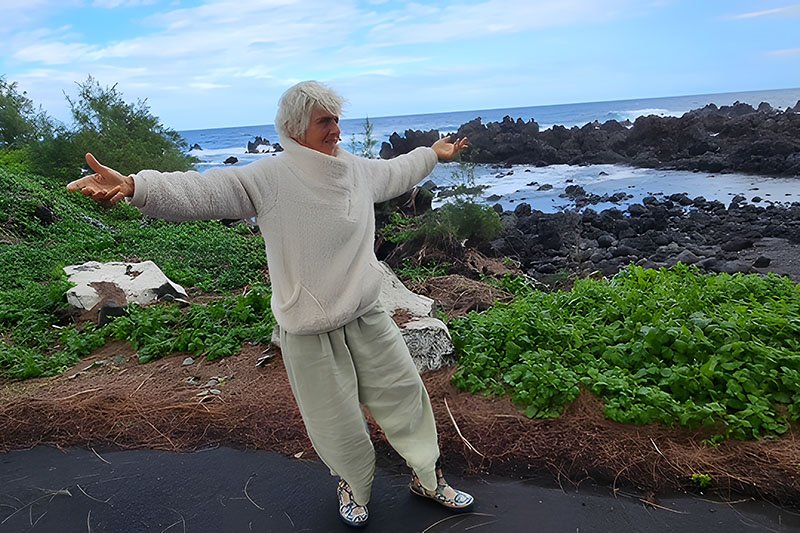
Photo by Molly Carney
Ecstasy in the Everyday
When Bodhi stopped leading ecstatic dance, she did not leave the work so much as let it seep into every corner of her life. “For me, when I look back at what it was, it gave me, in a way, a curriculum, a pedagogy, a way of knowing my own self that then took me in many other directions,” she reflects. “From ecstatic dance, I feel like it came down to, ‘You must live this in your life,’ rather than being something that happens on Sunday morning.”
That calling drew her into land-based practice and education. She became deeply involved with the permaculture movement on Hawaiʻi Island, working with the late medical anthropologist Beatrix Pfleiderer on a program they called The Earth Speaks. Together, they wove movement, breathwork, chakra mapping, and hands-on work with soil, helping participants experience “how important it is for the wholeness of a human being to be in a continuum and interdependence with the earth.”
In her own life now, ecstatic dance rarely involves a sound system. “I try to acknowledge my own movement in my life as my own ecstatic dance every day,” she says. “It’s not necessarily formal with music. It can be just walking my dog. It can be just being in my garden.” The circle that once gathered on Sunday mornings has rippled outward in Bodhi’s life to chopping wood, carrying water, tending plants, and listening to the island’s rhythms under her feet.
Keeping the Medicine Kind
For Bodhi, ecstatic dance is a question lived through the body. “I think it’s an embodied inquiry into the deeper questions of ‘Who am I?’ and ‘Who are we?’” she says. “There is nothing that is more relevant than the commitment to that question.”
“If the ‘Who am I?’ question just stays mental, then you’re just going to go along with the fabric of the mind,” she notes. “As you’re allowing a let-go into movement, there’s also always an invitation. The deeper I let go, the deeper I can also witness. And that’s not a mental thing.” She calls that quiet witnessing “stillness.” “At the heart of stillness,” she says, “is ecstasy.”
Bodhi resists ranking some practices as higher or more refined than others. “I don’t have a value judgment,” she says. “We are all in a circle with each other and have so much porousness with our own movements. Any judgment I have inside of myself about what’s good and what’s bad is going to get mirrored in a facilitation experience. Everyone in an ecstatic dance gathering comes to me as an embodiment of the sacred, whatever that means.”
Asked what she most wants to leave dancers with, she answers: “Keep the medicine kind. Movement is a gift; not everybody can do it for a whole lifetime. When a human being offers their movement — however small, even stillness — it’s a blessing.”
From her home on Hawaiʻi Island, she watches ecstatic dance continue to evolve, glad those Sunday circles helped set it in motion. The legacy she cares about most is quieter: circles where all ages feel welcome, judgments are soft, and attention is deep enough that, as she puts it, “Ecstatic dance isn’t something that happens at an event. It’s… life itself.”
~~
Bodhi invites readers to contact her at: bodhitaraishere@gmail.com.
Rashida Alisha Hagakore is an ecstatic dance facilitator, EFT (tapping) and meditation guide, and writer. With a background in business administration, she brings a systems-minded approach to consciousness work, braiding clear structure, deep care, and communal imagination into every space she holds.
Kathryn Dickason is a scholar and journalist who has published widely on dance studies and medieval studies, including her book, Ringleaders of Redemption: How Medieval Dance Became Sacred.
Comments are closed.
Responses
A beautiful article about a beautiful person!
Glad to read about Bodhi. Thanks.
Bravo 👏…lovely article and especially appreciate the emphasis on kindness …in motion❣️ Appreciate Bodhi’s reference to Bhagwan or Osho as he later became known after his passing – his “dynamic meditation” also seeded this ever-expansive, physical and somatic, non-verbal communication expressiveness we now call ecstatic dance. Mahalo Bodhi and Aloha to Kalani for being such a fertile place where both of you gave birth to what is today, so precious to the EXPERIENCE of community.