Creating Diverse Queer Representation in Ballet
June 8, 2026
An Interview with Adriana Pierce of Queer the Ballet
BY EMMALY WIEDERHOLT
Adriana Pierce is a dancer, choreographer, and director based in New York City as well as the Founder and Artistic Director of Queer the Ballet, an initiative working to make mainstream visibility for all LGBTQ+ artists a priority in the ballet sphere. Adriana shares her own history in ballet and the isolation she experienced in her queer identity, how she connected to other queer ballet artists and came to create a network, how she explored what it means to choreograph a pas de deux with both dancers en pointe, and how community building and social support are at the root of Queer the Ballet’s mission.
Note: This article was published in Stance on Dance’s Spring/Summer 2026 print issue. To learn more, visit stanceondance.com/print-publication.
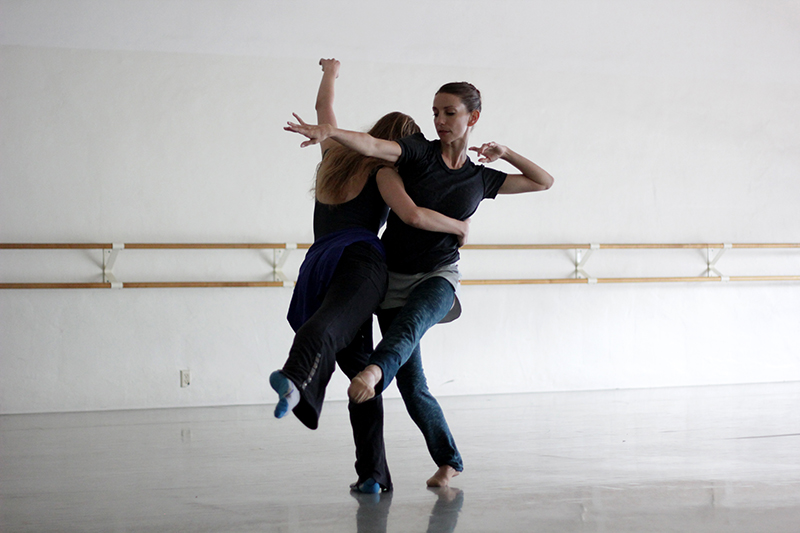
Adriana Pierce and Ashley Knox, Photo by Alejandro Gonzalvez
~~
Can you tell me a little about your dance history and what shaped you?
I grew up in New Jersey near New York City, and I grew up doing a lot of jazz and ballet, but my goal was to do musical theater. When I was young, I said I was doing ballet to help my jazz technique, but then I ended up auditioning for the School of American Ballet, got into the summer course, and then was asked to stay for the year, so by the time I was 14 I was commuting in and out of the city to train at Lincoln Center. That’s where I fell in love with ballet. I was at School of American Ballet for five years and then completed my apprenticeship with New York City Ballet. I went to Miami City Ballet and danced there for seven years. In 2017, I came back to New York to dance in Justin Peck’s Carousel. That was my full circle moment of doing the musical theater I always wanted to do. After that, I was in the West Side Story film and Fosse/Verdon on FX. Then the pandemic hit. It was interesting for the pandemic to hit at the peak of my performance career. I pivoted and started thinking about how I wanted to contribute to the dance field as an artist.
How did you get into choreographing?
I’ve been choreographing since I was a teenager. Outside of my academic and conservatory training, I was always doing more contemporary and interpretive projects. The first time I ever choreographed was a solo on myself when I was 14. I also choreographed some community musical theater during high school. The first time I choreographed a ballet was for the student choreography workshop at School of American Ballet. That was a big deal for me because it was the first time I was working with dancers wearing pointe shoes. It blew my mind and broke my creative world open. When I was 17 or 18, I knew I wanted to pursue choreography professionally. There was never a point when I was not choreographing even when I was dancing professionally. While I was dancing with Miami City Ballet, I was doing outside projects. I would choreograph pieces on the dancers in the company in projects that were not affiliated with the company and do things in the community with other arts organizations. I was cultivating my choreographic voice all the way through my professional career.
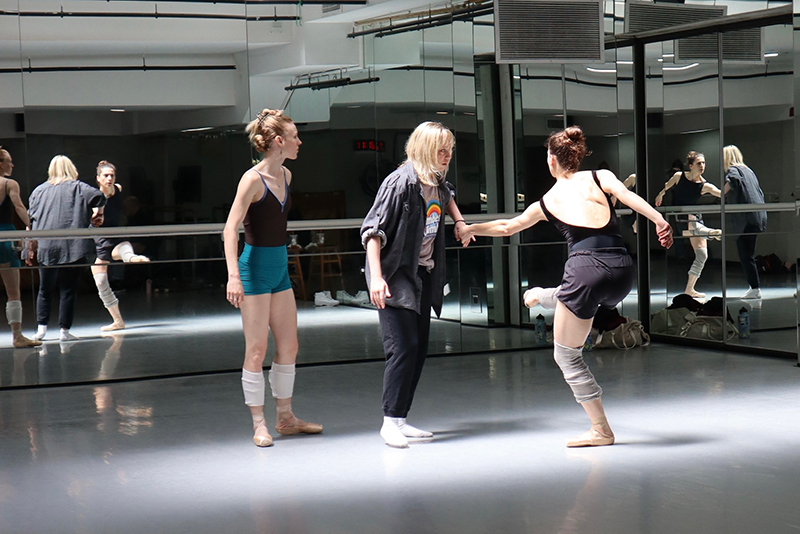
Demi Trezona, Adriana Pierce, and Lauren Flower, Photo by Rosie Elliott
What was the impetus for Queer the Ballet?
During the pandemic, there was an article that came out in Pointe Magazine about queer women in ballet. Although I had left my career in ballet, I had been one of the only queer women I knew working in professional ballet. The article asked, “Where are all the queer women in ballet?” It outlined a few who I didn’t know and who were younger than me. I felt like the conversation was always along the lines of, “Here are a few queer women, but where are the rest?” I wondered: Why aren’t we all talking to each other? Why have I felt so isolated in my queer identity in ballet? I reached out to a couple of the dancers who were profiled in the article and said, “Let’s talk.” We started getting on Zoom calls and just chatting. It was the first time I was part of a group of people where we were allowing our queerness to enter a ballet space. We were racking our brains trying to think of other nonbinary or lesbian dancers and asking if they wanted to join our Zoom. The group grew. There are actually quite a lot of queer people who are not cis gay men in ballet, but we haven’t been allowed to take up space.
I was inspired by those conversations. I was feeling connected and seen. I wanted to do something. It started out as just wanting to create a project. It was the middle of the pandemic, so live performances weren’t happening. It was an awkward time to figure out how to do work. I also realized there had to be some research done about what it means to create queer ballet. It started with just wanting to do a project but ended up being a much bigger thing. My main goal in the beginning was just to have the conversation, and to make it so that if someone goes on Google and types in “queer ballet” or “lesbians in ballet,” something comes up. That’s where it started, and it grew from there.
As a choreographer, what are some ways you create queer representation in your work?
The first thing I did was ask, “How does ballet function in a queer way?” That’s what I was focused on in the beginning. I was very fortunate to be granted a residency at the Bridge Street Theatre in Catskill, New York. It was during the pandemic. The residency was just me and two queer dancers from American Ballet Theatre. We drove up to Catskill and lived above the theater for two weeks. Every day we went downstairs and onto the stage. Literally, ballet step by ballet step, we figured out how to construct a pas de deux for two women en pointe.
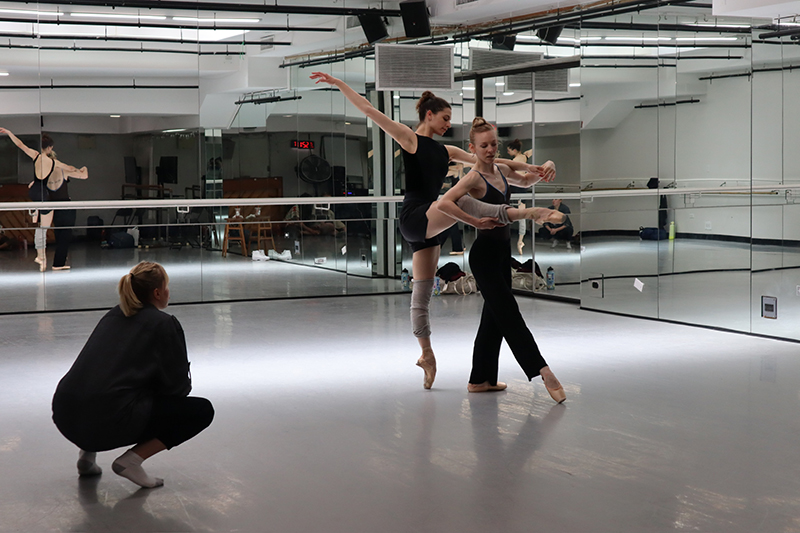
Adriana Pierce, Demi Trezona, and Lauren Flower, Photo by Rosie Elliott
I thought it would be easier than it was, and then I realized there are so many things to contend with. The pointe shoe is limiting in some ways, but also opens some possibilities, especially when you have two people in pointe shoes. I realized how much less grounded a pointe shoe is. Until I had two dancers in pointe shoes trying to hold each other up, I didn’t realize how much the person in the flat shoe has so much more agency. I wanted to know how that changes our bodies in the partnership. We are taught that the person in the flat shoe is the holder, guider, and manipulator. They are in charge. In the pointe shoes, we are being held, manipulated, and giving up agency. I was trying to find agency within the pointe shoe as opposed to something that is limiting or a gender qualifier.
The other thing I did was break down partnering in ballet into five pillars: lifts (any time one person is supporting another), turns (any time one person is stationary and the other is turning), promenades (there’s a level of support but both people are rotating together), counterbalance (playing with weight), and how the two people relate to each other (their connection, the story they are telling, their dynamic). When you see a pas de deux, you see these elements. Each step in the piece I created during the residency was an answer to those different pillars. I wanted to find something authentic to two women dancing together instead of slotting them into the pattern that we assume a pas de deux is. Women have a different distribution of weight and muscle strength, and we have been socialized a certain way. What can we do with the tools that we have? This piece was my answer to the traditional idea of what a pas de deux is but giving each partner equal agency.
The other part of Queer the Ballet that has become a huge focus is how vulnerable it is to be your full queer self in the studio, and what support is needed when you’re exploring that. A lot of the queer dancers I work with, it’s the first time they have ever been able to bring their full selves to the table. It’s thrilling and rewarding but also scary and can feel destabilizing. A lot of my work with Queer the Ballet has been asking how we have these conversations safely and offer support. We’re still learning. In 2024, I brought in queer dancers from all over the country to work together, and it was beautiful, but I realized we needed to have more support to hold space for how much it brings up. It’s not easy work.
I understand Queer the Ballet produces live performances, dance films, and classes. Are there specific projects or initiatives that you’d like to share more about?
We’ve always been project based. We’ve talked about expanding to a nonprofit but being fiscally sponsored and project based at this moment has allowed us to shift toward what the community needs. The past year has been tricky with the current political environment. When the president issued an executive order about there only being two genders, a lot of arts organizations clammed up with regards to giving funding. Focusing solely on creating performances hasn’t felt like the right thing. It’s been more about community building and support. In that way our community classes have been amazing by creating trans- and queer-inclusive spaces where people can just practice ballet. That can be very healing. We have a lot of projects planned and coming up, but right now we’re focused on community support in a difficult time, especially with the attacks on the trans community.
I can’t overstate how powerful it is to just be queer in the ballet studio, to feel fully seen, instead of fitting into this mold of a femme-presenting ballet dancer. I never felt seen that way as a professional dancer, ever.
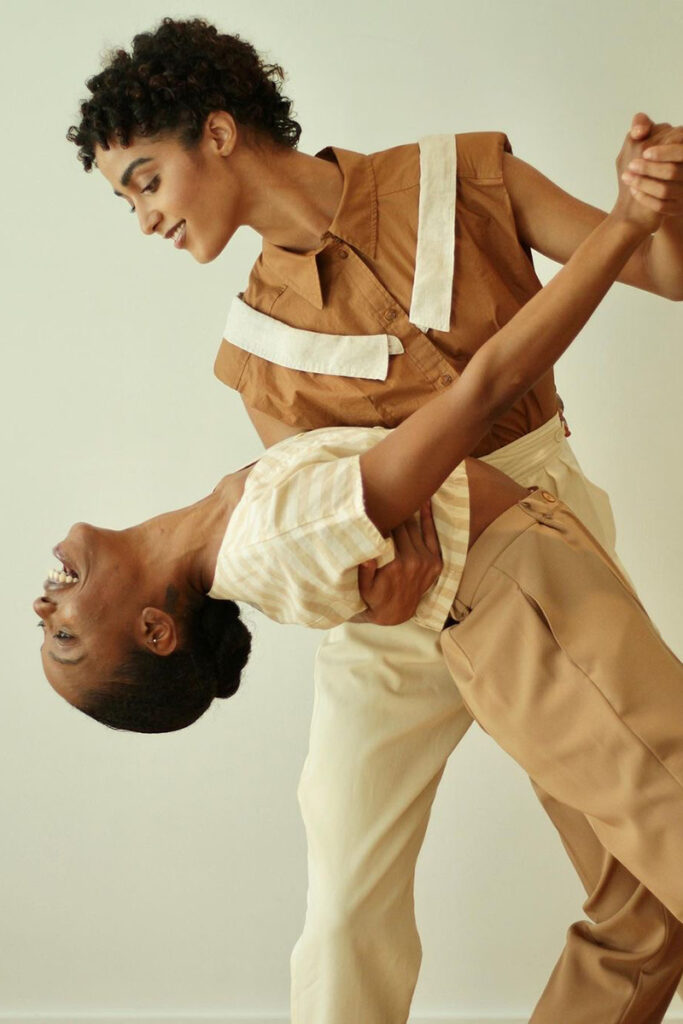
Cortney Taylor Key and Audrey Malek, Photo by Leigh-Ann Esty
Have you seen a shift in ballet in terms of queer visibility? How far has the ballet world come and how much further does it have to go?
In terms of queer visibility, it is often trans feminine people, or people who are assigned male at birth. I don’t see it going the other way. For trans masculine or nonbinary dancers, there doesn’t seem to be a path forward. I’ve been very encouraged by the broader conversation that I have proudly contributed to about queerness, but I still think that larger companies are hesitant to take risks. These companies that have endowments and are more financially stable can take more risks. After the pandemic, everyone was feeling energized by change and were thinking forward. I think that has chilled. I would like to see more explicitly queer works, not just with two men onstage, but different queer stories by different people. I haven’t really seen that yet. I’ve been pitching queer narratives with women, and it doesn’t seem like there’s a hunger for it. I’m going to keep trying though.
What’s next for Queer the Ballet?
We are in development for a big performance project that I am excited about. We are continuing our community program and developing new ways we can support the queer ballet community.
Any other thoughts?
When I was in a professional ballet company, I was isolated and felt alone in my identity. There are so many more dancers who are out now. I am very proud of our young queer artists who are living out loud. I want to make the professional world they are growing in a better place for them. I’m committed to kicking the door open and leaving it open. The young people coming up deserve to be seen and grow into their fullest artistic and personal potential.
~~
To learn more, visit www.queertheballet.com.