It’s Never Too Late
May 4, 2026
Tales of a Midlife Dancer and Scholar in the Big Apple
BY RAVEN MALOUF-RENNING
Note: This article was published in Stance on Dance’s Spring/Summer 2026 print issue. To learn more, visit stanceondance.com/print-publication.
I have a confession: deep down, for my entire life, I’ve always been a nerd. Libraries get my juices flowing, and intellectual discussions are my bread and butter. For me, nothing has ever been more exciting than getting ready for the first day of school. I love every part of the ritual: shopping for back-to-school clothes and supplies, going to the bookstore and getting the books I need for the semester, and, best of all, getting brand new notebooks and pens in anticipation of notetaking while reading, studying, and participating in seminars. When I was an adjunct lecturer at California State University, East Bay, I got a vicarious contact high from starting a new semester with students and helping my co-professor, Eric Kupers, put together the syllabus for the new semester. I found myself buying a new notebook and fresh new pens for the occasion, and relishing student intros where they told us about themselves and their artistic and scholastic pursuits. That had been a constant in my life in some form from 2016 to 2023. However, in the fall of 2024, just one day after Labor Day, I stood at the front door of my Manhattan apartment as my wife snapped a picture of me wearing my New York University Tisch School of the Arts T-shirt, my student ID on a lanyard, and optimistically clutching my Performance Studies tote bag which contained my laptop and the aforementioned blank notebooks and fresh new pens. This time, I was the student instead of the instructor. At the age of 49, after 26 gap years, I was going back to school for an MA in Performance Studies.
I’ve often quipped that moving across the country from San Francisco to New York City and going back to school was probably the most positive and expensive midlife crisis I could have engineered for myself. On the one hand, I can imagine how it sounds to people who might scratch their heads wondering why I would upend my established life in San Francisco where I had a comfortable home, a community I’d built over the past two decades, and a cadre of collaborators who had seen me through some of the best and worst times in my life. Someone who values safety and security might wonder why I’d give all that up in order to chase a dream. To that, I’d answer that comfort and predictability when out of balance can breed complacency and stagnation. By the fall of 2023, the dance residency that had fueled my independent creative work for nearly four years was coming to a close. My creative arc there had run its course. In addition, budget cuts and fee hikes were looming at CSU East Bay, and as a part-time adjunct, I would be first on the proverbial chopping block. In addition, I had been feeling the pull to relocate to New York City since 2018, and the call had become so insistent that whenever my plane left the tarmac at JFK International Airport, I would burst into tears. I had several very clear signs that I needed to make a change in my life, and soon. I talked it over with my wife, who was and continues to be extremely supportive and fully on board.
I applied to the MA in Performance Studies at NYU Tisch that fall, thinking it would be a long shot, but I’d carefully researched the program for several years and knew it was where I wanted to be. I knew I had some stiff competition, so I tried to be realistic about my chances. In March 2024, after taking an online dance class, I received a notification that there was an update to my application status. I signed into the portal, clicked the link containing the update, and there, with a burst of virtual confetti, was my acceptance letter. I remember joyfully screaming for about five minutes before I could squeak out to my household, “I got into NYU!” The following months heralded a flurry of activity: culling and packing everything we owned, apartment hunting, hiring movers, getting travel certificates for our three cats, and the poignant parade of goodbyes we shared with our Bay Area community, the largest of which was a heartfelt performance ceremony held by Eric Kupers and our beloved ensemble.
There was onboarding to be done with student loans, registration, getting my student ID, and a host of other activities NYU needed from me in order to successfully matriculate. That was probably the steepest learning curve for me, especially given that the last time I had been enrolled in higher education, all bureaucratic forms were handled either on paper or over the phone. Luckily, I had support from my administrative advisors in the Department of Performance Studies to help me adapt and navigate the inevitable hiccups that online forms tend to bring. Finally, the Wednesday before classes started, I met my MA cohort in person for the first time and was already making friends with a handful of the folks there. We were about to embark on the ride of our lives.
Since I arrived in New York, I’ve often quipped that I live with one foot in academia and one foot in the dance studio. I need both in my life in order to critically think about the world around me and then metabolize it into art.
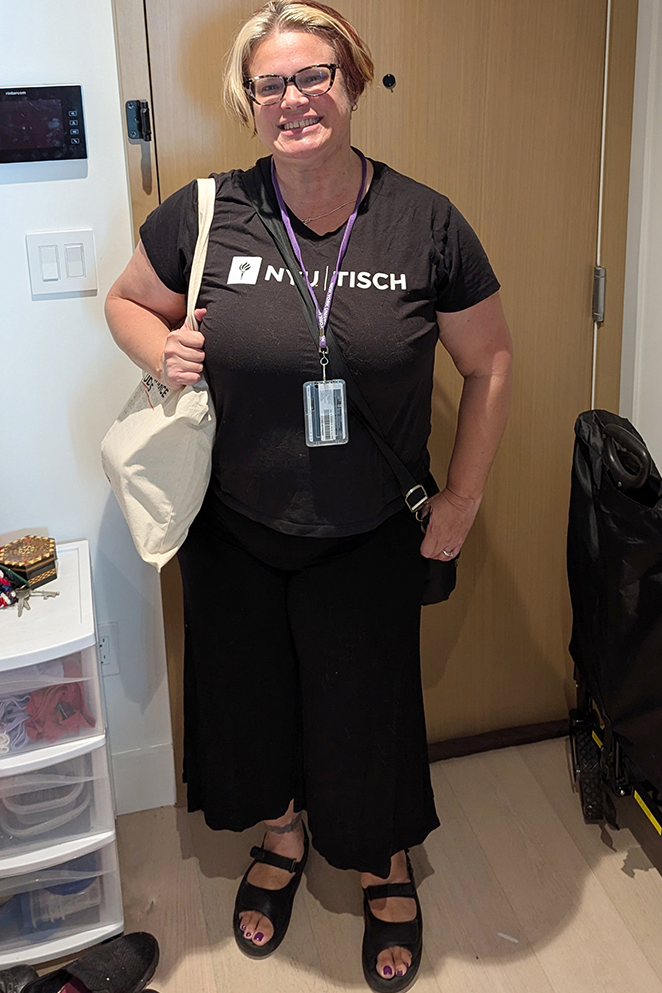
Raven by the door for their first day. Photo by Micharelle.
One Foot in Academia
I was part of a cohort of 28 people of various races, nationalities, and artistic disciplines, ranging in age from 51 to 22. I was the second oldest in my cohort, and the oldest by far among the handful of dancers in the group. Coming back to academia with half a lifetime of experience between my undergraduate and graduate years served me well, as did my unceasing thirst to learn more about the world around me. I leaned into my decade of experience in inclusive performance practices and made it the focus of my research for my master’s thesis project. My goal was to explain the work I’d been doing to academics, while simultaneously thinking through the “why” of what we do through the intersecting lenses of Dance Studies, Disability Studies, and Queer and Trans Studies. Part of the beauty of this program was the flexibility I had to choose my own adventure; the only required classes that the whole cohort took together were Intro to Performance Studies and the Thesis Project. The remaining units were electives that we could select based on our own research interests. I didn’t merely keep up. I thrived. I maintained a perfect 4.0 GPA throughout the program and won the Graduate Performance Studies Award for my research into disability arts.
In addition, I was elected one of two MA representatives of my cohort to act as liaisons between our cohort and the department faculty and staff. It was a role I felt comfortable in, as I had been well prepared by my associate director role back in California. In addition to a check-in every semester, my counterpart and I held several artist salons in the spring semester so that our classmates could share their works in progress, whether they be artistic, academic, or a bit of both, and get feedback on their work. I also got to present my work at a student conference, which felt like a rite of passage since it was the first presentation I’d given to the public on inclusive dance without Eric and our ensemble. Our studies culminated in June 2025 with a two-day symposium where we presented our research to the public, either in traditional conference style or in broadly construed modes of performance. I had the honor of closing out the symposium and our time in the program.
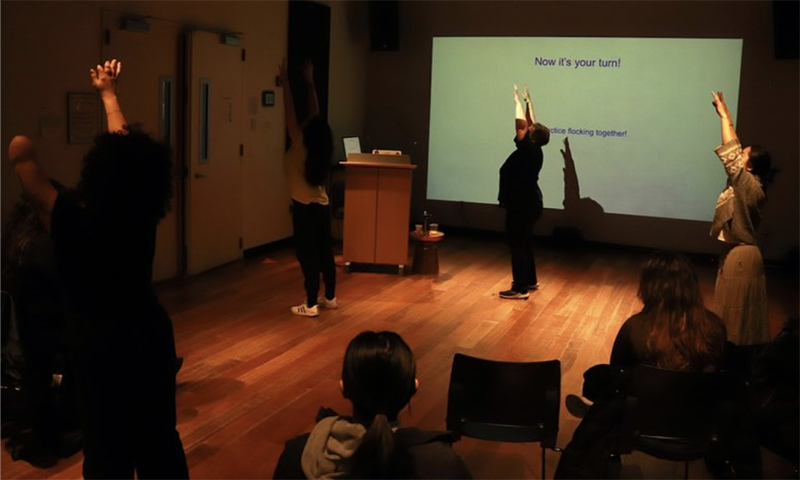
Participants from Raven’s workshop at PRAXIS, INC in March 2025. Photo by the NYU Department of Performance Studies.
One Foot in the Studio
My time in the program was very brain-intensive: we read dense theoretical texts by thinkers including but not limited to J.L. Austin, Jacques Derrida, Judith Butler, Franz Fanon, Theodor Adorno, Denise Ferreira DaSilva, Arseli Dokumaci, and many, many more. We had deeply involved discussions about the material in our seminars, in study sessions, and in evening lectures. We attended performances and happenings around New York City to contextualize what we were reading into embodied art, whether that was traditionally staged productions, the performance of everyday life, or everything in between. My intellectual muscles were being trained for the academic equivalent of a dance marathon.
Being a lifelong mover, having time in the dance studio to metabolize everything I was learning was essential to my sanity as well as my need to somatically integrate theory into practice. To fill that need, I turned to dance classes at Movement Research, a dance organization in New York’s East Village that advertises itself as “one of the world’s leading laboratories for the investigation of dance and movement based forms.”[1] The organization’s radically inclusive approach to dance appealed to me, especially since as a middle-aged dancer navigating chronic pain, injuries sustained from abusing my body when I was younger, and neurodevelopmental disabilities, any dance space I enter needs to be grounded in disability culture values.
I got so much out of every class, but the teachers I returned to again and again were Luciana Achugar, Ogemdi Ude, and Christopher “Unpezverde” Nunez. Achugar’s classes center around a somatic inquiry she calls the “Pleasure Practice”[2] which encourages the re-wilding of the body, “searching for an undoing of power structures from the inside out.”[3] Taking her classes in the fall of 2024 was the highlight of my week; after spending the week dissecting dense theoretical texts, I could surrender to the pleasure of moving from my spine, my feet, my shoulders, or wherever the focus was in the moment. In one memorable class, Achugar invited us to let our spine be a creature. For me, this class represented the epitome of Mary Oliver’s exhortation to “let the soft animal of your body love what it loves.”[4]
Ogemdi Ude’s classes, called “Forget How To Dance,”[5] explored that dreaded space every dancer has faced at some point during their career: forgetting the choreography. Her classes were an invitation to see what emerged in the space of forgetting when we get out of our own way.
And last but certainly not least is Christopher “Unpezverde” Nunez’s class in his Vortex[6] methodology, a haptic method for learning dance that he developed as a visually impaired dancer which decenters sight as the primary mode of choreographic and pedagogical transmission. It has been and continues to be pivotally life changing for me.
Life After Grad School
Even though my MA was conferred in August of 2025, I still retain my identity as an artist and scholar. Artistically, I continue collaborating with Eric Kupers at a distance, and I’m currently working for Christopher “Unpezverde” Nunez as a performer and collaborator in his new work Tamata, which will premiere in New York City in the summer of 2026. Academically, I do research and archival work for both choreographers, and I recently joined the editorial staff of the Women & Performance Journal as a reader who helps to determine whether a submission is ready for peer review.
Yes, I upended my comfortable life in San Francisco to move across the country and take risks I only ever dreamed of before. I’m glad I did, because what I sacrificed in comfort, I got back in spades in opportunities for personal, academic, and artistic growth. The Big Apple is a demanding companion to be sure, but I can’t imagine my life without it pushing me to be better, think wider, and dream bigger. If that’s my midlife crisis, I can’t think of a better way for it to come about.
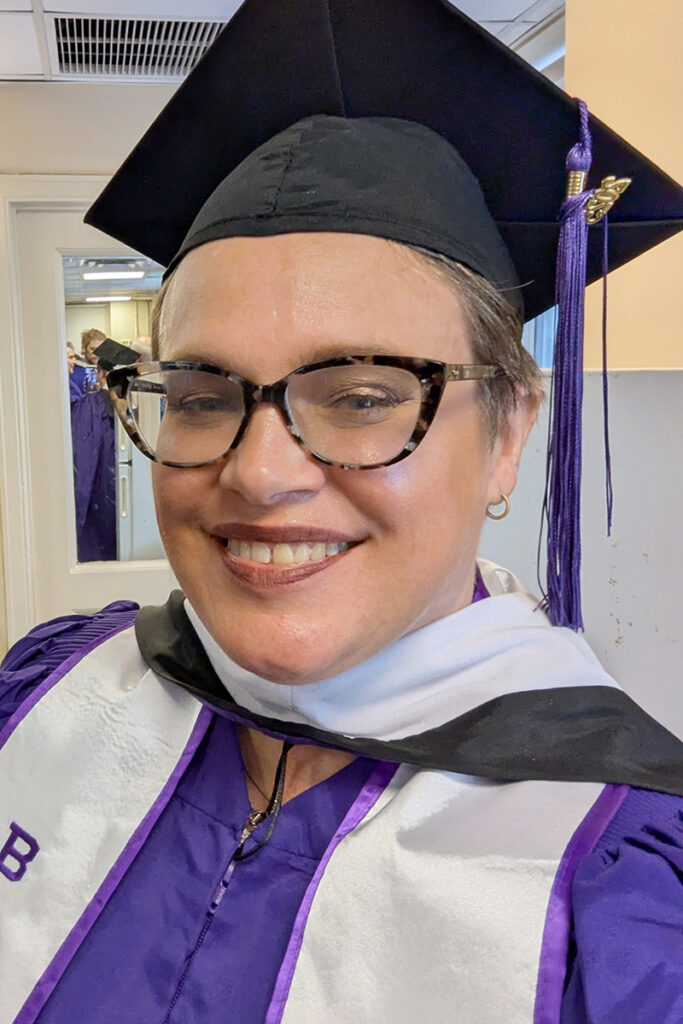
Self-portrait of Raven in graduation regalia backstage at Radio City Music Hall.
~~
REFERENCES
“About Us.” 2025. Movement Research. August 25, 2025. https://movementresearch.org/about-us/.
“Luciana Achugar.” 2025. Movement Research. May 30, 2025. https://movementresearch.org/people/luciana-achugar/.
“Morning Class: Forget How to Dance.” 2024. Movement Research. December 5, 2024. https://movementresearch.org/classes/2756/.
Oliver, Mary. 1986. “Wild Geese.” Dream Work. Boston: Atlantic Monthly Press.
“The Pleasure Practice: A Spell for Utopia.” 2025. Movement Research. March 21, 2025. https://movementresearch.org/workshops/2857/.
Unpezverde, Christopher. 2019. “Christopher Unpezverde Núñez.” Christopher Unpezverde Núñez. 2019. https://www.unpezverde.com/vortex.
~~
[1] https://movementresearch.org/about-us/
[2] https://movementresearch.org/workshops/2857/
[3] https://movementresearch.org/people/luciana-achugar/
[4] Oliver, Mary. 1986. “Wild Geese.”
[5] https://movementresearch.org/classes/2756/
[6]See Nunez’s website for a detailed description of his methodology: https://www.unpezverde.com/vortex
Comments are closed.
Responses
I am beyond proud of you. I’ve known you since elementary school. Witnessed, watched,admired, learned and have been awe inspired by you. You rock, are an a amazingly strong person and am lucky enough to have been in your presence to grow from.