Dancing a Mercurial Legacy
April 27, 2026
An Interview with Rachael Dichter, Co-Artistic Director of GRAVITY
BY COURTNEY KING; PHOTOS BY ROBBIE SWEENY
In December 2025, I interviewed Rachael Dichter, Co-Artistic Director of Jess Curtis/Gravity, now GRAVITY. Jess Curtis unexpectedly died on March 11, 2024, in San Francisco, California. Rachael and I talked about the legacy of Jess Curtis, the organization and programs he built, what the company is up to now, and the grief process.
I met Jess Curtis around 2015 when I was house managing at CounterPulse, and later, in 2017, I overlapped with him and Rachael for about a week at Impulstanz. When I lived in San Francisco, Jess was a staple of the dance scene, and I saw him or circulated around him often. My interactions with him were brief and not particularly personal; however, they were impactful. His energy, humanity, warmth, humor, and kindness felt monumental and inspiring. Rachael refers to his physical presence in our interview, and I echo her sentiment. Jess felt large, almost moon-sized, and felt as if he contained all the magic the moon promises.
Note: This article was published in Stance on Dance’s Spring/Summer 2026 print issue. To learn more, visit stanceondance.com/print-publication.
~~
When I watched the Jess Curtis Memorial Video, I saw you in The Dance That Documents Itself from 2014. He talks about how he wants you to hear from all your friends about how incredibly fierce a performer you are, and about being happy. When and how did you start working with Jess Curtis?
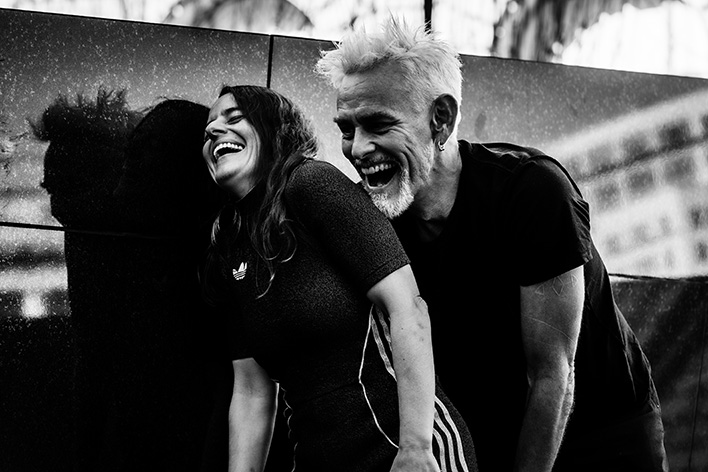
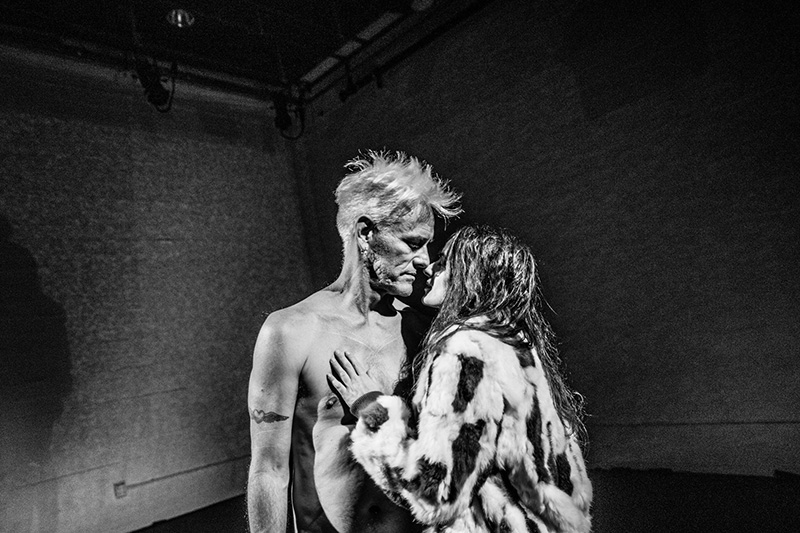
In 2010, Jess moved back to the Bay Area more full time. He always worked and lived between San Francisco and Berlin, and was casting for a project at Yerba Buena Center for the Arts. He’d seen me on stage before and asked me to join. We immediately started dating. So by The Dance That Documents Itself, we’d been working together about four years. The duet you’re mentioning was called When I think of you you’re naked (2013). We both stood on stage facing out to the audience, him naked, me not, and it was improvised each night. We traded lines, always starting with “I want you to…” That night, he ended by saying he wanted me to be happy.
How would you describe Jess’s work?
It changed so much over the years. In Jess’s earlier work, it was often about him giving his body intense physical experiences that were directly communicated to the audience. He was always very concerned with what the audience received. You could feel him pushing physical, emotional, and sometimes psychological boundaries, and then striving to translate that risk-taking to the audience. Over time, the work moved from extreme physicality to subtler explorations. He became very interested in the inner workings of his physical, emotional, and psychological experience.
As he continued, he became interested in differing experiences and how to communicate different ways of perceiving. The last three group pieces he made were performed in darkness by casts of blind and low-vision dancers, as well as sighted dancers. They were created for blind and low-vision audiences and to give sighted audiences the opportunity to experience dance through senses other than the visual. He asked, “What’s interesting about dance when you can’t see it?” We worked a lot with sounds and tactile elements, touching the audience as we moved.
I guess the thread might be: how to communicate the human experience in a simple and direct way. He was often practical about it. His work was very emotional, but it also had a measured quality.
There was a series of duets he made with a friend, Jörg Müller, called Performance Research Experiment #1 and #2.2 (2006–2014). Performance Research Experiment #2.2 was a simple performance of actions. Audience members were hooked up to heart rate monitors. The results were projected on the wall, recording people’s reactions to a series of actions: whipping, Jess marking his body with a bleeding pig’s heart, making it look like he was going to smash his thumb with a hammer, and hugging audience members. It felt like a scientific dissection of human nature. He was very interested in: “What am I doing on stage? How can I communicate it to you so that you feel it in your body, and what will make you feel the most in your body?”
When I watched some of the old videos, I could see what you’re talking about. The one that moved me the most was Ice Car Cage (1997). I wish I could have seen it live, because even watching it on video, I could feel it when his skin pressed into the ice. It’s really intense.
When I saw Miguel Gutierrez recently, he mentioned a project you are organizing for and around Jess Curtis. What is the project?
GRAVITY is producing a spring season called OUT/OF|THE\FOG, May 18 through August 20, 2026. It will include a reimagining of Ice Car Cage, now ICE. CAR. RAGE. The last performance Jess was working on was a reprisal of duets from his work over the years. He’d already asked a few people to participate, and we’re continuing this work with a performance called Duetrospectives, where five artists will present responses or reimaginings of the original duets they performed with Jess.
We’re also partnering with ROT Festival, formerly Kathleen Hermesdorf’s FRESH Festival, to host three weeks of classes with international as well as local artists. The weekend of May 28 through 30 will be the performance, Duetrospectives, which will include the piece Miguel mentioned, Not a Prayer (1995), a trio choreographed by Jess. Then there will be four other pieces that were originally duets, with Sherwood Chen from Paris, Claire Cunningham from Glasgow, and Maria Scaroni and Steph Maher from Berlin, and I’ll be performing a solo version of When I think of you you’re naked. From June 5 through the 7, we’re partnering with Fort Mason to produce ICE. CAR. RAGE. in their parking lot, with the cast of the RUPTURE collective, a local five-person Black collective including Gabriele Christian, the other co-artistic director of GRAVITY. Then we continue our partnership with Fort Mason with a visual art show, PLEASE. STAY. TOUCH., June 15 through August 15, of Jess’s work, its roots, and how that legacy continues. We’re excited to share this season with the community.
As performance by nature is ephemeral and mercurial, how are you approaching remounting Jess’s work? What are your thoughts on retrospective work? And, how do you stay true to an avant-garde vision?
I feel like it’s a question I’m always engaged in on some level – how to carry the past and keep growing.
After Jess’s passing, we were immediately interested in continuing his vision for Duetrospectives. It felt like a way we could carry the torch. Jess always worked very collaboratively, and all these duets were co-choreographed. He tended to make work with his partners and friends, so there was something about the relational. In the end, the people who worked deeply with him are collaborating to decide what lives on.
In some cases, these were duets that happened 25 or more years ago, so we were interested in the questions: What does time do to memory? What does time do to your interest?
It feels more like a living tribute. We could have decided to simply recast the duets. That would have been another choice around legacy. But the gifts we got from working with Jess were the ideas of experimentation and change. So, I think we’re all asking the question: How do we keep that alive in honoring his legacy?
Jess passed unexpectedly at 62, but he was already thinking about transitioning out of the company. He would eventually have been looking to pass it on to somebody else’s artistic vision.
He was always very interested in what the younger generation of artists around him was doing. He had fiscally sponsored artists with whom he had strong relationships, and he was always excited about what was coming next. The kind of structure he set up to support younger artists and provide access services continues to vibrantly morph, change, and grow.
Practically and administratively, as you are the co-artistic director of GRAVITY, how are the legacies of his programming and access services maintained and evolving?
In deciding to continue GRAVITY, we moved to a diversified leadership model immediately. We now have a five-person administrative team that produces work by Gabriele and me, as well as our fiscally sponsored artists, and we provide access services through audio description of live performances throughout the Bay Area. We have also continued to prioritize hosting and producing international artists. That was always very important to Jess: championing international exchange between the Bay Area and other parts of the world. Thus far, the vision is quite similar, but the day-to-day is different, as it follows a shared leadership model.
Most people thought GRAVITY would end with Jess’s passing, as it was a founder-led organization, and that it would make sense to sunset it. But a feeling persisted that there was a way to carry on working and to honor the memory.
I’m so curious what it feels like for you to work on these upcoming projects, having had such an intimate relationship with Jess.
We were together for 12 years. He was such a big presence. There’s a way in which I feel like I know his history more than I know my own. His life was big, and I knew all of it. So I’m living in that memory. When someone is no longer physically present, when they pass, there’s an enormity that’s hard to talk about, or even to name. Death is so strange. And so mysterious. On a personal level, in facing something that feels so big, any forward movement feels like progress. When you lose someone you are so intertwined with, understanding how to stand up and take a step forward at all feels like a lot.
I was rehearsal directing and dancing in the last show he made in 2023, a few months before he passed. One day after a difficult rehearsal, he said to me, “At the bare minimum, you’ve gotta promise me that you have this enough that if I die tomorrow, you can put the show on.” He never talked like that, so it struck me as very unusual. I said, “Yeah, okay, we got this, but Jess, if you die tomorrow, putting this show on is the last thing I’ll be thinking about.” And he got angry, which was out of character, and said, “No. You have to know me better than that. You have to know it’s what I would want.” I remember thinking, “Okay, this is a real conversation.” In the wake of his passing, when everything felt disorienting, I remembered that conversation.
Death is so unknowable. I don’t think there is any way to make sense of somebody being there and then not being there. It feels lucky to have a way to engage with the beautiful memories we all have of that time. It feels like a way to honor it all.
I think all of us feel OUT/OF|THE\FOG will work the magic of moving us forward – through a process, though none of us know exactly what that process is. This show is a loving, a remembering, and a looking back to look forward.
I was doing another interview about GRAVITY, and they asked about the idea of genius and what Gabriele and I thought about it. I have always been interested in the idea of “scenius” instead of “genius,” that it’s a scene that often produces what we call genius. Jess would always say his biggest strength was getting smart people in the room together and getting out of the way. He had a very light touch in terms of how he worked with people. Gabriele and I are looking to carry that forward.
Jess had access to a lot of resources that many artists don’t, and he was always interested in how he could share those resources. We’ve inherited some of that legacy. Obviously, the funding structures are different now, even a year later. Who knows what the future will hold? We’re trying to use whatever resources GRAVITY has to uplift voices that don’t have the same kind of opportunities and who we feel are doing interesting and groundbreaking work in different areas.
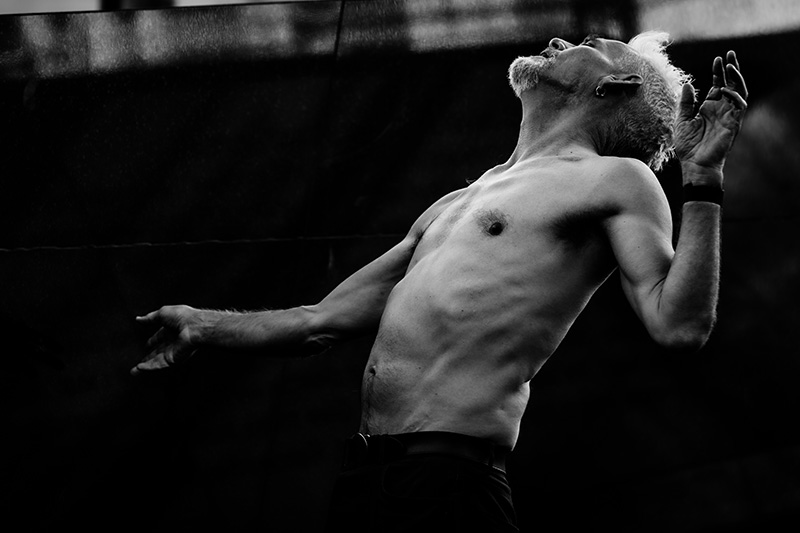
In the contact improvisation world, they used to call Jess’s back “the playground.” He was known as that. So much of what people seem to remember about him was his physical presence, his size, the way he smelled. He was a physically embodied person.
What is the legacy of that? We don’t have a translation. How does the sand trickle down around a body and into the bodies around them, and how does that sand trickle into the bodies around them? That magical process is the only real legacy.
~~
To learn more, visit www.gravity-sf.org.
Comments are closed.
Responses
Thank you for this interview—full of grace and love and insight into grief, loss and legacy. The phrase —feel the sand trickle down around a body and…those around—is powerful! I’m excited to see the show soon!