Facilitating Human Communication and Connection
April 6, 2026
An Interview with Kevin Iega Jeff
BY EMMALY WIEDERHOLT
Kevin Iega Jeff is a choreographer, director, and dance educator based in Chicago with a long history of building and directing institutions that have shaped Black dance in America, including JUBILATION! Dance Company in New York City and Deeply Rooted Dance Theater in Chicago. Iega has recently been commissioned by New York Theatre Ballet to create a new work, Noi-Tar-Gim, that will be presented in the company’s upcoming production Legends & Visionaries on April 10-11. Here, Iega shares what the institutions are that shaped him, how his father’s migration out of the Jim Crow South was the impetus for Noi-Tar-Gim, and why he is working to preserve his legacy.
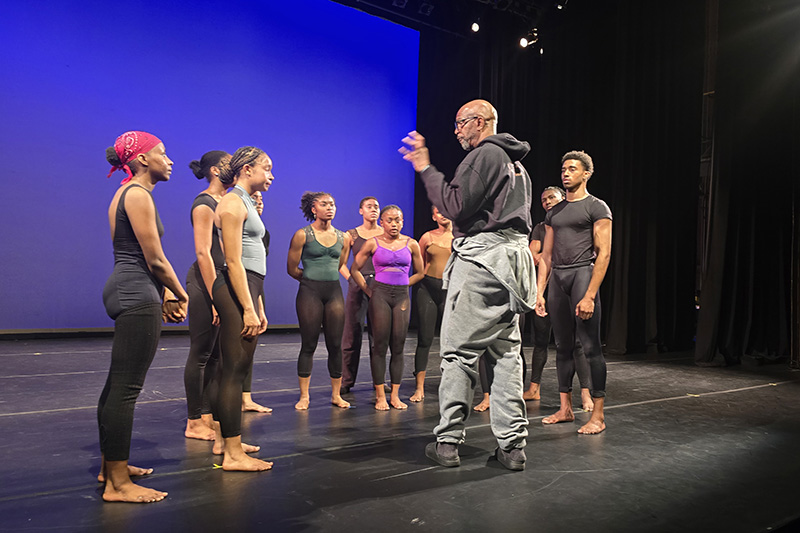
Photo by Black Pearl
~~
Can you first tell me a little about your dance background and what shaped you as an artist?
Basically, five institutions shaped me. The first would be the Bernice Johnson Cultural Arts Center in Jamaica, Queens, New York. BJ’s students went on to do incredible things that shifted the paradigm of dance in America. Her studio was legendary. My mentor was Lee “Aca” Thompson, who was critical in giving me a foundation of understanding that this art form is not only about performance but human and community development.
I was lucky enough to get into the High School of Performing Arts. Fame was shot the year I graduated. I also trained at the Alvin Ailey American Dance Center. Upon graduating, I went into a production of The Wiz while I was also attending The Juilliard School. I appreciated the balance.
The last to shape me was Madame Darvash. She demystified ballet in a way that was revolutionary and helped me connect the dots to my training in various traditional African forms, jazz, ballet, Broadway commercial dancing, as well as Limon, Graham, and Horton techniques. I was lucky to grow up in a city like New York where the ecosystem worked to build dancers and the studios had some sort of bridge to each other.
When I graduated from Juilliard, I was on a trajectory to join the Ailey company, but I redirected myself. I wanted to explore more behind-the-scenes work in choreography and teaching. My mentor, Lee “Aca” Thompson, showed me how dance can change lives and how I have the ability as a teacher to use the art form not just as a standard of professional excellence, but also as a process for intentional human development. So often, I would see dancers achieve artistic excellence but not have a sense of who they are as people at the core of the work. I couldn’t see myself dancing in places where I wasn’t growing as a human. I saw dancers sacrificing their humanity and their sense of self to please companies, in my view to a detriment. I wanted to envision a process and an organization that would take the whole person into account, specifically through the lens of being a Black dancer.
So when I was 21, I formed JUBILATION! Dance Company in New York City. We did quite well. We toured internationally for seven years. The company had a 10-year trajectory before we ran into the AIDS epidemic. We lost a lot of the human infrastructure that was the foundation of the company. It became too foreboding to go on.
That’s when I decided to take a pause and do more community focused work. During that bridge period, I was approached by Joseph Holmes Chicago Dance Theater about taking the role of artistic director. I took the job, but it wasn’t a good fit. Their infrastructure was so focused on a traditional model, it hindered the work I wanted to do around community development.
So I started Deeply Rooted Productions in Chicago with my colleagues Gary Abbott and Linda Spriggs, with LaVerne Alaphaire Jeff (my sister) and Diane Shober providing management support. I forged relationships with these wonderful people that culminated in my inviting them to Chicago to join me at Joseph Holmes until we realized we needed another entity to continue to do the work that we wanted to do. We co-founded Deeply Rooted Productions 30 years ago as the nonprofit home for Deeply Rooted Dance Theater.
I stepped down as Artistic Director in fall 2019 and as Executive Director in fall 2022. During that period, I served as Creative Director, helping lay the foundation for the Deeply Rooted Center for Black Dance and Creative Communities, which is a nearly $25 million project. We are developing a state-of-the-art facility designed to serve as a home for the company, as well as partner dance and cultural organizations. It will also be a home for archiving the history of Black dance and a home for interdisciplinary communal creativity.
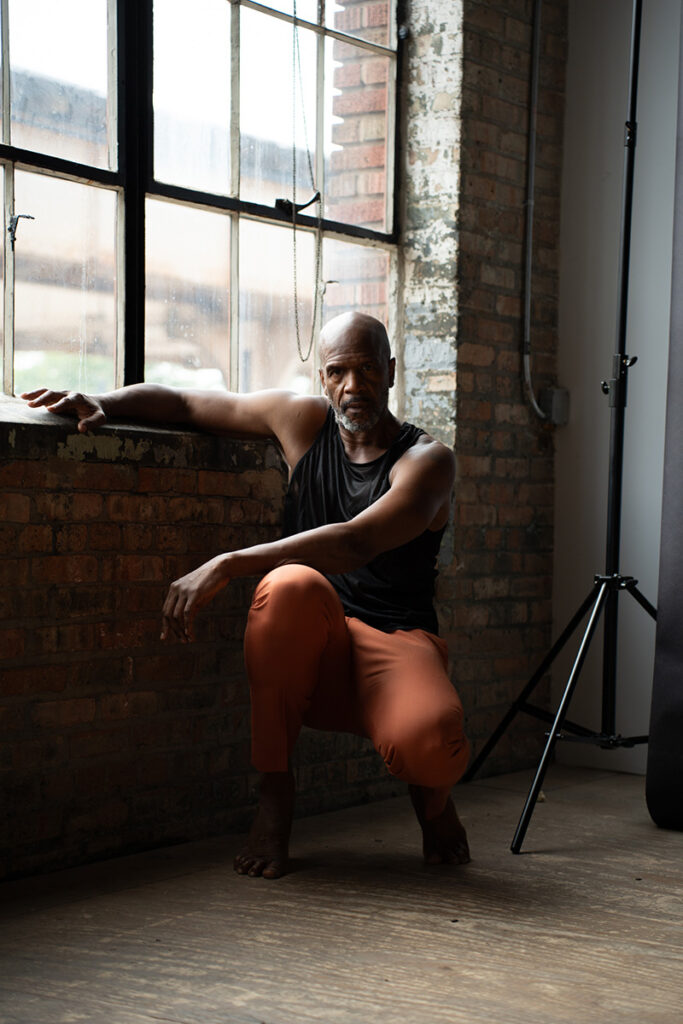
Photo by Michelle Reid
You’ve done some very high-profile work but also have done some community-focused projects. What is the throughline in your work?
I come from a tradition where we value the power of creativity within each person. I believe that when creativity isn’t channeled constructively and aligned with each human being’s purpose, that energy may inevitably be expressed for harm. We all have the commonality that we are creative in some way. The more we understand the roots of our creativity, the more we can cultivate resilient people, thriving communities, and vibrant societies. I believe in excellence in dance as a means to challenge each person to become their highest self within their pursuits and aspirations. From there, those standards of excellence can serve as a bridge for meaningful human communication and connection. Then the art form advances us in ways that are deeply profound. That’s my overarching goal for what I do on stage and in process. Even though the product is important, I think process is equally important if not more.
What was the impetus for your new piece on New York Theatre Ballet, Noi-Tar-Gim?
Steven Melendez, who was the artistic director at the time the work was commissioned, had a concept called Letter to My Father. The idea was he would invite four choreographers, including himself, to choreograph a work inspired by that theme. That gave me my marching orders. He and I talked about it, and I decided I wanted to work with the gifted composer Darryl J. Hoffman. I would use my father’s story to create a work about a life in migration. At the end of his life, the reflections I witnessed in my father and within myself inform the piece.
What has been the choreographic process?
I didn’t know if it was going to be literal or abstract, but it ended up becoming more abstract because none of the dancers represent a visual image of my father. It didn’t make sense to tell a narrative story.
What is important about my father’s life is that he grew up in the Jim Crow South. He would talk about the dichotomy of living in the South where there was such joy and love within his community, but at the same time he was living in an environment of terrorism. How does one build a life where your life is threatened every day? Yet my father found a way to carve a life with happiness, hope, vision, and achievement.
Noi-Tar-Gim is “migration” spelled backward. I wanted to explore my father’s life in abstraction, examining through his story the energy and spirit of a life, as well as of lives in migration. What showed up for me are three different passages. The first passage is informed by his youth in the South. I remember my father told me a story about going to a juke joint on a Saturday night. Afterward he would walk home with his friends, since they didn’t have cars, and in the distance they would see car lights coming. They would get off the road and duck into a ditch because they didn’t know who was in the car. It could be someone from the Klan who wanted to do something harmful. They had just come from a juke joint, full of joy—walking down the road, likely flirting and laughing—when suddenly they must step aside to preserve their lives. It’s the stark dichotomy of existing within that charged, conflicting energy.
The second passage is about the actual migration. In the music, there’s a theme running through it, like a vehicle moving. The goal is to show the energy of life evolving, or migrating, through human lived experiences—a metaphor of movement, journey, and transformation.
The final passage reflects an arrival at one’s last chapter. My father lived a deeply successful life and expanded that sense of possibility for his children. Yet he was denied a full education; in that time, with a sharecropping father not far removed from slavery, survival—not schooling—was the priority. In order to survive, a lot of sharecropping families had to give their time to the earth. For some parents on the other side of slavery, getting an education at that time didn’t ensure you would eat. My father wanted to go to school, but my grandfather didn’t see the worth in it. He thought he was doing the right thing to ensure my father’s future. They had a lot of tension about it. How that informs the last section is my father always had this question about how much further he could have gone if he didn’t live in an environment that suppressed him. Maybe he would have realized some things earlier if he had the education.
In my own life, I can relate to my dad’s feelings. Although I’m fulfilled in my successes, I’ve had similar reflections because of systemic marginalization. Yet, because of the life he afforded me, I see the value of my life more than I think my father saw the value of his.
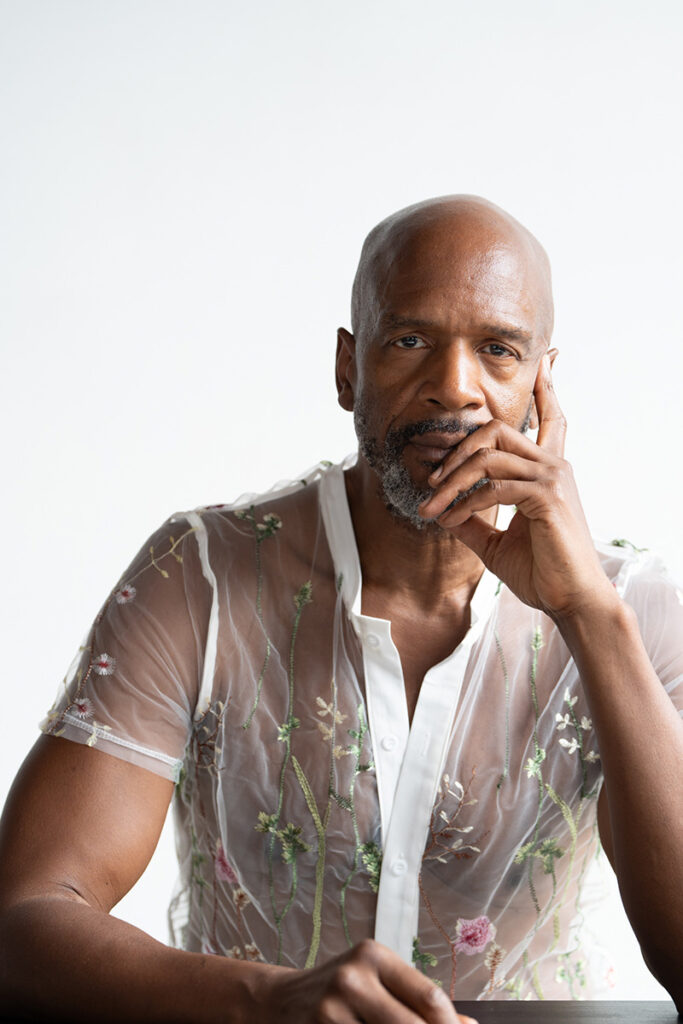
Photo by Michelle Reid
What do you hope audiences take away?
I want to be as clear as possible in my choreographic intentions, then I want to release any pre-prescribed attachment to how the audience feels about it. That’s not something I should be concerned with at this point. I am concerned with using my skills and gifts to be coherent in my intention. And after that, I hope the audience understands what I’m trying to say.
Is there something you hope the dancers take away from the process?
I hope they see how valuable they are. In some ballet environments, dancers are trained to be silent executors. In this process, I’ve tried to open the door to their voices more. An exquisite senior dancer amongst the group is Sarah Simon Wolff. She’s centered in the piece because I feel like there’s a throughline between her and my father’s spirit. With all the dancers, I wanted to inspire them to speak and share about themselves. I want them to know how important their voices are. I want the work to speak to their lives and their relationships. It’s inspired by my father’s experiences, but it’s not just limited to my father’s experiences. It has space and breadth for their experiences as well.
Is there anything else you’re working on that you’d like to share more about?
I’m 66 now, and I feel I’ve entered what I call my third chapter. My first chapter was as a dancer. My second evolved into a life as a dancer, choreographer, and builder of institutions. That journey began with JUBILATION! in New York, where I served as artistic director with management support, though in truth, in many intervals, I was functioning as an executive director before I had the language for it. With Deeply Rooted, I stepped fully into that dual role—executive director and artistic director—again supported by a strong team. Now, in this third chapter, what matters most to me is returning to a deeper, more centered artistic focus.
During this chapter, I aim to document, archive, and capture the legacy of my journey and works for future generations. I’m working on the iegaMOVES Legacy Project. The components are literally chronicling or archiving the legacy works that could live beyond my life. I also want to present curated performances drawn from my legacy works in the cities that have shaped my artistic life: New York, DC, Chicago, Memphis, and Dallas. These are the five cities where I’ve done significant work and had significant relationships that supported my work over time. My vision is that the performances will happen in each city, and that the performances will also be shot for public broadcast in partnership with a media partner in Chicago. All of that is what I’m working on now. But what’s super important to me, even more than my personal legacy, is curating an evening that uses my journey and my work to point to unsung, or less sung, voices that have impacted me and dance in America, especially Black dance in America. I want to shine a light on those souls who helped make me and my work possible.
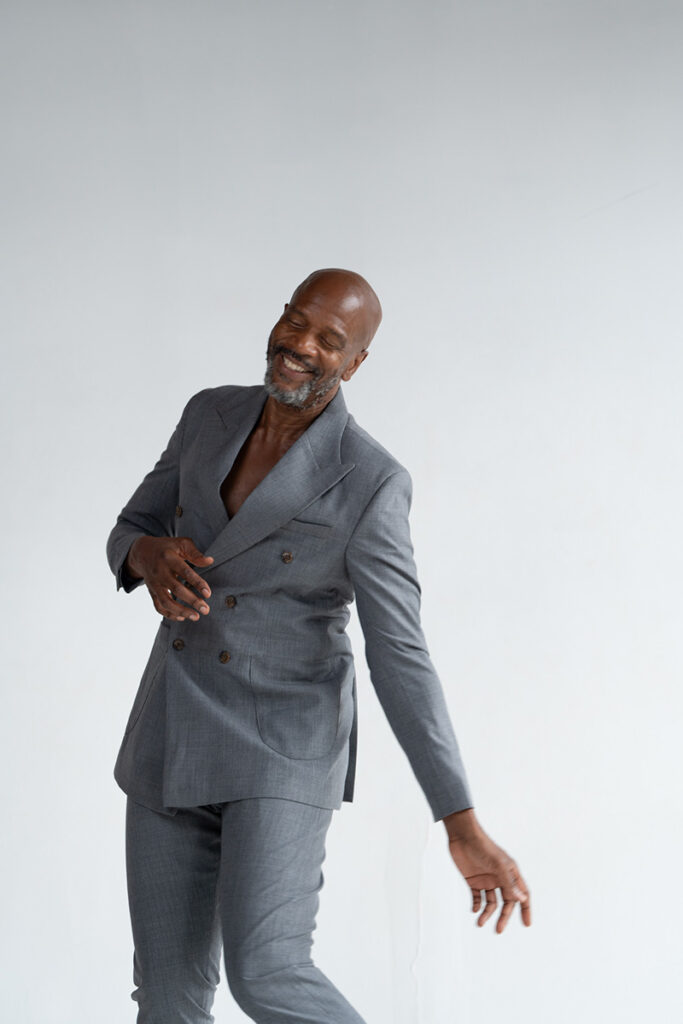
Photo by Michelle Reid
~~
Responses
There are no comments at this time.
Be the first to start the discussion by filling out the comment form.