Spreading the Joy of Rhythm and Movement
March 23, 2026
An Interview with Quynn Johnson
BY EMMALY WIEDERHOLT
Quynn Johnson is a master tap dancer and teaching artist based out of Maryland who uses rhythm and movement to tell stories in classrooms and on stages around the world. As co-founder of the nonprofit SOLE Defined, her work fuses tap, body percussion, and education. Here, Quynn shares how sand dancing has become a central part of her practice as well as how she approaches teaching literacy and math through tap dance.
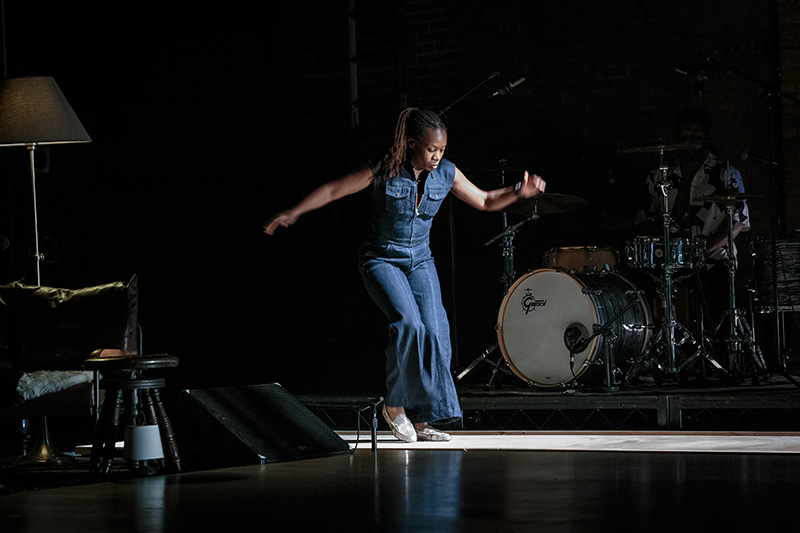
Photo by Tony Turner
~~
Can you share a little about your dance background and what shaped you as an artist?
I was born and raised in Flint, Michigan. My dance education started at Creative Expressions Dance Studio led by a woman named Sheila Miller-Graham. My tap education came from Alfred “Bruce” Bradley. That is where my initial love of dance was created. We studied ballet, tap, jazz, hip hop, and some cultural African dance. I learned how to express myself in a positive way. It gave me a voice when I was too shy to speak. Dance was my voice. It became a vehicle for me to use my voice.
After that, I went to Howard University. I didn’t study dance at Howard, but I was able to study traditional West African dance with an arts organization on campus called NSAA Dance Ensemble. That taught me the parallels between tap dance and West African rhythms and movements.
In 2015, I merged efforts with Ryan Johnson, a Guggenheim Fellow and a former member of STOMP, Cirque du Soliel, and Step Afrika! We combined efforts to start an arts nonprofit called SOLE Defined. Through SOLE Defined, I get to express a lot of my creativity onstage as well as through the classroom. That was another level of creativity I didn’t know I had; I didn’t know we could use tap to teach literacy and math until I started exploring it.
SOLE Defined is doing programming nationally. Ryan and I have created opportunities for people to tour with us and perform body percussion, tap dance, and sand dance. SOLE Defined also has teaching artists in the Bronx with a partnership with Excellence Community Schools.
Over the past few years, I’ve gotten into how ancestral memory shows up for me through movement. That looks like exploring movement through sand. I love sand dance so much we’ve added it to what we perform. Sand dance is a level of new exploration because sand is my friend and is not my friend. It’s not forgiving because it will go anywhere it wants to go. It will expose my rhythms for good or bad. It will become slippery, so balance is key. But it also allows me to deepen my thoughts into a different place. It’s an opportunity to jump into a new level of percussion dance.
Last April, I was able to have a weeklong residency with Dance Lab New York. They have a tap project curated by Ayodele Casel and Torya Beard. I worked with artists specifically on sand dance and asked how we maintain the integrity of an art form when the masters of that form have passed on. How do we maintain the integrity of something that hasn’t been lost but isn’t readily practiced?
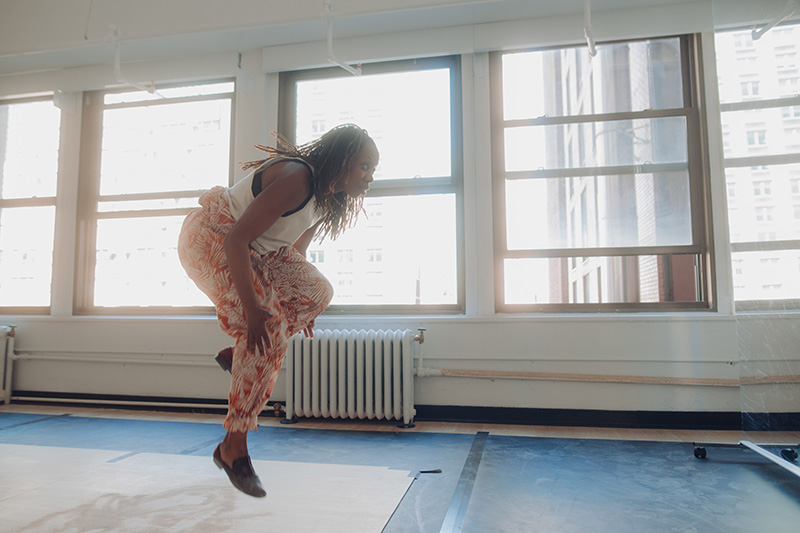
Photo by Jenna Maslechko
How did you start choreographing, and how would you describe your choreography?
My tap teacher in Flint, MI, was cast in a touring show, which meant he couldn’t be with us in person, so he offered the opportunity for several of the older students to teach. Mind you, as a kid growing up, I taught an imaginary class. I took attendance and everything. And now I had to teach real people. It was a great opportunity, and it laid the foundation of how to teach and create. He showed us how to create phrases and teach a class. Those were the initial foundations of choreographing.
When I came to Howard University, I started performing with NSAA Dance Ensemble, and they wanted to learn how to tap dance. I was the only tap dancer in the group, so I had to teach them how to tap. I had to choregraph a class.
In the beginning, my choreography was not as deeply connected to storytelling. Over time, I learned how to use the art form as a tool for storytelling. Once I understood that dance can be used as a tool that way, being able to tell stories through my feet and connect emotionally felt incredible.
Sand dance is a different level of choreography. When you ask people to dance in sand, there’s a level of education that has to happen. What kind of shoes do you wear? What type of surface can you do sand dance on? You have to get comfortable with putting sand on the floor. That has been a challenge. I have found a lot of pleasure and challenge between sand and percussive dance.
What was the impetus for SOLE Defined?
I had a dance company, and so did Ryan. But we found ourselves performing in similar spaces often. We decided to merge those companies to become one. A lot of time going into non-tap dance spaces, people would ask, “Do you do rhythm tap or Broadway tap?” To me, all tap dance has rhythm. Within the realm of percussive dance, the question became, “How do you define your sole?” Versus someone else asking what box you’re in. SOLE Defined is in our 10th year of being an arts nonprofit. It’s been an incredible rollercoaster. Ryan and I merged our efforts to be able to have a tour show that has gone everywhere from New York to Italy supporting artists to not only perform but also to teach in the classroom. We have three to four artists based in New York who teach in the schools weekly. There are about 30 to 35 classes a week they are teaching. That increases the opportunity for the students to be connected to these art forms they may not have had access to. It’s an opportunity to bridge an access gap that exists in public education.
Are there one or two projects with SOLE Defined you’d like to share more about?
The first one is ZAZ. Ryan spent years living and working in New Orleans and experiencing its culture. This show pays tribute to the residents of New Orleans who were affected by Hurricane Katrina and the aftermath. It tells stories using first person narrative. Ryan spoke to many people who were affected by the storm. This show has become a physical archive of their stories. It includes atmospheric immersion. The audience is literally on the stage, and they are physically feeling the storm and then the displacement from their family and things in the theater. The audience has to leave their seats in the theater start to understand the discomfort residents in New Orleans felt for weeks, not knowing where their loved ones were or when they could return home.
The Pulse is the opposite. It’s also high energy and immersion, but it’s strictly focused on the love of tap dance and body percussion. It is multimedia with live percussive music. It’s about groove and how we can sit in that groove.
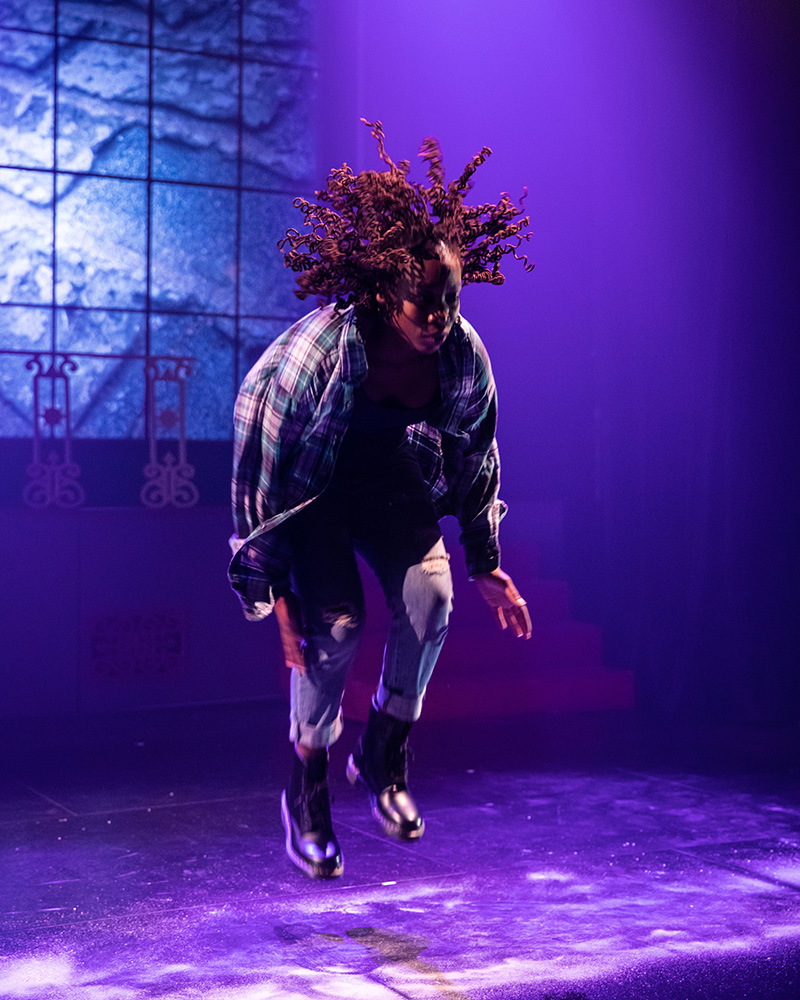
Photo by Jonathan Hsu
SOLE Defined has an extensive outreach program. Can you share more about it?
This year we’ll hit more than 10,000 students through in-person shows, weeklong residencies, and regular classes with our teaching artists in New York. It’s phenomenal the impact we’re able to have. We also do professional development for educators on bringing movement into the classroom. In addition, we do two school performances called The R.E.M.I.X. and Beats Beneath My Feet. That’s where we go to schools and get the kids excited. They might have a residency, so it can be a kick-off assembly, or it can be an opportunity to learn about the art form.
We’ve done some specialty programming in Waterloo, Iowa, through an arts organization called Arts Ignite, and in Johannesburg, South Africa, in a residence for women and children affected by HIV/AIDS. I’ve also gone to Uganda through Arts Ignite. When we got to the school, we saw the conditions the students were working and learning in. The overlap between the students being interested in learning and the teachers being interested in giving them education was paramount. One teacher had 90 kids in her class. To be able to go there and lead them in tap dance, body percussion, and stepping was such a great time.
How do kids learn tap if they don’t have tap shoes?
It depends. Some schools have a budget for me to bring tap shoes to their school. Those students get an even deeper connection to tap dance because they can hear the sounds they are making. For schools that don’t, the students wear their regular tennis shoes, or if they have hard sole shoes at home they wear on special occasions or religious events, then they can start to hear the sounds they are making with their feet. There are some occasions where the younger kids want to make the sounds I make. If it’s a kindergarten class, they will go find a tile to stand on in order to hear the sounds their feet are making. I also bring a tap board into the classroom so I can bring students up so they can hear whatever choreography we are doing. Their faces light up.
What are some of the ways you bridge tap dance with literacy and math?
With literacy, we work on connecting elements of tap dance to things like phonetic awareness and storytelling. Students are able to retell stories using the elements of choreography. In choreography, we learn steps, we practice them, and we perform them. If we connect a character in a story to a specific movement, we can follow the journey of the character and express it. If the character is sad, what does that look like in our bodies?
This entire week, I’ve been at Curtis Bay Elementary School through a partnership with Arts for Learning Maryland doing a tap mathematician residency. The teachers wanted to work on multiplication. In tap dance, we have a jam circle. As we go around the circle, for every multiple of two, you have to stomp, for every multiple of three, you have to slide. What happens is the students get to see a physical pattern. It’s connecting mathematical symbols with tap steps.
Or let’s say we do heel stomp times shuffle stomp. We know that anytime we see the times sign, that’s going to be a slide. How many sounds is heel stomp? That’s two. So we have two times shuffle stomp, which has three sounds. Can you tap that math? That’s what we did today. We worked with third through fifth graders. Some of the teachers weren’t involved with the residency. They came to the performance today and got to see the students dance the math. One of the teachers asked the students how they know what heel stomp means. They were able to explain it to their math teacher because of the sounds and the beat they made. Now the math teacher has another way of engaging the students when I’m not even there.
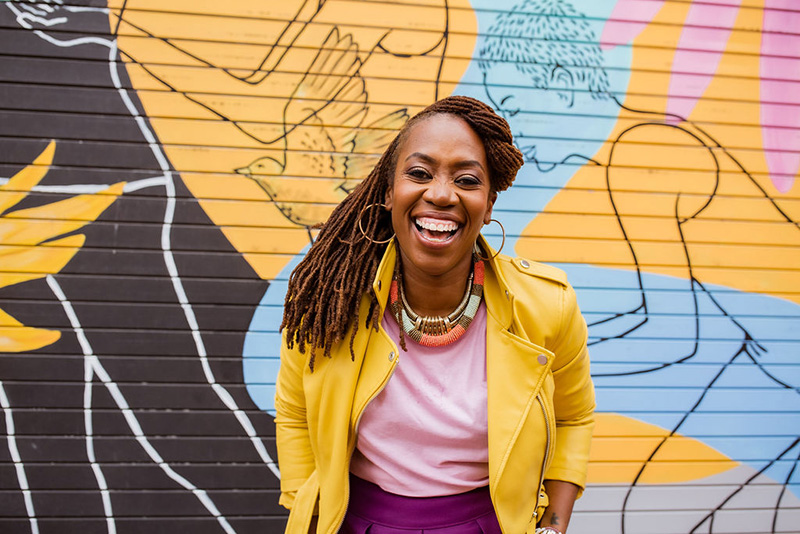
Photo by JA Creative
~~
To learn more, visit quynnjohnson.com.
Responses
There are no comments at this time.
Be the first to start the discussion by filling out the comment form.