Creating Dance for Community
March 9, 2026
An Interview with John Heginbotham
BY EMMALY WIEDERHOLT
John Heginbotham is a Brooklyn-based choreographer, performer, teacher, and the director of Dance Heginbotham. John recently received the Bowen Award for Inclusive Choreography, a $10,000 award by Mark Morris Dance Group supporting innovative work created with and for people living with Parkinson’s. John will be partnering with the New Orleans Ballet Association to lead a multi-generational cast of young dancers, seniors, and people with Parkinson’s in a large-scale performance premiering this spring. Here, John reflects on how he works to create dance that is fun for the community and for the community.
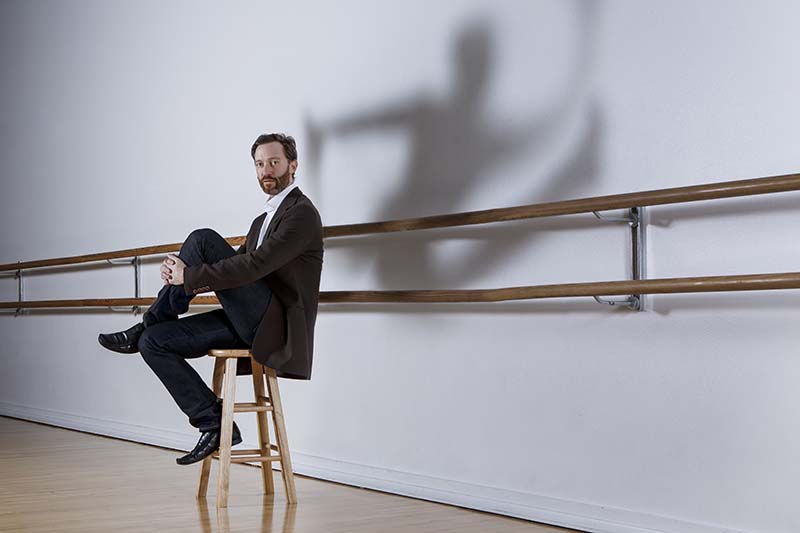
Photo by Bud Lammers
~~
Can you share a little about your dance and movement background and what shaped you as an artist?
I’ve had a beautiful long obsession with the arts and the performing arts. That crystallized into a career in dance in various ways. As with many of us, my fascination started very young. I grew up in Anchorage, Alaska. Both my parents were interested and in love with the performing arts. They took my sister and I to every arts event in Anchorage, in particular musical theater. I saw live shows but also a ton of videos of the golden age of Hollywood musicals. That’s how I fell in love with the performing arts.
My first performing experience was in a professional production of A Christmas Carol with Alaska Repertory Theatre. I totally fell in love with theater and knew without a doubt that was where my life was headed. I knew I was going to be an actor and live in the big city and live in a skyscraper.
My folks enrolled me in a local dance studio that offered tap, ballet, a little modern, disco, and Polynesian cultural dance. I had this exposure to all these different genres. I loved it, and that took over my focus.
I went to Juilliard after high school and fell in love with the Mark Morris Dance Group who I saw at the Brooklyn Academy of Music when I was a freshman. I did everything I could to be involved with that company. After many years, I finally became a company member. It was a lot of work, and it was never certain I would get to be involved. I spent a good portion of my performing career with the Mark Morris Dance Group. I was a permanent member for 14 years, but then before and after I did extra work for them.
Choreography was always an interest, even when I was a little kid. When I watched musicals, I understood someone was making the steps up. When I saw Gene Kelly or Xanadu, I knew someone was responsible for designing the dance sequences. I started doing choreographic experiments when I was 11 and kept at it. Over time, that focus became more important to me. I had a good performing career but fell more in love with the art of choreography.
I’m still in love with it. Now I direct Dance Heginbotham and do independent projects in ballet, musical theater, and occasionally TV. I love putting together the puzzle of what creates a compelling dance.
What usually drives your choreography?
It depends on the project. Often music is the immediate focus, but sometimes I don’t work with music at first or at all. One of the recent pieces I did was called You Look Like a Fun Guy and it was to the spoken text of a lecture the composer John Cage delivered. Music is often the thing that drives me, but the project has to have something compelling about it, whether it’s an image or an idea. With the John Cage piece, I read a story about John Cage that was compelling and I wanted to dance with it.
I also like to be told what to do. With musical theater or the little TV I’ve done, they give me a script and tell me exactly what they want, and I love trying to figure out how to best deliver to support the broader project in my own way.
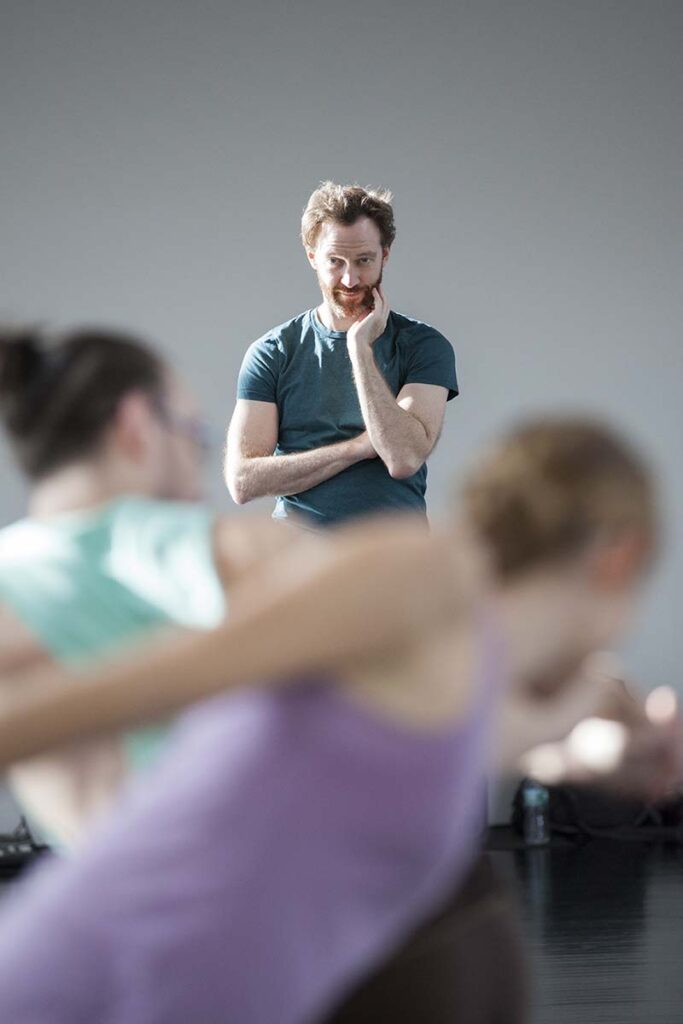
Photo by Janelle Jones
Can you share more about the project you will be doing with New Orleans Ballet Association in conjunction with the Bowen Award? What was the impetus behind the project?
I’ve had a relationship with the Dance for PD community since it began 25 years ago. (Dance for PD is a program of the Mark Morris Dance Group.) What this award allows me to do is go to New Orleans and work with several communities there. Dance for PD will be the center of it all. It allows me to do one of my favorite things, which is invite people to the dance. Maybe some will have a lot of training, and maybe some won’t have any. And there will be some for whom, in the case of Parkinson’s Disease, movement has been removed from their lives to a degree. I like working with people in the community to build something that is fun for them and that is for them, a customized experience for them to share and live within.
My plan is to collaborate with local musicians for the musical element and to have varying communities all onstage together performing a new work that will emphasize the beauty that is possible through whatever movement is available to you.
Have you previously worked with such a dynamic group of so many age ranges and abilities?
I have created several pieces of choreography for the Brooklyn-based Dance for PD. In those situations, the cast was 90 percent Dance for PD participants, but a core element of Dance for PD is that there are the caregivers, family, and friends who participate in the dancing along with the people who have Parkinson’s. There’s always some degree of disabled and able-bodied people in the room together. I’ve worked with a continuum of people with varying dance experience, though not to this extent of being intergenerational. So this is new for me in a way.
How will you access these communities?
New Orleans Ballet Association has their communities they serve that they will bring into the studio. They offer regular classes for people with Parkinson’s, and in the past, they have presented performances for and with Dance for PD.
What do you hope audiences take away?
Joy. And I hope maybe they’ll dance along with us from their spectator perspective.
I understand you’re a founding teacher with Dance for PD. How do you generally approach working with people with Parkinson’s?
One aspect of Parkinson’s is that it affects each individual differently. And it can affect people differently on different days. Because of that, I walk into the room not expecting or predicting what I’m going to receive from the participants. The first thing that happens is watching and listening to who is in the room. We’ll do some talking and some breaking the ice to get people in a groove, as well as get myself in the groove. I will walk in with a piece of music in mind, as well as with ideas that I might discard once I see what’s happening. We’ll figure out where people are finding pleasure and delight in what they are doing, and where people are feeling challenges or displeasure. And then I’ll veer toward the pleasure, which is not to say we don’t ignore the reality of challenge, but ultimately we’re there to have fun. If movement is a challenge, this is a place where people can move in a lot of different ways, including extreme stillness or extreme mobility. It’s all encouraged. Wherever you are is the right place to be.
I have a follow-up question. Since you mentioned that people with Parkinson’s can live in their body so differently day to day, will your choreography for the New Orleans Ballet Association be improvisational or set?
I tend to be attracted to some degree of noticeable relationship between music and movement, but I approach it with a great deal of performer interpretation. I would never demand that on this beat everyone must hit open hands. There has to be a degree of malleability. I will design the piece knowing that people will arrive at a destination in a sequence a bit on their own time. To me, that means there’s a degree of improvisation and spontaneous decision-making.
One time with the Brooklyn Dance for PD group, I thought I was going to make a piece with more codified movement, but then through the course of making the piece, it was more interesting when the participants were making the decisions. It did kind of become a big improvisation. I accept that there’s that possibility, but we will find out through the course of practicing it.
I have to acknowledge that there must be some freedom within the choreography. I can set up guidelines, but the guidelines have to be flexible.
Is there anything else you’re working on at the moment you’d like to share more about?
I just started working on a project that might involve the Dance for PD community and a multi-generational community. The project is called Carnival of the Nearly Extinct Animals with Ocean Music Action, which is made up of musicians who want to support ocean health. I’m just starting work on this project. It will follow the structure of Carnival of the Animals by Camille Saint-Saëns. It will involve some professional dancers and potentially also those from Dance for PD, as well as children and elderly folks.
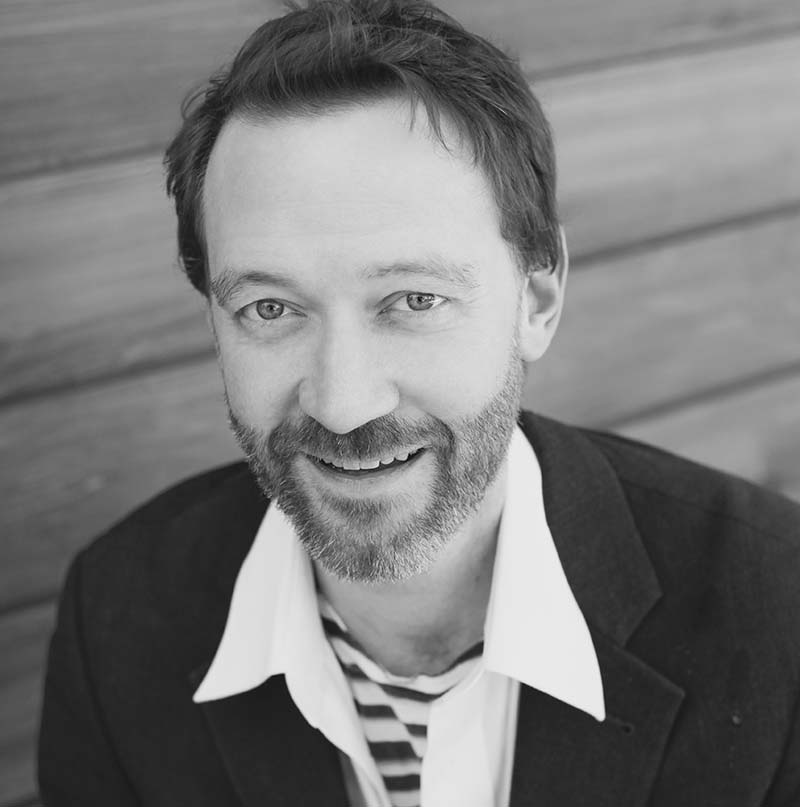
Photo by Amber Star Merkens
~~
To learn more, visit www.danceheginbotham.org.
Responses
There are no comments at this time.
Be the first to start the discussion by filling out the comment form.