Improving the Reach of Dance
March 2, 2026
An Interview with Niamh O’Loughlin
BY EMMALY WIEDERHOLT
Niamh O’Loughlin is a queer Irish dance artist based in Dundee, Scotland. She has a special interest in using improvisation, storytelling, and myth as tools for connection and transformation. Niamh recently received the Bowen Award for Inclusive Choreography, a $10,000 award by Mark Morris Dance Group supporting innovative work created with and for people living with Parkinson’s, with which she will be transforming participant memories and movement into a collaboratively built dance film called Spell Body. Here, she shares some of the ways she aims to make dance accessible as well as how she is drawn to using folklore within her choreography.
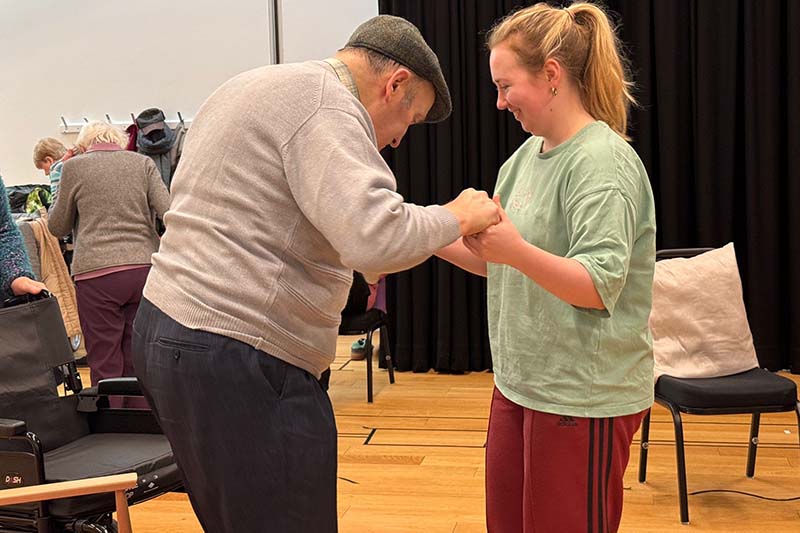
Photo by Lucas Chih Ping Kao
~~
First can you share a little about your dance and movement background and what shaped you as an artist?
I’m originally from Ireland but I live in Scotland now. I started out as a kid as a competitive Irish dancer. I started doing commercial styles in my teens, and then I realized I wanted to study dance more and I ended up specializing in contemporary dance. At the time, there was no degree in dance in Ireland, so I had to look at the UK. Scotland had free education, and I didn’t have the funds to go to London, so I ended up in Dundee. I currently live in Dundee, though I have gone away and come back. I studied at the Scottish School of Contemporary Dance for four years. I knew I wanted to specialize in choreography. I’ve always had that hat on with regards to watching dance and what I was interested in. After leaving college, I performed way more than I thought I would. I immediately got an opportunity to work with Dance for Health, specifically working with people with multiple sclerosis. That strand of my work continued from there. I later trained as a Dance for PD teacher. I’ve worked with my current group of people with Parkinson’s disease for the past five years. I see them every Monday morning. They are the light of my week. They are such a family unit; they all take such good care of each other. I’m also an Associate Artist at Scottish Dance Theatre, which is the national contemporary dance company in Scotland.
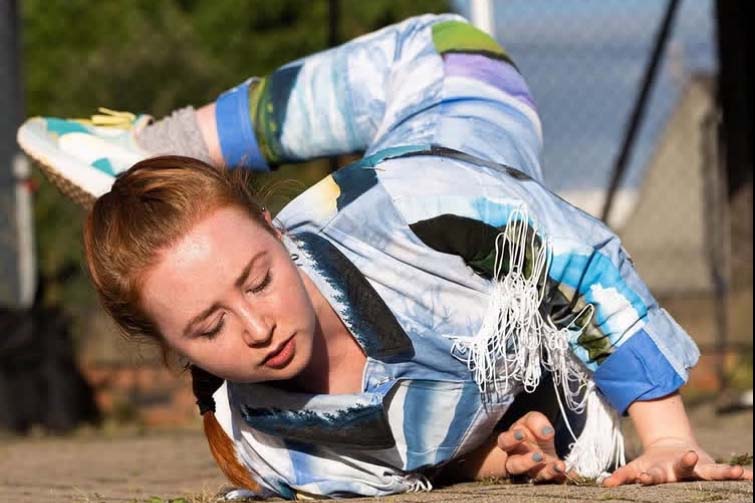
Photo by Ben Douglas
What usually drives your choreography?
I get really excited about making languages. They are usually character or creature driven languages. I love folklore, so my choreography has been driven by folklore over the years. I made a show inspired by a woman who was burned to death by her husband for not eating a third piece of toast because he thought she was a fairy. In the piece, you didn’t really know if she was a fairy or not. That was a fun language to make. Witches are always a favorite. I also like aliens.
When I perform myself, I’m more interested in somatics. I made a solo on myself that explored the textures of mountains. I got quite frustrated with the lack of infrastructure for touring, so I’ve been making work for outdoors, online, and other digital platforms, work that is flexible for different places.
I do tour My Friend Selkie, a work I made for young audiences ages three to five. We’ve done that in schools, hospitals, respite centers, outside, and at music festivals. I love all the different ways you can get close to audiences.
What was the inspiration behind Spell Body, the piece you will be making in conjunction with the Bowen Award?
Spell Body is inspired by the confessions of a Scottish witch called Isobel Gowdie, who gave the most complete confessions that a witch ever gave. She talked about how she became a witch. She gave the interviewers 36 spells. She told the interviewers that at night she left her shadow self behind and met the queen of fairies. She talked about transforming into a hare, a crow, and a cat. I love the imagery. All the people I work with who have Parkinson’s tell me such good stories and led such mischievous lives. I thought we could be inspired by the story of Isobel Gowdie and bring in all their stories.
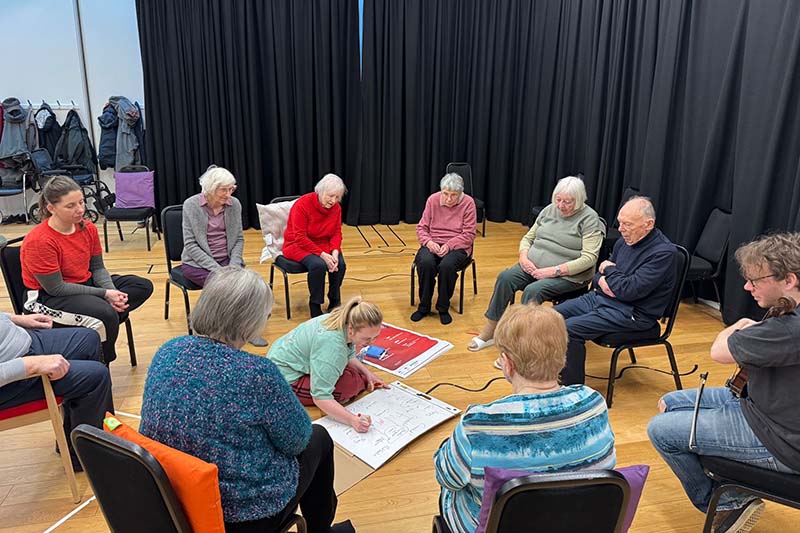
Photo by Lucas Chih Ping Kao
What has been your process creating Spell Body so far?
Some of my initial ideas I came up with for the imagery and solo elements fell flat on their face straight away. They required a level of confidence in the group that wasn’t there yet. I panicked. I have since been taking it much gentler and am working in a subtler way. I went to Lucy, who the award is named after, and said, “The group is not as confident as I thought!” She said it’s all repetition. We’ve been working with more set choreography than I usually use and have been repeating it lots. It’s been more effective. We’ve been working with different rhythms, the music and lyrics, and taking it from there.
How will you be using the participants’ stories in the choreography?
I ask the group questions and then let them talk amongst themselves and then we all share. This will form part of the choreography and the visuals. We will also record their voices and use that in the soundscape.
Where do you hope to share the film?
I’m going to start with a premiere in Scotland in Perth Theatre and would like to distribute it to different dance film festivals from there.
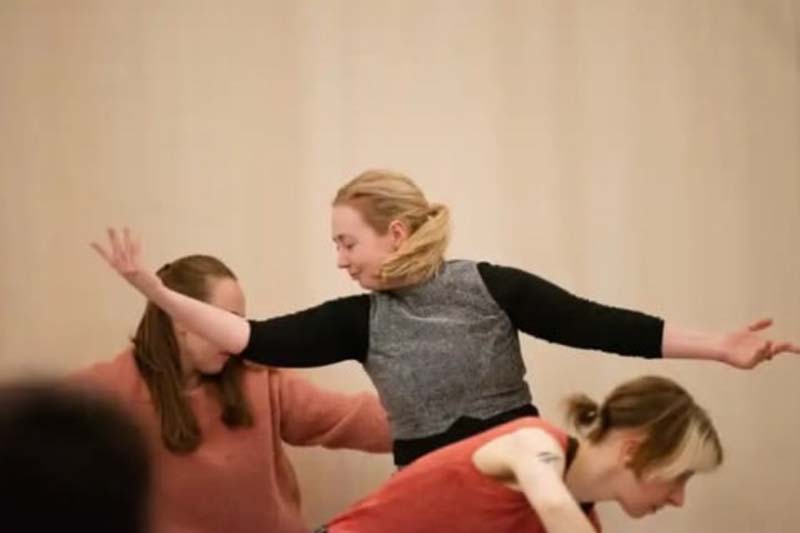
Photo by Sarah Barr
What do you hope audiences take away?
I’m always blown away by the authenticity of movement in the group of people I work with, and I hope audiences are as blown away as I am. For example, at the end of class, we dance our thanks to the person next to us in the circle as an improvisation. The way people dance for each other, make eye contact, and give a genuine demonstration makes me cry.
I understand you’ve worked with a lot of communities in your career, and that accessibility and inclusion are important to you. What are some ways you generally make dance available to people with different bodies and abilities?
I received a commission two years ago from the Edinburgh Fringe Festival to work in a special school in Edinburgh. The Edinburgh Fringe recognized that even though it’s an international festival, there are people within Edinburgh who the festival doesn’t reach. I worked with teenagers with complex needs to make a dance. All of them were preverbal. We designed a session that captured all their needs, which were very different from each other. Some people were in a bed, some people used a wheelchair, some used a standing aid. We designed a session that made the most of all their talents. Then we turned it into a full school party with all the props made into giant versions of themselves. It was complete chaos and it was lovely. What was interesting and I didn’t know would happen was that after the big celebration, when we came back together to do our session again, there was a huge jump in engagement. I could see real ownership in these teenagers. That was special and unexpected.
In some of my other classes, there tend to be people who are neurodivergent or use a wheelchair. It’s part of the fabric of the class that we have adaptations. There’s a little boy in one of my classes who uses a wheelchair. I talked to him at the start of the term about learning wheelchair dance technique, which I’m trained in. He was interested. There’s a lack of diversity in dance in Scotland, and changing that starts with the children by giving them the tools, so if they wish to dance professionally, they have a different control of their body and the same confidence and opportunities nondisabled kids are getting.
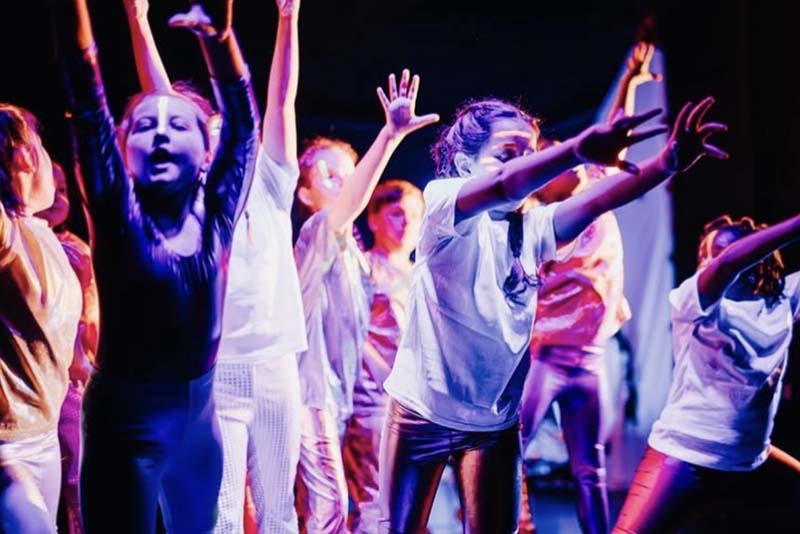
Photo by Andrew Perry
Is there anything else you’re working on at the moment you’d like to share more about?
I’m currently working on a dance project called The King of the Birds inspired by the Celtic myth of the wren and the eagle. It’s the story of a competition to see who will be king of the birds. They decide it will whoever flies the highest. The eagle flies the highest, but then the wren is hiding in his wings and then the wren flies a little higher. This is a common story in Ireland. It will be a duet with two amazing dancers. We’re making it for the outdoors, but we hope to fit it into other non-traditional dance spaces, like libraries or schools, to improve the reach of dance and get it to people who are not likely to see dance in a theater.
~~
To learn more, visit www.niamholoughlindanceartist.com.
Responses
There are no comments at this time.
Be the first to start the discussion by filling out the comment form.