Putting Dance Back in Public Spaces
February 23, 2026
An Interview with Ojudun Taiwo Jacob of Illuminatetheatre
BY EMMALY WIEDERHOLT
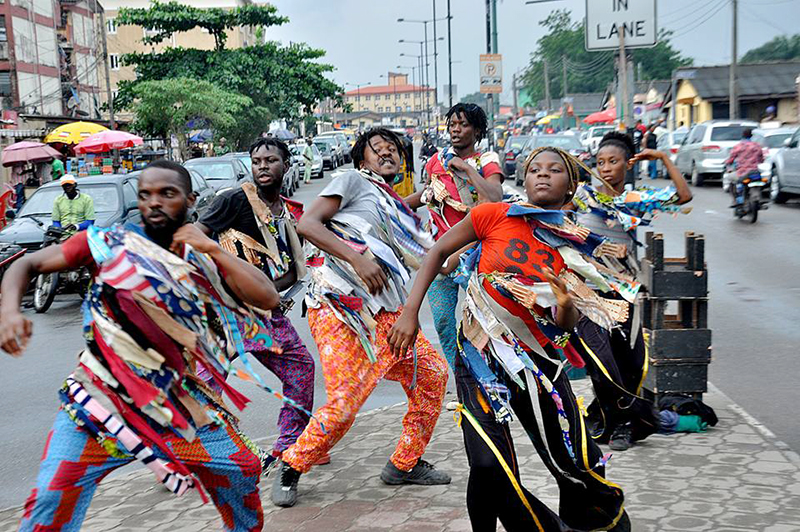
Illuminatetheatre is a dance collective and creative lab reshaping Nigeria’s cultural landscape by bringing dance and theater into public spaces to make the arts free, dynamic, inclusive, and accessible to all. Through decolonial practices, the collective organizes workshops, performances, and community engagement. They aim to empower youth, celebrate African heritage, and mentor socially conscious leaders. They envision a vibrant Nigeria where performance art thrives in everyday life, in street corners, parks, and markets as stages for cultural expression. By harnessing the power of dance and theater, Illuminatetheatre strives to inspire personal growth, strengthen community ties, and redefine communities through artistic narratives and practices. Here, artistic director and co-founder Ojudun Taiwo Jacob describes how Illuminatetheatre got started and its deep focus on creating community access to dance.
Photos courtesy Illuminatetheatre.
~~
Can you share a little about your own dance/theater background?
I studied dance at Crown Troupe of Africa, a Lagos-based dance and theater type of academy. That’s my professional background. I started dancing in high school. After high school, I wanted to dance, so I opted to study dance before my university studies. This academy encourages and empowers young minds interested, enthusiastic, and passionate about dance. This marked a transformative and formulative period. We would train eight hours every day, five days a week. I studied there for seven years. The first three years were intensive studying and training. After that, we slowly got into the performance phase. Every week, we had performances. Over time, the training became a combination between studying and practice, which sharpened our level of professionalism and discipline. I am currently enrolled as a master’s student in Contemporary Dance Education at Hochschule für Musik und Darstellende Kunst Frankfurt (MA CoDE).
What was the impetus for Illuminatetheatre?
After seven years of studies at Crown Troupe of Africa, I was due for a new challenge. I left without knowing exactly what to do. Then I started doing some freelance jobs. After a few years I realized that wasn’t my call. I wanted something more unique. In 2014, I realized I had a lot of interest in performance in public or pop-up spaces like parks, markets, abandoned buildings, busy streets, etc. This realization came as a conscious path to decoloniality. I discovered that pre-colonial African dances were originally situated in these kinds of open spaces. Describing them as unconventional performance spaces became a topic of interest. That’s why I started exploring this path.
I did a few performances by myself and afterward I talked to a couple of my colleagues about my passion and interest. And that was how we started. There were three of us: me,
Olowu Busayo, and Enechukwu Emmanuel Uche. At that time in our lives, we were just finishing university. I studied political science, one of us studied public administration, and the other theater. It was the point in our lives when we had to make decisions on what next step to take. We thought maybe this could be a starting point.
We didn’t even have a name. We were just a group of young people fueled by enthusiasm and passion. At the commencement of each new project we did, we invited other young dancers to research and collaborate with us. Since we had zero financial support, our greatest strength was collaboration. For example, we collaborated with musicians and gave them all the rights to the music created during the process. Over time, we thought we should give ourselves a name. We wanted to change the discourse of Nigerian dance and performance space, to make a difference out of nothing. That’s how we came up with the name Illuminatetheatre.
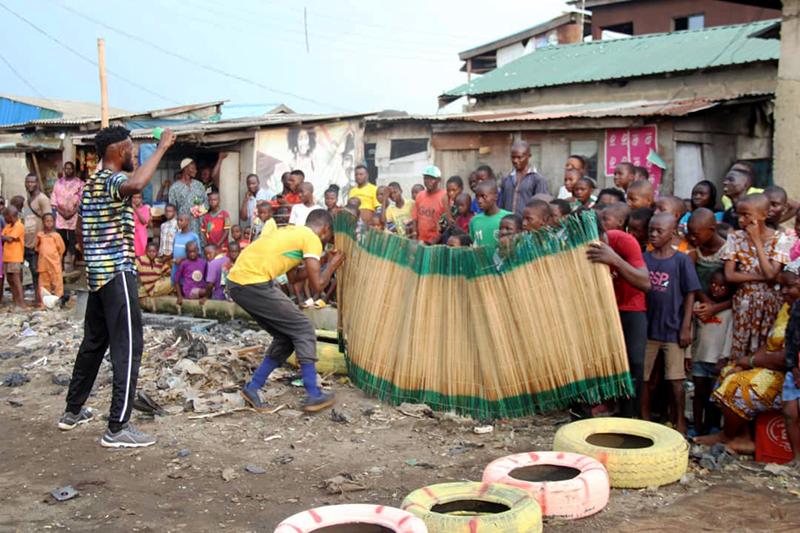
Over time, we realized that dance in public spaces is empowering for the people we performed for. In Nigeria, dance itself is something of a particular class; it’s not accessible or affordable. We come from a financially disabled community where there was no access to dance. Therefore, we focused on breaking this barrier by bringing dance and performances to public spaces and establishing a point of community dialogue through our politically conscious works.
How has Illuminatetheatre evolved since it was founded?
We now have about 10 or 15 people involved. We have regular plenaries where we organize and plan our projects. We check in on individual capacities. This is what shapes our new works. Since I’m mostly not in Lagos, I contribute virtually. For example, I write about our projects and publish them on our website. The people in Lagos take on the physical responsibility of field and body work.
Are there a couple of recent projects you’d like to share more about?
Our last big project was called The Migrant. It explores migration from an African perspective. It reflects on migration pre-colonial, during the colonial period, and how the theme takes shape in post-colonial Africa. The project was inspired from my lived experiences in Berlin. We started the research by collecting stories from people with different migrant backgrounds in Berlin, continued in Friedrich-Alexander-Universitäat Erlangen Nürnberg (FAU), and then headed to Lagos where our hub is, to create the project. Excerpts were shown in Lagos. It premiered at Volksbühne, a theater in Berlin. This project is coming back this year. We find this topic relevant considering the current global political shift favoring conservative policies.
In Lagos right now, we have something called Open Studio, a quarterly event that brings young dancers and cultural practitioners together to share their work and have a dialogue with the people in the community. This gathering fosters exchange between the artists, the locals, and international communities. Depending on our capacities and resources, we invite people who give lectures, seminars, film screenings, and performances.
I understand that your projects often combine traditional African methods with contemporary forms. Can you say more about that?
I often ask: How has dance evolved in Africa over time and what impact does colonization play? There has been a lot of colonial influences on African dance, art, and theater. For example, Nigerian educational institutions still focus western theories in the curriculum. The techniques of the likes of Bertolt Brecht, Stanislavsky, and Rudolf Laban are still taught in schools today. I later learned about a Nigerian theater-maker named Hubert Ogunde and his mobile theater. What he did with theater was not necessarily what we were taught. In my developmental process, I started digging into archives and learning about people like Ogunde and the epistemology landscape of African dance and theater. This knowledge enhances the trajectory of our current dance practices.
Today contemporary African dance is shaped by the never-ending influence of western culture. If you look at what is called Nigerian music, there are a lot of instruments that are not considered traditional. But when these instruments are combined with traditional instruments, they create a hybrid music that is considered Nigerian. These hybrids shape modern African art.
What we mean by a contemporary approach is acknowledging the influences and how dance has evolved over time. For example, my parents don’t speak English, but I speak English, and it doesn’t make me less African. We feel that our approach is what we call Afro futurism, an Africa that is shaped by its past and current.
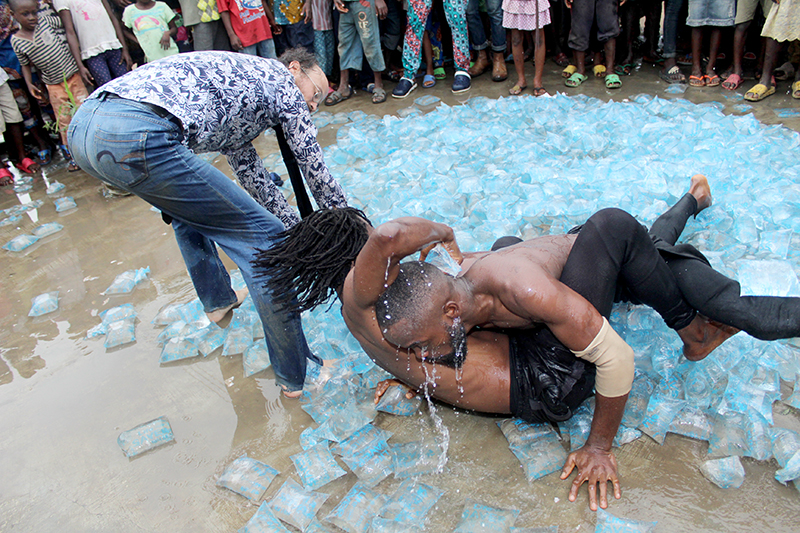
This is what we mean by blending traditional and contemporary styles to create something new, something we can associate with. Another example is we reclaim space by performing in a park or in a garage or in a market square. It’s considered an unconventional performance space. Meanwhile, if you look back in African history, dance festivals were not held in theaters. Does that mean they were not conventional? No, they were conventional to those people and that really matters to us.
What is Illuminatetheatre’s relationship with the broader community now that it’s been around more than a decade?
There’s been a lot of interest. For example, I can think of several young people who were inspired by what we do and what it means to reclaim space and history. Some of them are still dancing with us. Some of them got inspired through encounters with our practices. In these communities when we started, we were considered a little bit strange. In one of my first performances on the streets of Lagos, someone said I was an insane person, especially because of my dreadlocks and dance moves. I also had an elaborate costume and what I was doing was alien to this community at that time. People didn’t know that this kind of art could be accessible in public spaces. Over time, people have become more conscious that art can be accessible in public spaces. Our community in Lagos is called Bariga. It has become a cultural hub for dance and performance. The reception from the people we are interested in reaching has been great.
What’s next for Illuminatetheatre? Is there an upcoming project or focus you’d like to share more about?
We’re going to be in Salzburg this summer teaching for three weeks at the Salzburg summer academy. Our workshop is themed Unbound Geographies: Re-imagining Bodies, Borders and the Cities. The interdisciplinary workshop explores how bodies, borders, and urban spaces shape one another. The course examines how histories of migration, displacement and colonialism are embodied in contemporary European cities. Two of my colleagues will join me from Lagos.
Also, we are currently planning a festival called Art Mobile Lagos. Art Mobile Lagos is a biennial cultural festival and experimental platform for contemporary artistic exchange. The first edition took place in 2020, marking the beginning of a project that transforms the city of Lagos into a moving constellation of artistic encounters. Every other year, Art Mobile Lagos creates temporary pop-up venues across different urban and communal sites, from markets to bus stops, from open streets to waterfronts, establishing alternative spaces for creative dialogue that remain accessible to the public. The festival takes a new shape this year as it collaborates with Art Core Warri. Art Core is a non-profit community organization with its base in Warri, Delta state, Nigeria, that is dedicated to harnessing the power of art as a tool for advocacy, narrative change, and community empowerment. Art Core believes art has the unique capacity to inspire, educate, and mobilize individuals and communities while addressing pressing social issues and celebrating local creativity.
That means that the festival will kick off in Warri, a cosmopolitan city known for its diverse ethnic groups and rich cultural heritage, carrying a strong sense of community, humor, and hospitality. We will then continue in Lagos, a vibrant economic and cultural powerhouse known for its dynamic mix of frenetic energy, cultural vibrancy, dance, music, and cultural festivals. Our partnership is only possible through a shared ethical and political alignment. We recognize the need to respond to the fractures of our contemporary global community. This collaboration emerges as a logistical convergence and collective commitment to rethinking how knowledge, truth, and community are produced and sustained. In doing so, we intentionally foreground precolonial indigenous epistemologies within African societies and ways of knowing that may have been rendered invisible by colonial modernity.
We therefore conceive this edition as a space where truth will be grounded and embodied. Our curatorial framework draws from the cosmologies of Ifá, Ayélàlà, Egbesu, and Erivwin, spiritual and philosophical systems that articulate truth, justice, memory, and ancestral accountability within Yorùbá and Delta State cultural landscapes. These traditions offer symbolic reference; they provide living epistemological structures through which communities have long organized ethics, governance, and relational life. By placing these cosmologies in dialogue, we illuminate how ancestral and historical knowledge systems remain interconnected across ethnic and geographic lineages, shaping communal belief systems and modes of resistance across time.
For us, when we establish any community project, it’s important to have different perspectives on whatever topic we’re talking about. Art Mobile Lagos starts on the 24th of November, there will be a break between cities, and then it will end on the 6th of December.
Any other thoughts?
I would like to emphasize that for us at Illuminatetheatre, dance is an anchor for community dialogue, and we want dance and performance to be accessible to everyone, especially people from financially disadvantaged communities. These are the most important things for us. Our goal is to communicate and relate to the people. If there is a dance concert that costs $5 to attend, my family cannot afford it. It’s already extremely expensive for them. We bring dance to the streets and our community because it’s the only way people from our communities can access it. Community accessibility to dance and cultural practices is our core collective goal.
~~
To learn more, visit www.illuminatetheatre.com.
Responses
There are no comments at this time.
Be the first to start the discussion by filling out the comment form.