Umfundalai: A Contemporary African Dance Technique
December 1, 2025
An Interview with Dr. C. Kemal Nance, Master Teacher of Umfundalai
BY EMMALY WIEDERHOLT
Umfundalai (pronounced Ma-Foon-Da-La) is a contemporary African dance technique that comprises movement vocabulary from dance traditions throughout the African diaspora. Developed by Dr. Kariamu Welsh, the technique seeks to articulate an essence of Africa. Dr. C. Kemal Nance is Senior Master Teacher of Umfundalai and is an Assistant Professor in the Departments of Dance and African American Studies at the University of Illinois Urbana-Champaign. Here, Kemal describes what Umfundalai is and how it developed, how the technique is evolving with time, and why Umfundalai is a valuable and empowering training.
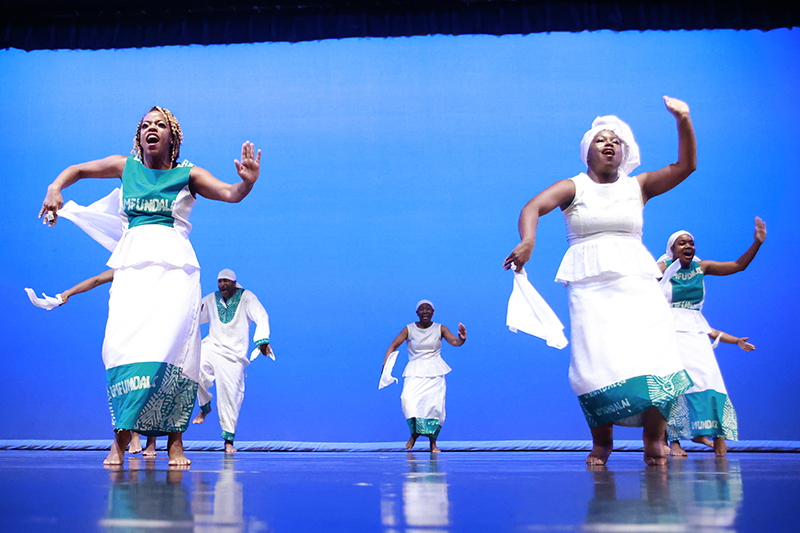
Photo by Zamani Feeling
~~
Can you share with me a little about your dance history? What shaped you as a dance artist?
I started dancing in undergraduate school at Swarthmore College, and I danced more seriously after I graduated. I went to Temple University for my master’s and started dancing with local companies. I’ve been affiliated with Umfundalai since I was 18 when I met Dr. Kariamu Welsh during my first year at Swarthmore. I danced for 20 years with Kariamu & Company: Traditions, the professional company Mama Kariamu started that featured Umfundalai. I also danced as a guest artist with Chuck Davis’ African American Dance Ensemble in Durham, North Carolina. I did a lot of neotraditional African dance in the Philadelphia area, including with Dunya, Ibeji West African Dance Company, and the Seventh Principle Performance Company. Currently I’m an Associate Professor of Dance at the University of Illinois Urbana-Champaign.
Umfundalai was developed by Dr. Kariamu Welsh, who has now passed. Can you tell me a little about who she was?
It’s a hard question because she meant so much to me and she meant so much to so many people. Some factoids about her: She was a professor emerita of Dance Studies at Temple University. She was a Guggenheim winner and a decorated choreographer. She was the first director of the National Dance Company of Zimbabwe. She was a scholar and writer who wrote several books about African dance and African American dance.
She was also my dance mom. She introduced me to myself in terms of my love for movement and African dance. She was a source of light for those of us who knew her and still miss her dearly.
How did Dr. Kariamu Welsh develop Umfundalai?
She was beginning to dance and choreograph at an exciting time in American history in the middle of New York City during the Black Arts Movement (1965-1975) when everybody was questioning Black discourse and writing about Black phenomena. Historically people don’t treat dance as being one of the modalities in which people talk about our experience, but Dr. Kariamu was dancing about our experience. It started as a way to tool her choreography that was largely about being a Black woman in the United States. Through experimentation with African textiles, Black vernacular movement, and Katherine Dunham technique, that synthesis of things gave way to a codified movement practice steeped in the African continuum.
How is Umfundalai organized as a technique?
Umfundalai is a contemporary dance technique that rides on the premise that African dance lives and breathes wherever African people reside. What that means is it galvanizes a movement vocabulary not just from the continent of Africa but the diaspora as well. That’s my academic answer. My more personal answer is that Umfundalai is Dr. Kariamu’s love letter to Black people across the world. It’s an open-ended project in the sense that we add to Umfundalai every day. It centralizes the experiences of Black people around the world. It’s a codified technique, a movement practice, and a philosophy.
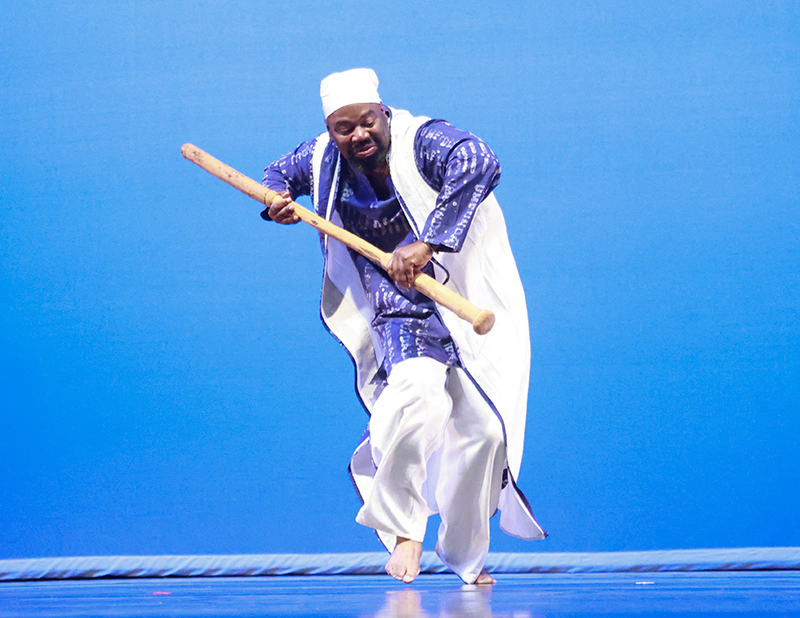
Photo by Zamani Feeling
African diasporic dance is a huge continuum. How did Dr. Kariamu Welsh distill that breadth into a technique?
There are a number of ways in which movement comes to us in Umfundalai. Some of it is an advancement of Katherine Dunham’s technique. Some of it is from Dr. Kariamu’s field studies as a Fulbright Scholar in Zimbabwe. Some of it is from neotraditional West African dance practices. Some of it is from things that Black people do in terms of movement. All of that is fair game in terms of the African diasporic wellspring of creativity. Some of it comes from movement invention or choreography. Dr. Kariamu was a brilliant teacher and choreographer. It is a vast question because the idea of creativity is a vast question.
How is the Umfundalai teacher training organized?
I’m really proud of our teacher training programs. We have two of them offered through the National Association of American African Dance Teachers (NAAADT). The first is called M’Singha Wuti, which means “of the people.” That’s a recreational training for people who have studied Umfundalai, fallen in love with it, and want to share Umfundalai recreationally with communities who want to move, like kids or the elderly. It’s a license to use Umfundalai in that way. It’s six or seven weeks long, it’s virtual, and it ends with an in-person experience at the annual NAAADT conference, which we call Nanigo.
Then there’s the professional certification, where people steep themselves in Umfundalai dance culture and vocabulary in order to know it well enough to share it at universities and professional dance companies. That takes about two years. It too is largely virtual. The virtual sessions are designed to align Umfundalai practice, so in order to pursue an Umfundalai professional certification, you have to be immersed in an Umfundalai population so you get the training. When we have our Nanigo, our annual summer conference where we’re in person, we get down to the nitty gritty where we’re doing intensives and workshops, whereas we’re debriefing virtually in our individual spaces during the winter. To be a conduit of African dance, and particularly Umfundalai, you have to know something about history, aesthetics, pedagogy, and biomechanics. All those things are woven into the Umfundalai education. Once you have completed those benchmarks, then we have a big teaching ceremony. We’re in the middle of a cohort that is expected to finish in 2026.
What kinds of dance artists pursue the professional certification?
The profile of every cohort is different. Before Mama Kariamu transitioned, it was mostly people who had danced with her company and wanted to have a credential to share it. Time is marching on, so we get a cadre of people who come to Umfundalai from various points of entry. Some studied with a master teacher and have fallen in love with Umfundalai and they too want to share it. They typically come from the academy. Some fall in love in the community dance circuit. Some people are high school or undergrad teachers, and they see it as a good movement practice to engage people with African dance.
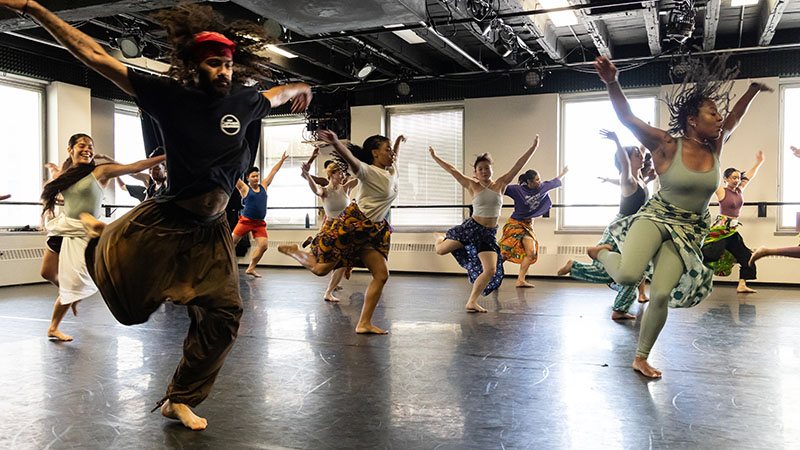
Photo by Aeria Charles
How widely used is Umfundalai?
Unfortunately, Umfundalai has been a best-kept secret for a long time. It’s been around for 55 years, and I think now it’s starting to spread and have more currency in the field. People are falling in love with it as a movement practice and a way to train the body.
Is Umfundalai ever incorporated into other movement practices?
We prefer people teach it as Umfundalai, but it’s a movement practice on the body so there’s only so much control we have over it. There are people who have woven it into Black studies curriculum or their jazz or contemporary dance curriculums. We even had one of our master teachers weave it into her fitness curriculum before she retired. It does have applications in other spaces, but we prefer if you are going to teach Umfundalai, you teach it as a class so the name recognition, context, and history is embedded.
How has Umfundalai evolved since Dr. Kariamu Welsh passed away?
I’m looking for those changes. Umfundalai means “essence” or “essential” in Kiswahili, so it’s not about exactitude the way we think about it in other dance practices. Don’t get me wrong – there is a correct way of doing it. But as newer bodies take on the dance form, I’m delighted to see how it goes into the house and battle scenes, for example. One of our newest Umfundalai master teachers is a virtuosic street dancer. What I love about Umfundalai is that it makes commentary about what’s happening right now. What we know as street dance has at its core the African aesthetic. You can’t get to hip hop, house, Chicago footwork, lite feet, or any of those practices without talking about the African aesthetic. As such, there’s always going to be a dialogue where one is impacting the other, and it’s a beautiful thing.
What’s more exciting for me is that people are starting to recognize Umfundalai when they see it. They know where to get access to it. We have a nonprofit that serves as a clearinghouse for developments in Umfundalai.
How has Umfundalai influenced your own teaching?
It’s what I teach. It’s my movement practice of choice. I’m so fortunate to be in a space where I don’t have to fight for its validity. After being here at the University of Illinois Urbana-Champaign for so many years, we’re seeing the benefits of dancers who have trained in Umfundalai.
At the U of Illinois, we want the movement practices to talk to each other. Dancers need to be versatile. My colleague is a ballet specialist. We’re teaching our movement practices together this semester, and we’re delighted that we get to be in dialogue with each other. That shows how porous these practices are, that they are dealing with the commonality of the human body. African dance doesn’t have to be the antithesis of ballet; they are adjacent to each other and use the body with care and precision.
Why study Umfundalai as opposed to any of the dances in the diaspora?
The beautiful thing about Umfundalai is it’s not bound by a specific tradition or cultural practice, so you don’t have to worry about disrespecting a custom you don’t know or upsetting the ancestors. It’s a contemporary form. If you’re going to study neotraditional or traditional dance, you have to take into account those things. Dance doesn’t exist in a vacuum, it exists in the human experience. Umfundalai still honors those things but you’re free to speak to “right now.” You get to use this rich movement vocabulary to dialogue with what’s happening in a contemporary space.
Why is Umfundalai important for a dance artist?
Philosophically what Umfundalai does is it tells you your body is enough to create beauty and movement. It teaches you about respect; not only for your own body as a vessel but for the community you’re dancing in.
In a lot of neotraditional African dance spaces, you learn by imitating. That works for a body that is 20, 30, even 40. The thing I love about Umfundalai is it gives you a skillset and understanding of the body so there is a way to do African-inspired movement properly and you can take care of the body instead of just doing it.
Any other thoughts?
The NAAADT is specifically designed to take care of Mama Kariamu’s legacy. We have an annual event called Nanigo in a different location every year where people can learn Umfundalai in community.
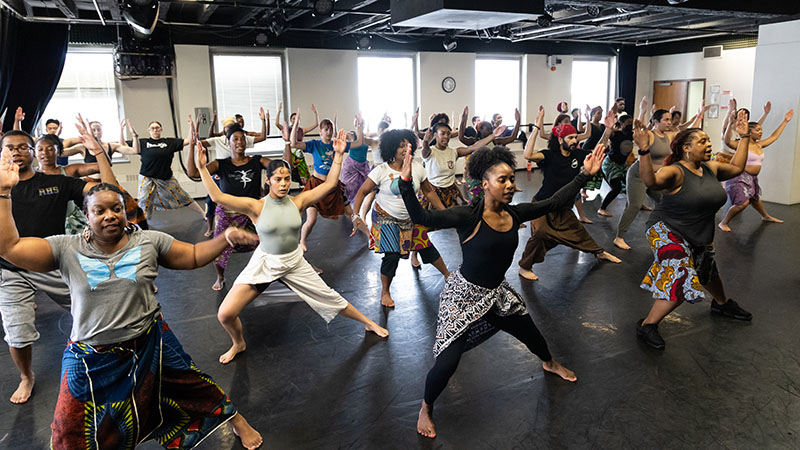
Photo by Aeria Charles
~~
To learn more, visit www.umfundalai.net.