Dance in the Desert: Dance and Research in the Southwest
November 9, 2026
BY YVONNE MONTOYA AND IMELDA CORTEZ
Note: This essay was first published in Stance on Dance’s Fall/Winter 2026 print issue. To learn more, visit stanceondance.com/print-publication.
“You are a dance company that does research? Why?” These are the questions that are often asked when the staff at Safos Dance Theatre speaks about the company’s multifaceted dance advocacy and research initiative Dance in the Desert: A Gathering of Dancemakers.[1] Founded by Safos Artistic Executive Director Yvonne Montoya in 2017, Dance in the Desert initially began as a gathering of Latine Dancemakers in Arizona with the goal of uplifting Latine dance artists of all genres and backgrounds by connecting dancers across geographies and centering local expertise. In response to the ever-changing needs of the Arizona dance community, and the ongoing needs of the dance company that runs the program, Dance in the Desert has shifted, evolved, and even went on hiatus for a few years before re-emerging in 2025 as a multi-state binational dance research initiative.
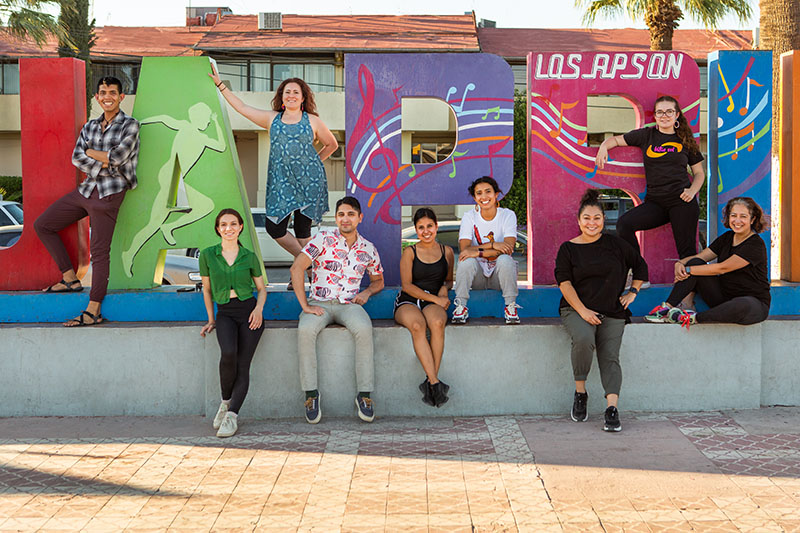
Dance in the Desert 2022, Photo by Brian Halbach
What is the Dance in the Desert initiative?
The inaugural Dance in the Desert took place in Phoenix on April 26-28, 2018. The first gathering brought Latine dance professionals from three communities in Arizona: Tucson, the small border town of Douglas and Agua Prieta in Sonora, México, and the Phoenix-metro area. In addition to Arizona dance artists, we invited dance leaders, researchers, and administrators from other Latine communities nationwide to join the three-day convening. The first gathering included work-in-progress showings, meetings among dancemakers and arts administrators, and focus groups.
Following the success of the 2018 Dance in the Desert pilot program, Safos Dance Theatre and co-organizers hosted a second gathering in Tucson from May 15-19, 2019. This gathering focused on professional development by providing dancemakers and choreographers space to connect with dancers and incubate new work.
Dance in the Desert 2020 was set to take place the first weekend of May in Douglas and Agua Prieta. Due to the pandemic, the gathering was postponed until May 2022. Instead, co-organizers offered a series of free professional development webinars. In 2021, the Dance in the Desert community met virtually in a series of quarterly online happy hours where dancers shared resources about upcoming grants, online performances, and calls for artists.
Dance in the Desert returned May 19-22, 2022, in Douglas and Agua Prieta. The gathering featured professional development workshops and eight master classes of various styles from both sides of the border.
After 2022, Dance in the Desert was put on hiatus as the company shifted focus towards the premiere of its first national touring work. It is important to note that the Dance in the Desert initiative was not meant to be ongoing. Rather, it was meant to be a catalytic moment to inject resources into a community to spark growth and fuel momentum. The goal of Dance in the Desert was to connect geographically isolated dancers with regional and national dance communities while centering local expertise.
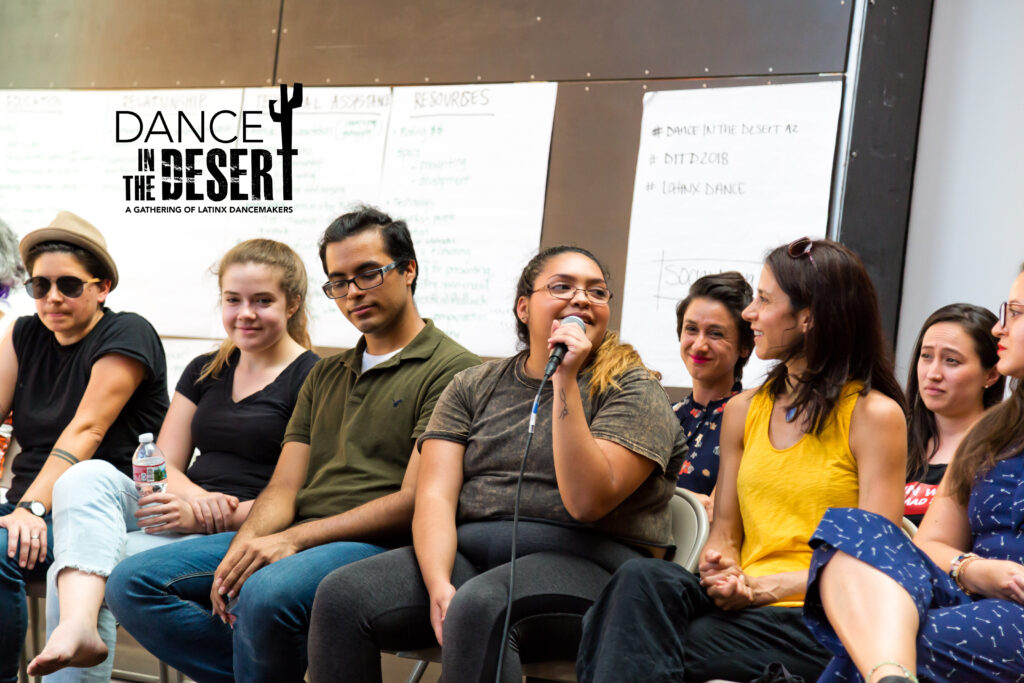
Dance in the Desert 2018, Photo by Dominic AZ Bonuccelli
Dance in the Desert and Research
Research is an integral part of the Dance in the Desert initiative. The program is grounded in Participatory Action Research (PAR) methodologies. Since 2018, Dance in the Desert organizers collected data including one-on-one interviews, pre- and post-gathering surveys, and program debriefs at each convening. This research informed the content of each year’s gathering. The goal was to get a clearer understanding of the specific strengths and challenges of Latine dance artists working in Arizona.
In general, there is a need for more robust research regarding dance artists and communities. While initiatives like Dance Data Project collect and publish important information regarding the national dance community, the research focuses on the largest 150 US-based ballet and classical companies and the largest 150 US-based contemporary and modern dance companies. This important research unintentionally overlooks individual dance artists and smaller companies that are working in geography beyond the coasts, like Dance in the Desert artists.
The National Association of Latino Arts and Cultures published “A Mirror and a Map” using the data from the 2024 National Latinx/é Arts and Culture Survey. The website shares data on Latine arts organizations across the United States and Puerto Rico. However, the data set does not have a specific dance section. Rather, dance exists under the larger umbrella category “performing arts” lumped together with music and theater. The research component of Dance in the Desert seeks to fill these gaps in dance research.
Dance in the Desert 2025 Research Initiative[2]
In 2025, Montoya assembled a team of 10 researchers, community liaisons, and dance administrators to conduct 58 interviews with dance artists ages 18 to 75 across New Mexico, Arizona, and the US/Mexico Borderlands. The central question we set out to answer was: What does it take for dance artists and communities in the Southwest not simply to survive, but to thrive?
Arizona
In Arizona, the Dance in the Desert team interviewed past gathering attendees to see if past gatherings left a lasting mark on the dance artists who participated. Of the 21 dance artists of the original cohort, the Dance in the Desert team interviewed 17.
New Mexico
In 2025, Dance in the Desert expanded into New Mexico, conducting 41 interviews with self-identified Latine dance artists throughout the state. Facilitated by community liaisons, the Dance in the Desert team did in-person interviews with artists from eight communities in New Mexico. The goal was to learn about the strengths and challenges of New Mexico dance communities while exploring the idea of cross-state connections and collaborations.
General Interest Forms
In addition to the in-person interviews, Dance in the Desert had a general interest form where any dancer from any location could take a survey and share the strengths, challenges, and experiences of their dance communities. We received 32 responses.
Research Findings
What emerged was clear: The Southwest is home to deeply vibrant dance ecosystems rooted in cultural memory, community care, and artistic innovation. For the Latine dance artists we spoke with, dance is far more than performance. It’s education, healing, storytelling, cultural preservation, and relationship-building.
Spotlight New Mexico
The New Mexico interviews portray a dance community that is vibrant, culturally rooted, and resilient, but fragile in its material conditions. Interviewees describe a landscape rich in folklórico, flamenco, hip-hop, contemporary, and traditional forms, with a strong sense of place and family-rooted belonging, yet one that remains vulnerable to underfunding and inconsistent infrastructure.
The strongest theme in the New Mexico data is scarcity. Artists describe financial barriers, a lack of affordable and dedicated rehearsal and performance spaces, limited mentorship and culturally resonant teaching, and a persistent urban-rural divide that leaves southern and smaller communities feeling overlooked. Several analyses also note that success is often imagined as something that happens elsewhere, which contributes to fragmentation and discourages long-term investment in local careers.
At the same time, the New Mexico interviews make clear that the community is ready for collaboration, preservation, and growth. Artists want shared resources, stronger mentorship pathways, and better documentation of traditional dance narratives.
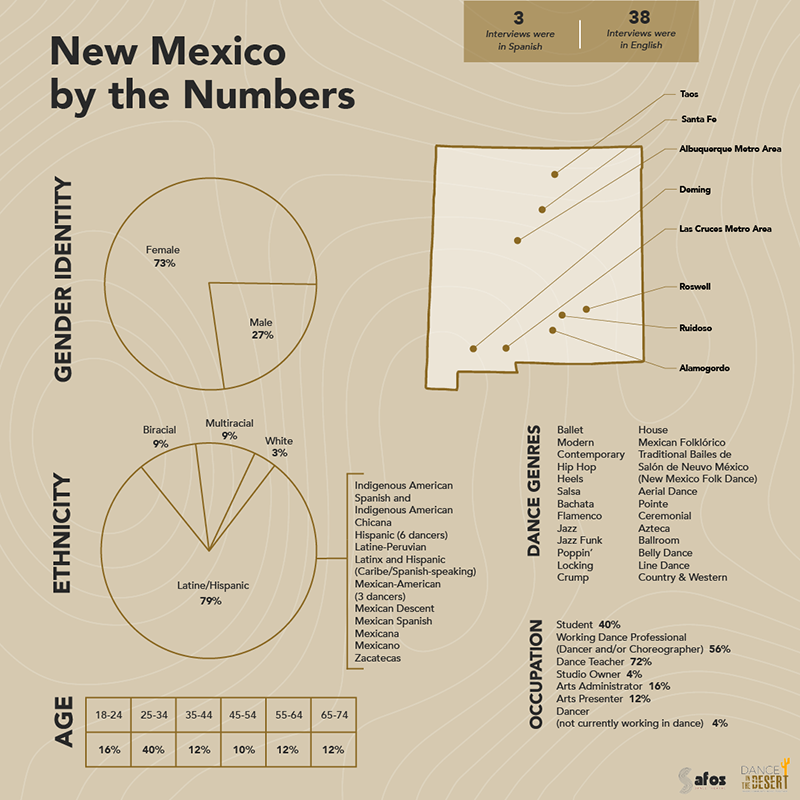
Infographic by by Lauren Memarian
Spotlight Arizona
The Arizona interviews describe a welcoming, collaborative, and culturally expansive ecosystem that is simultaneously under-resourced. Artists repeatedly identified financial instability, lack of institutional care, limited paid opportunities, insufficient space, and uneven access to professional development as core barriers, alongside geographic gaps that leave border communities and rural areas underserved. The recurring takeaway is that artists want stronger systems of support, not just more events: sustainable funding, mentorship, accessible space, and more intentional cross-regional and interdisciplinary collaboration.
In Arizona, part of our research questioned the impact of past Dance in the Desert gatherings. We learned that the gatherings were critical relationship-based ephemeral infrastructure for professional development, community building, and cultural preservation across Arizona and the Arizona/Sonora Borderlands region. Participants described it as a transformative experience that shaped their artistic identities, expanded their professional networks, and provided essential resources.
Past Dance in the Desert attendees told us that Dance in the Desert was a moment that changed the trajectory of their careers. In particular, dance artists in rural border communities stated that the gatherings were a vital link to a broader professional network. Dance artists shared that the Dance in the Desert gatherings provided real opportunities like new collaborations, job offers, and cross-regional projects, often sparked by a single conversation. Dance in the Desert provided a rare dance space where cultural roots and contemporary practices were honored side by side.
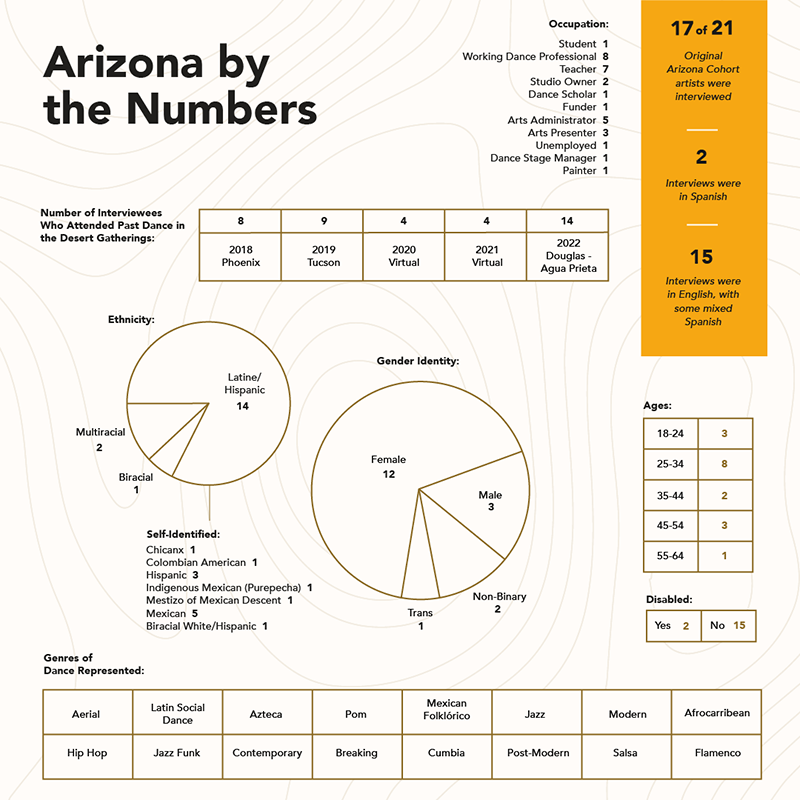
Infographic by by Lauren Memarian
General Interest Forms
Dance artists who filled out the general interest forms were predominantly Latine/Hispanic (37.5%), female (68.8%), and LGBTQ+ (37.5%), with strong representation from Phoenix and Tucson. Material needs (space and funding) were the most concrete and urgent barriers. Community belonging was the dominant motivational theme. Participants were not just looking for classes; they were looking for a sense of collective identity and mutual support. This suggests that Dance in the Desert’s value lies as much in social infrastructure as in artistic programming.
In Conclusion
Looking across both states, the pattern is clear. The talent is undeniable. What is missing is the infrastructure underneath: stable funding, affordable space, lasting mentorship, and the kind of connection that turns scattered communities into a real regional ecosystem. The findings of this study reveal a shared reality: The Southwest already possesses an extraordinary wealth of artistic talent, cultural knowledge, and community-driven creativity. From Phoenix to Albuquerque, Tucson to Las Cruces, and Douglas to Deming, artists are building meaningful work that reflects the histories, identities, struggles, and aspirations of the region. Dance communities across both states are deeply rooted in cultural traditions while also pushing toward experimentation, interdisciplinary collaboration, and new forms of storytelling that speak to the contemporary Southwest experience.
At the same time, the research makes it equally clear that artists cannot sustain these ecosystems through passion alone. Across both states, the same structural barriers repeatedly emerged: chronic underfunding, lack of affordable rehearsal and performance spaces, limited mentorship infrastructure, geographic isolation, uneven access to resources, and insufficient long-term investment in artists. While Arizona artists often described a growing but uneven infrastructure centered in urban areas, New Mexico artists emphasized fragmentation, rural isolation, and the ongoing struggle for visibility and resources outside major cultural hubs. Despite these differences, both states ultimately confront the same question: How can the Southwest build a sustainable regional dance ecosystem that allows artists not only to remain in their communities, but to thrive within them?
The interviews strongly suggest that the answer lies in collaboration. Arizona and New Mexico are uniquely positioned to work together because their dance communities are already connected through shared borderlands histories, migration patterns, cultural traditions, educational networks, and artistic influences. Rather than functioning as isolated state ecosystems, the findings demonstrate that the future of dance in the Southwest depends on building stronger regional relationships that allow artists, educators, organizers, and institutions to share resources, knowledge, and opportunities across state lines. Rural and border communities, which are often excluded from larger arts infrastructures, should be centered within these efforts rather than treated as secondary participants.
Ultimately, this research demonstrates that the foundation for a thriving Southwest dance ecosystem already exists. The artists are here. The communities are here. The cultural knowledge, creativity, and commitment are already deeply present. What is needed now is a sustained infrastructure that matches the depth of that artistic labor. Dance in the Desert has already shown what becomes possible when artists are given space to gather, collaborate, and build relationships across boundaries. The next step is not simply maintaining that momentum but expanding it through deeper partnerships between Arizona and New Mexico that transform isolated efforts into a lasting regional movement for dance in the Southwest.
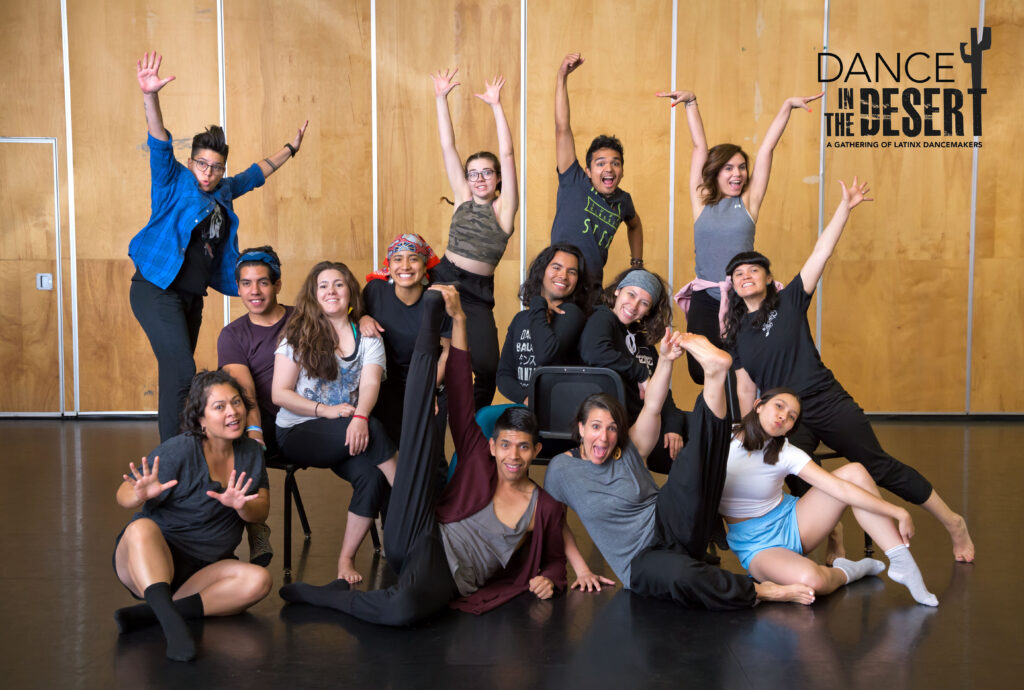
Dance in the Desert 2019, Photo by Dominic AZ Bonuccelli
~~
A full research report on the Dance in the Desert 2025 Research Initiative is published on the Safos Dance Theatre website. For more information, visit www.safosdance.org or contact safosdance@gmail.com.
~~
[1] Dance in the Desert is separate from the similarly titled Las Vegas Dance in the Desert Festival.
[2] The Dance in the Desert 2025 research team included Yvonne Montoya, Principal Investigator; Imelda Cortez, Researcher; Mireya Guerra, Research Consultant; Arizona Community Liaisons Ammi Robles and José José Arrieta Cuesta; New Mexico Community Liaisons Martín Quintana and Angel Guanajuato; Project Administrators Megan Neese, Amelie Fisher, Baylie MacRae, and Wesley Creigh.
Responses
There are no comments at this time.
Be the first to start the discussion by filling out the comment form.