The Time Taken
November 2, 2026
BY TOBY MACNUTT
Note: This essay was first published in Stance on Dance’s Fall/Winter 2026 print issue. To learn more, visit stanceondance.com/print-publication.
In March of this year (2026), I premiered my solo show A Singular They. The road from first brainstorm to public viewing was eight and a half years long. This was easily three times the development length of any prior piece of mine. I didn’t choose to do it that way, and at many points thought it would never be seen, but the process of taking time was, itself, illuminating, and ultimately served the work.
The goal of the show was to take audiences into my embodied existence. As a queer, trans, nonbinary, and disabled person who uses varying mobility aids, the way my body exists, appears, and moves is fluid. This fluidity has often been perceived as contradictory or purely performative. With this solo work, I wanted to get audiences to a point where they could experience all these facets as simultaneously true and overlapping, the way that I live in them, instead of trying to decide which one is the “real” me. I settled on eight linked vignettes in different movement modes, with collaborating co-choreographers on five of them to help keep the pieces distinct, stretching fully into my inherent variation. There is no narrative and very little text; the goal of the show is to convey myself by being, not telling.
The first notes were made in late 2017; choreography started in 2018; the first excerpts of the work were shown in summer 2019; so far so normal. I landed a residency in fall 2019 at the New England Center for Circus Arts (NECCA), as the work contains two aerial pieces and a piece on ladders as well as ground dance. We restructured the residency to meet my access needs. I did a long weekend or so at a time, then went home for a few weeks, then returned, a first intentional elongation of the process. By February 2020, the choreography was complete. I had a set and rigging that fit in my car, music was being commissioned, and I could run the entire 65-minute, always-on-stage, all-changes-visible piece. I was ready for an in-progress showing in April 2020, then looking into technical residencies for a premiere in 2021.
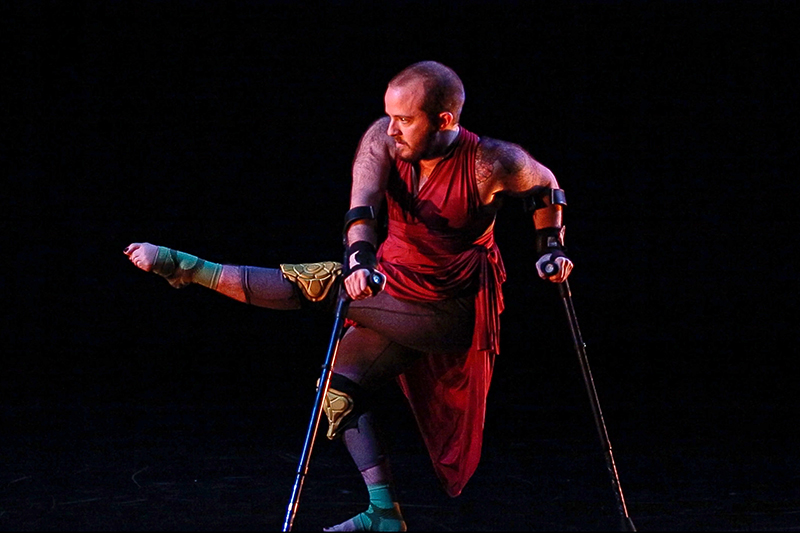
Photo by Robyn Nicole
Of course, that is not what happened, and then the unplanned elongation began.
When it became clear that in-person work was indefinitely delayed, NECCA filmed the show in August with strict COVID-19 precautions: aggressive ventilation, only two people besides me in the entire building, both masked with filtration. I hadn’t been able to rehearse and I had no audience; it was a strange and emotional time. We showed that informal film in November 2020 at a well-attended but distant-feeling virtual showing. During this time, I also received my first-ever nationally and regionally competitive funding in the form of a MAP Fund grant and NEFA’s New Work New England program, both sadly now defunct. I had an actual budget for the first time in my career… and I could do nothing.
For a while it seemed all I did was nothing. It became clear that as a higher-risk person, and someone who believes in not putting my community at risk either, that I could not perform in person, and certainly not embark on a tour. (I still can’t, and now for safety reasons as a trans person as well.) I had little to no access to rehearsal or body conditioning for several years. I wrestled with what to do. I thought about the work I’d made so far. I thought about filming. I debated giving the money back and quitting. I thought about the work, and thought about the work some more, and wondered whether it was worth it.
It is a strange thing to make a solo show. To put your body, and only your body, your whole self, in front of an audience, and say: “Look at me, and only me, for the next hour.” To say “I am interesting enough to be looked at; I am worth being looked at by strangers for an hour, in detail, in depth. I am responsible for you for the next hour, and I am holding that alone, and it will be worth it for all of us.” It feels bold to the point of egotistical; at the same time, it feels excruciatingly vulnerable.
But one of the first things I learned even pre-pandemic was that I would not be alone. Even though I am the only body performing—and am also the producer, and costumer, and set designer, and describer, and marketer, and soundscape composer, and as many other roles as I can possibly hold—there are more people in the credits for this “solo” show than any ensemble work I’ve ever made. Co-choreographers, on-site assistants, musicians, videographers, and more. I realized early on that they were not only pragmatically important but essential to the content and meaning of the piece. This is a work about identity, and no identity exists in isolation. Not all my co-choreographers or other artistic helpers share my various identity labels—some share some but not all, some share none—but each has some connection to how my life is lived out. That’s where my community is, especially as a rural dancer. I was working on my own, often, but not alone.
Those relationships are a big part of what kept me going. I wanted the work to go out into the world and create more relationships, more community. I wasn’t always entirely sure I wanted to be seen, or was worth seeing, but I knew someone like me was worth seeing, and that someone else out there needed to see it. I wanted an option besides isolation, for me and for others both like and unlike me. (As the years have tilted further into fascism, this being seen—unapologetic, unexplained, intimate—has become both scarier and more urgent.)
So I continued: In 2023, I started the slow pivot to film. I found a local videographer whose work I admired and who understood the heart of what I was trying to do. I began looking for sites that would add further depth and context to the pieces. In early 2024, I secured rehearsal space and started trying to get back to performance readiness. In August through November 2024, we filmed. Each vignette was set at a different site around Vermont, and after traveling there, setting up, filming in broken-up chunks for several hours, breaking down the set, and heading home, I needed recovery time before I could do it again. I also needed time to dust off the next piece being filmed, as I was reviving, rehearsing, and revising those pieces in the order the sites were available, not in show order.
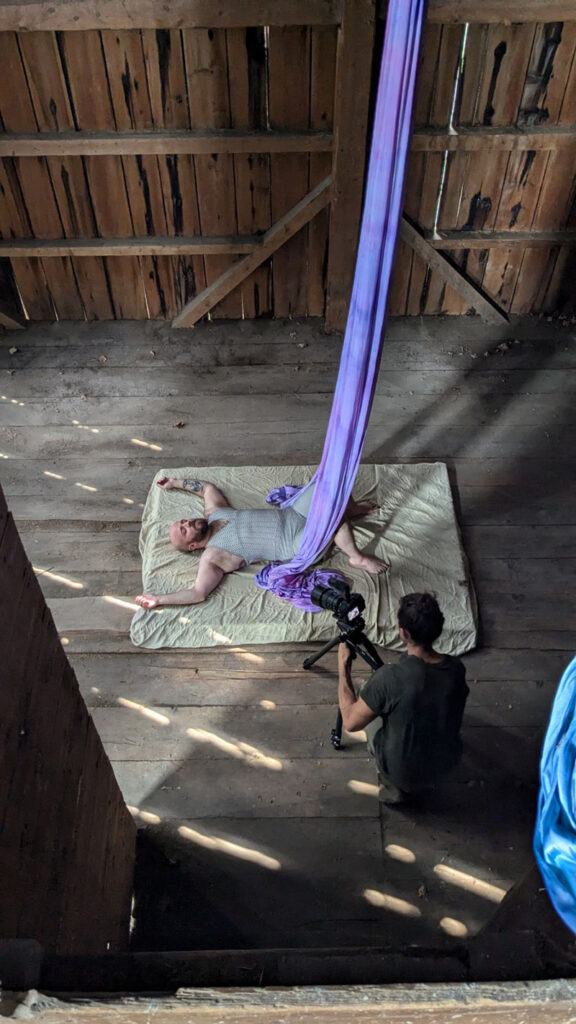
Photo by Nicole Dagesse, Videographer: Andreas John
I worried so much along this lengthy, unfamiliar path. I worried I would not know how to do the choreography anymore—but I remembered it. I worried I would not be able to do the choreography anymore—but I adapted. I was slower and more deliberate instead of working off muscle memory, and this made the performance itself deeper and more deliberate. Those three years I had spent “doing nothing,” thinking and worrying over the heart of the work and questioning whether it was worth it, gave me a deep understanding of what the heart of the work actually was, and that made sinking into it, revising and adapting it, directing the camera to follow it, all the easier. And more accurate! I had, in the earlier years, talked about the heart of the work as “change”: change in body, gender, pain, mobility. Time had shown me that the actual core of the work is consistency. There is still fluidity, yes, but not discrete states, only overlaps, building into one cohesive, constant self. Conscious realization enabled supportive production choices in filming and editing: each vignette flows continuously into another with dreamlike smoothness, with no broken jumps.
The money that had felt like such looming pressure now let me—thanks to flexibility from my grantors and fiscal sponsor—bring the work to completion in a completely unanticipated way. I could pay for the help I needed to make it accessible and beautiful. It also let me pay myself some, enough at least to take my time, again, in editing the film, which I chose to do myself. Edits and crafting the optional audio description took about a full year: a bit under 200 active at-computer hours all told, divided into chunks that my body and brain could manage. There are only so many continuous hours I can color-correct before my eyes threaten to fall out of my head. It seemed to take eternity, each task spawning other tasks like a fractal Xeno’s paradox. It felt like I would never be done.
It took the time it took: eight and a half years. In spring 2026, at last, it premiered in a well-attended virtual screening where the technology actually worked as intended (thanks to multiple tech rehearsals) and we were able to offer simultaneous described/non-described and captioned/interpreted versions. It was still strange to show it remotely, but the response was enthusiastic and gratifying, and continued past the post-show chitchat.
The work is still taking the time it takes. The rollout to film festivals or other showings is slow; I opted not to pursue an in-person screening over the summer but wait until perhaps fall, when audiences in my area are more inclined to come inside and look at a screen. Making the video available on demand has taken its own time.
When a project runs very long, hits many hurdles, and is plagued by level after level of self-doubt, there is a tendency to say things like “trust the process.” What process? I had not made a solo show before. I had not produced aerial and apparatus choreography myself before. I had not had major funding before. I had not had work interrupted by a global pandemic before. I had not made a feature-length dance for camera before. Some of these processes I could research or reference; others were effectively unprecedented. More useful, I think, is that it takes the time it takes. It takes time to figure things out. There is always another level of “I don’t have to do things this way”: I don’t have to take 21 days of residency in a row; I can spread them out over six months to make them manageable. I don’t have to perform in person to have an emotional performance. I don’t have to film in order, or all at once, or in continuous takes. I don’t have to schedule my virtual and in-person screen premieres in the same timeframe.
I see this with accessibility a lot, in myself and others: people might try to do something in a more accessible way before realizing we are still replicating an inaccessible structure we didn’t even realize was embedded. So we revise again. And this is true of so many processes and so many ways of trying to create, to imagine new and better and more human ways to be. Time lets us have our whole range of feelings; time lets material and knowledge settle in our body; time lets us make mistakes and recover; time lets us make changes. Time lets us be fully human; and in case that’s not enough in itself, humanity makes our art better and richer.
I hope my next work, whatever and whenever that will be, is not quite so elongated, and the circumstances not so unprecedented. The process for A Singular They was exhausting, often agonizing, and generally uncertain and precarious. Sometimes I miss the version that might have been. But I love what it has become, and it needed every bit of those eight and a half years to get there. I hope I’ll remember that next time.
It takes the time it takes.
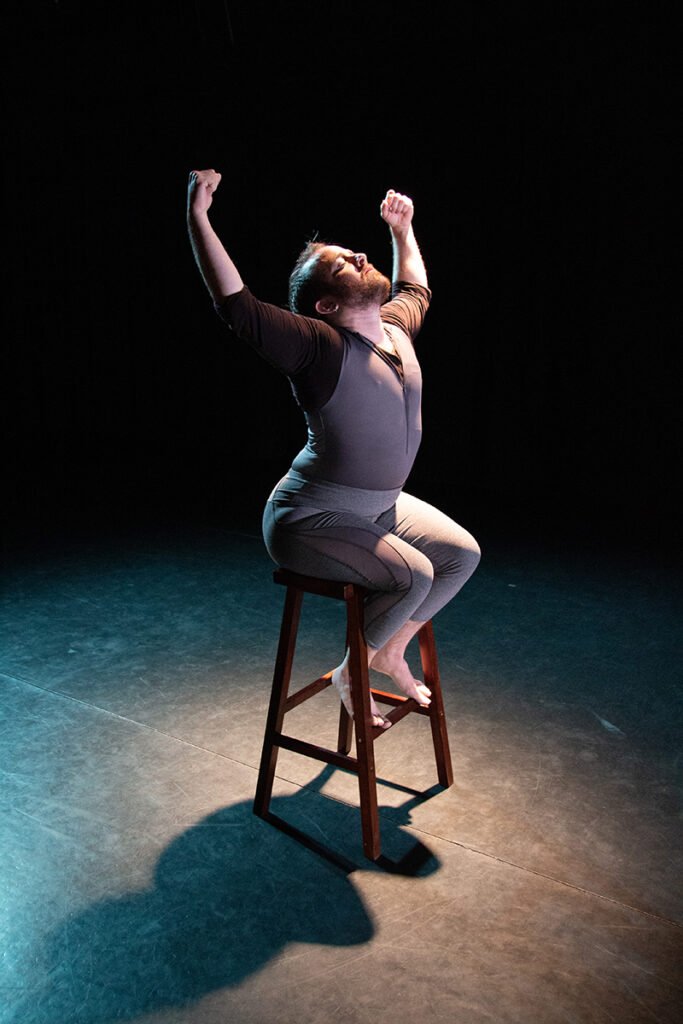
Photo by David Punia
~~
Toby MacNutt (they/them) is a queer, nonbinary trans, disabled dancer and author living in rural Vermont. Find out more about viewing A Singular They at www.tobymacnutt.com.
Responses
There are no comments at this time.
Be the first to start the discussion by filling out the comment form.