Freedom is a Constant Work
October 12, 2026
BY AJANI BRANNUM
Photos by Ciro Hurtado
Note: This essay was published in Stance on Dance’s Fall/Winter 2026 print issue. To learn more, visit stanceondance.com/print-publication.
~~
Dancing Through Prison Walls, FREEDOM TIME
Odyssey Theater, Los Angeles, CA
February 6 – 8, 2026
~~
“You built this place / Forgetting it was there in you / And so it grew / Into you, your home, your schools […] / You see you can’t see me / Because I am you” [1]
Read the words of this poem, “I Am You” by Forrest Reyes. Where does it place you, in time and space? When you reach the closing lines, are you still who you think you are? What’s the difference between the speaker’s experience and yours? What is “this place” they mention? How does it worm its way into our everyday spaces? Does it have an outside? And if so, how do we get there? Reyes’ words seem to answer this question as they ask it. Words become movement in his writing, and movement transforms into words. When these forms of expression combine, they hold the power to reshape the world.
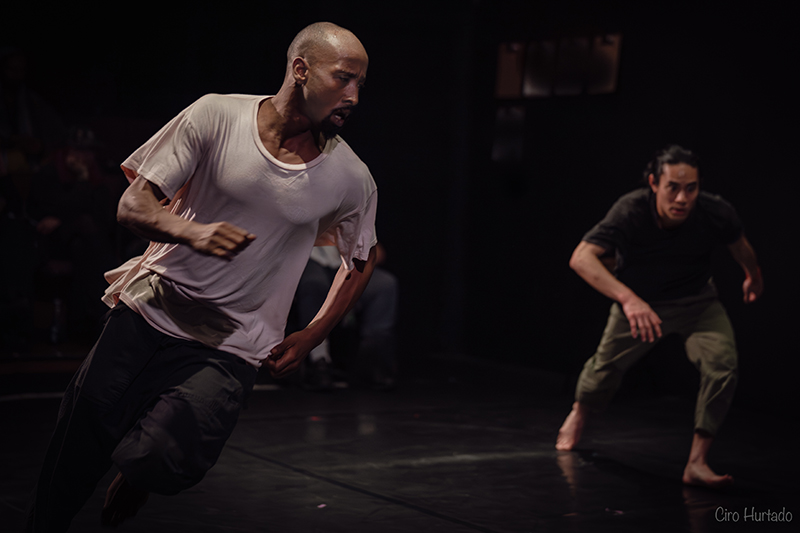
Dancing Through Prison Walls (DTPW) is an ongoing performance collaboration between incarcerated, formerly incarcerated, system-impacted, and “free-world” artists. It began in 2016 when Suchi Branfman, DTPW’s founder and artistic facilitator/director, initiated a 10-year choreographic residency at the California Rehabilitation Center, a medium-security state prison in Norco, California.[2] Through a combination of workshops, conversations, and performances – both inside and beyond the walls of CRC – DTPW uses dance to imagine a world without prisons. On the surface, dance and prisons may seem unrelated, just as life inside a prison may seem separate from life outside it. But, as demonstrated by DTPW’s most recent performance, FREEDOM TIME, movement can shed light on the relationships between incarceration, liberation, and the relationships that make transformation possible.
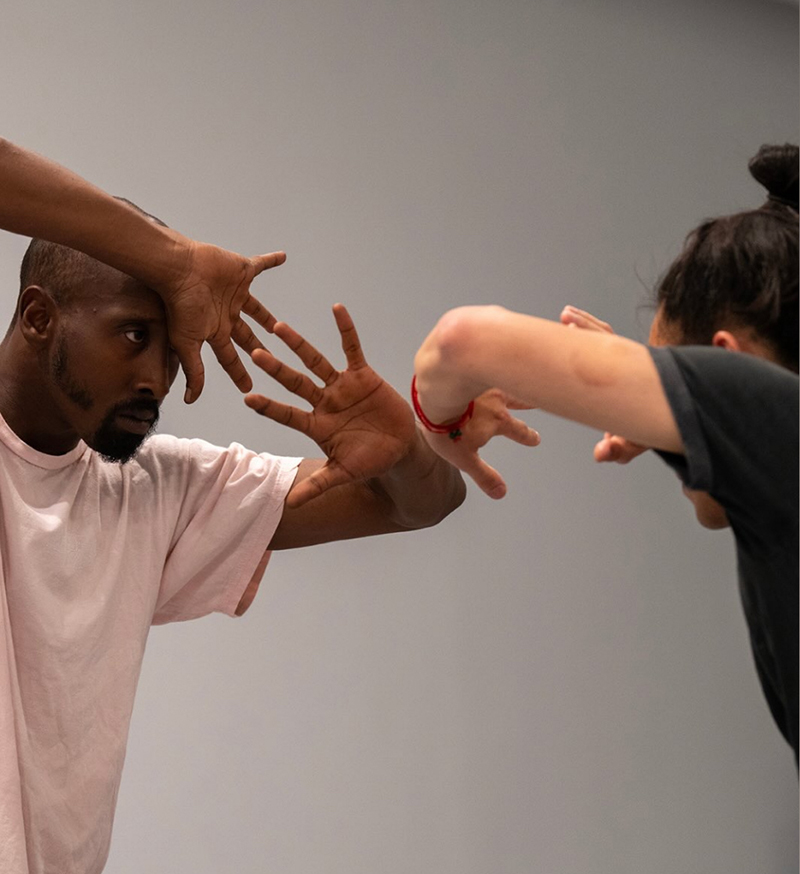
All DTPW’s projects are deeply collaborative, with “inside” and “outside” dancers creating short works that narrate the emotional, physical, and psychic dimensions of incarceration. The group’s work took a turn in 2020, when COVID restrictions blocked Branfman and her team from entering prisons. In response, Branfman devised a strategy that would allow the work to continue remotely. Instead of relying on video-calling tools like Zoom (which were banned in the prison), the DTPW team wrote and exchanged dances on paper: poems, stories, and creative visualizations all became prompts for movement. “Inside” dancers wrote down the dances they created, and sent them to their “outside” counterparts to embody and present both onstage and on video. (DTPW has collected and published many of these scores as a book, also called Freedom Time.[3]) This choreographic method is key to the mission and impact of DTPW’s work.
By transmitting dances in written form, the DTPW team continues a tradition of creating choreographic scores. Roughly defined, a score is any tool a choreographer uses to outline and convey a dance’s most important information to their performers.[4] Scores can be grouped into two broad types: scores that “[represent] the piece itself,” movement by movement, and scores that function as “a tool for information, image, and inspiration,” a set of guidelines for dancers to consult as they bring the dance to life.[5]
Dance scores share a function, and a name, with sheet music: what’s written on the page shapes what happens on stage. While some scores dictate a piece’s performance down to the smallest detail, many experimental choreographers prefer to leave their scores more open ended. In the latter case, dancers have plenty of room to interpret the instructions in their own ways. For this reason, choreographers often use scores to encourage improvisation and collaboration. They invite dancers to experiment, question, and tweak their own decisions as they turn the idea of a dance into an embodied reality. This quality makes scores especially useful when asking how dance can function as a tool for liberation. As DTPW collaborator Romarilyn Ralston (who spent more than two decades in prison) writes, scores equip DTPW’s collaborators – especially those who are incarcerated – “to choreograph in [their] mind[s] when the body is in captivity.” [6]
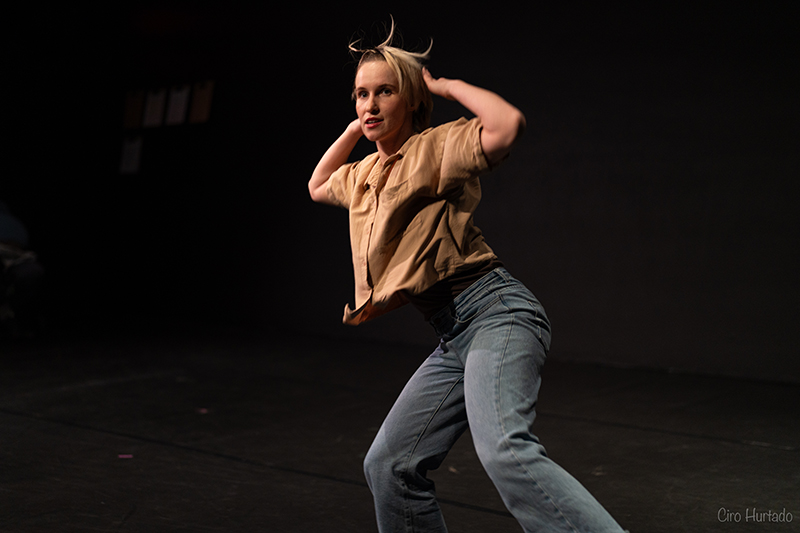
FREEDOM TIME presents interpretations of six DTPW scores. They reflect the range of the program’s growth, bringing together works by incarcerated people in four US states, Puerto Rico, and Palestine. These “imagined, dreamed, and written dances” [7] push on the connection between dancing and confinement from the show’s very beginning. Franchesca Nadal Cruz’s score “Un, Dos, Tres, Quatro, Cinco, Seis” opens the show with a sudden start; Amy Oden (the score’s choreographic interpreter/performer) enters quickly, almost frantically. Her gaze flits rapidly, following the rambling path she traces in the air with a single finger. She marks lengths with her footsteps, fingers, and thumbs. First through measurement, then through measured movement – a six-step sequence of turns, runs, jumps, lunges, and kicks – Oden marks out a small, confined space for dancing.
Cruz’s text (recited in English by Oden, and in Spanish by Denise Blasor) hints at the space in which she made the dance: a small cell, empty, perhaps, except for a mirror and chairs. A single chair occupies the space Oden fills with her variations on the six-movement phrase. As the dance progresses, her choreography carves sprawling pathways through the space, even up into the aisles of the seating area. It explodes past the confines described both by Cruz’s writing and Oden’s original phrase. Yet, Oden returns to the chair, again and again. “I sit in the chair alone,” Cruz’s text notes, “being in a cell on a chair and in front of the mirror all we can do is wait.”
Each dance in FREEDOM TIME shows us what can happen in that space of waiting. Some of the scores invite their interpreters to amplify, almost literally, the voices of their authors. Rhythm tapper Kenji Igus interprets two poems – Bartholomew’s “The Revolutionary Shuffle” (narrated by Flow Perona) and Ellis’ “Breaking Chains for a Change” (narrated by Terry Sakamoto Jr.) – that pay homage to Black and Brown resistance movements and the music and social dances that underscore them. Igus’ tap rhythms unfold continually against these soundscapes. At times they are punctuated by silences, explosions, and the sounds of scuffle. Nevertheless, they dissolve and re-form around an unrelenting musical pulse. Both poems vividly demonstrate how music and dance function as more than entertainment; they are a relief from the ongoing work of social struggle. Through these dances, we see, hear, and feel how these forms grant marginalized folks the energy to keep keepin’ on.
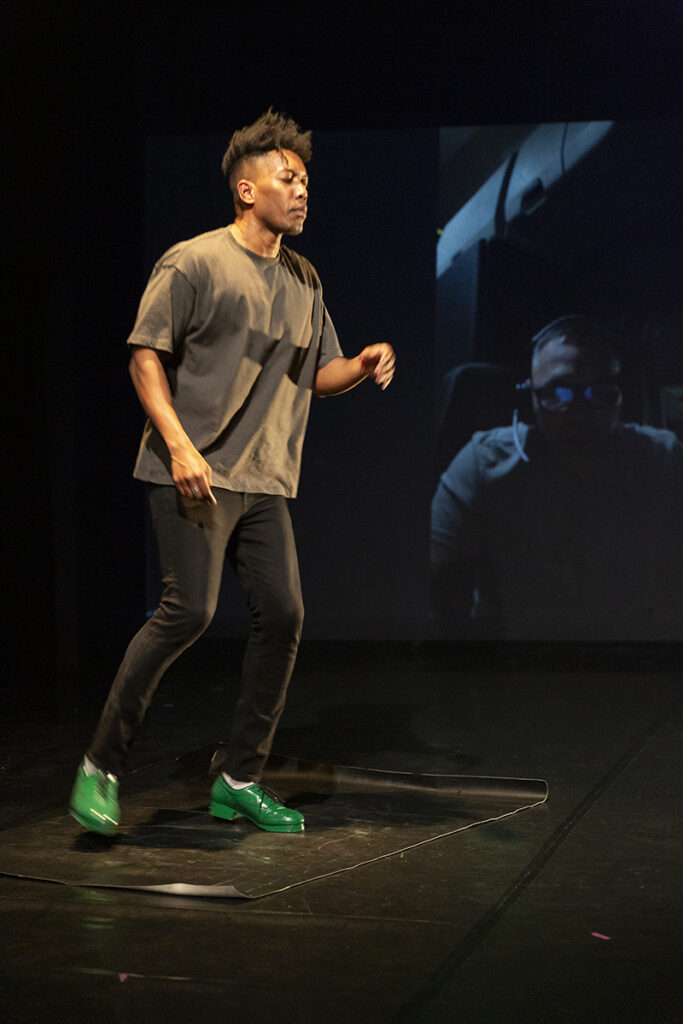
Sound also guides Mims’ interpretation of Amneris Manzano Diaz, Neilyann Rivera Rodriguez, and Sheyla Rosa’s collaborative poem “…to dance in the river / …un baile en el rio.” As she enters the stage, Mims’ recitation gives way to steady foot-stomps and body percussion, both of which unfurl into a fluid, full-body groove. The movement grows and shrinks, now soft, now sharp; in fragments, it echoes the poem’s images of a breaking heart, a “time bomb” of “mixing feelings,” the current of rushing water. Mims’ percussive movement meditation creates literal resonance between the words of the poem and Mims’ interpretation of them. By highlighting the emotions associated with incarceration – from fear and depression to lightness and freedom – the piece invites us to hear, see, and feel freedom dreaming all at once.
Many dances in FREEDOM TIME zoom in on incarceration’s sensory dimensions. In his interpretation of Justin Rovillos Monson’s “Lockdown Poetics,” Jay Carlon moves beneath, then on top of, an air-cushioned sheet of plastic, cut to the size of a standard prison cell. The scene conjures images of a membrane or a womb. The rasp of skin on plastic blends with the phone-call static of Monson’s recorded voiceover. Carlon’s sweat and breath echo the poet’s practice of “atomiz[ing] my body into layered / Script”: heeding his senses as a way of keeping himself humanly alive. By the piece’s end, Carlon’s movement has completely shredded the plastic sheet. Like Monson’s words, the plastic – and the dancing – bear witness to deeply felt, if temporary, experiences.
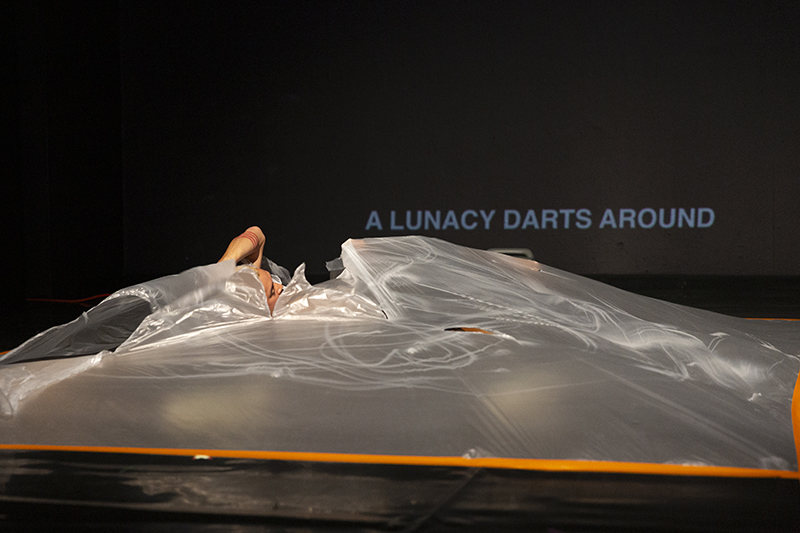
Watching “Lockdown Poetics,” I’m always aware that I’m seeing Carlon dance; I never quite get to put myself in Monson’s shoes. But this is not a failure. In fact, “Lockdown Poetics” uses dance to bring two intensely physical experiences together in a single moment. Maybe this is something other than empathy. While empathy may, as dance studies scholar Susan Leigh Foster argues, allow us to “project [our bodies and feelings] into the energy and action of the other [8],” the dances in FREEDOM TIME do not ask viewers to imagine themselves as incarcerated. Instead, each score poses a challenge to the performers who interpret it; each dancer is invited to grapple with their own limitations – like stage space and minimal props – as they bring each score to life.
Motasem Abu Hasan’s “Mu’tqala/Detainee” (interpreted by Barges Smahneh and Tom Tsai) vividly illustrates this task. In terse, often grim language (narrated by Romarilyn Ralston), Hasan’s score presents eleven scenes in the life of a Palestinian prisoner. Its choreography references a wide range of movements: small glances between jailer and detainee, menstrual cramps, the sensation of spiritual transcendence. In contrast to this starkly imagined world, Smahneh and Tsai navigate a landscape of baskets, rocks, and bolts of cloth. They complement Hasan’s text with pedestrian physical tasks: mirroring each other’s movements, throwing and balancing on stones, wrapping one another in fabric. Each task references the imagery in Hasan’s writing – but, more importantly, the tasks present Smahneh and Tsai with a relentless challenge. Their risky, even dangerous, choreography creates an entire world out of limited resources. The dancers’ imaginative resourcefulness may be awe inspiring, but it can never be separated from difficulty and risk. In this sense, FREEDOM TIME teaches a powerful lesson about abolition: a person does not need to be incarcerated to experience the effects of confinement.
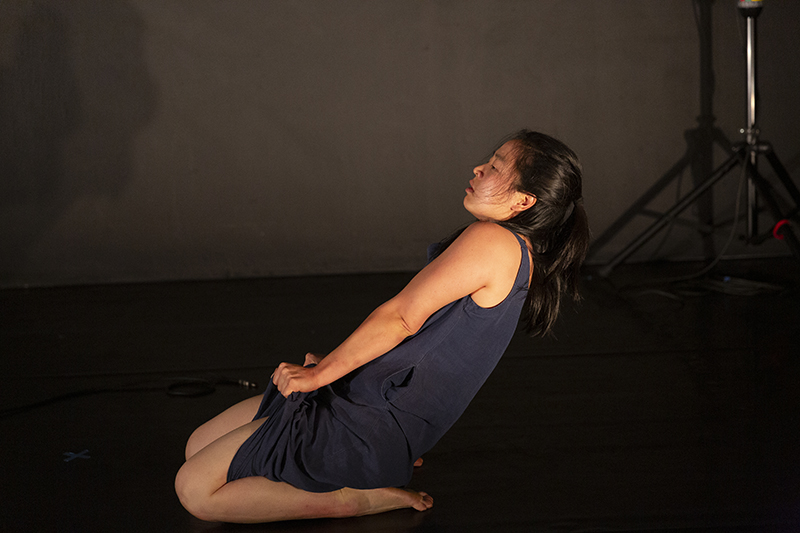
If this is true, how can folks in the free world contribute to abolitionist work? Yarelys M. Rossy Perez’s “El Final/The End,” interpreted by Selina Ho, depicts the fight for freedom as a path strewn with heavy stones and vicious predators. More than most of the pieces on the program, Ho’s dance deals directly with the limitations of stage space. She tussles with a set of sound speakers and a tangle of electrical cables. Her improvisation stays close to the floor, unfolding as a winding chain of falls, crawls, and rolls. Ho struggles the entire way, but by the piece’s end, she sits still, having completely changed the arrangement of speakers and cables in the space. Ho does not dance freely, and Perez’s poem does not magically abolish prisons. But “El Final” (like all the dances in FREEDOM TIME) shows us freedom is an ongoing attempt to transform the world as we know it.
Dancing can be, like Oden and Cruz’s mirror, a way to “see beyond reality”: not as an escape, and not as a tool for simple empathy, but as motivation to create a more just world. FREEDOM TIME shows us that getting rid of prisons starts with questioning the rules that structure our lives – what we call choreography, or what we call justice. Ultimately, these rules are made by people, which means they can be remade. Abolition, like a dance score, may make seemingly impossible demands. What can happen when we embrace that fact as an invitation to imagine, and then to act? FREEDOM TIME and DTPW embrace this challenge by sending scores through prison walls, and putting formerly incarcerated and system-impacted dancers at the core of their work, among other efforts. All these practices expand what many people might consider both dance and justice. It’s not all struggle, but it is all work.
~~
Dancing Through Prison Walls is a California-based dance and performance project whose mission is to dance with, choreograph with, and tell stories within embodied carceral landscapes and beyond, amplifying voices of incarcerated folks, and addressing mass incarceration. Through this work, DTPW moves towards their North Star goal of decarceration and abolition. Learn more about DTPW at www.dancingthroughprisonwalls.org.
Ajani Brannum (he/they) is an undisciplinary artist and researcher whose practice is a meditation on performance, embodiment, and selfhood. Born in Anchorage, Alaska, they hold an AB in English and a Certificate in Dance from Princeton University, and a PhD in Culture and Performance from UCLA.
~~
The title of this review riffs on the phrase “freedom is a constant struggle,” a song lyric quoted by Angela Davis in her 2016 book of the same name.
[1] Forrest Reyes, “I Am You,” in Freedom Time: Dancing Through Prison Walls (Saratoga, CA: Sming Sming Books, 2025), 24.
[2] At the time of writing, CRC is slated to close in Fall 2026.
[3] To learn more about Freedom Time (and to purchase a copy), visit https://www.smingsming.com/products/freedom-time-dancing-through-prison-walls.
[4] Dance studies scholar Alison D’Amato roughly defines a choreographic score as “any schematization of choreographic structure rendering the central principles of a dance communicable.” Alison D’Amato, Mobilizing the Score: Generative Choreographic Structures, 1960-Present (PhD dissertation), 2015.
[5] Jonathan Burrows, A Choreographer’s Handbook (London: Routledge, 2010), 141.
[6] “Introduction,” in Freedom Time, 7.
[7] Freedom Time, 81.
[8] Susan Leigh Foster, Choreographing Empathy: Kinesthesia in Performance, 11.
Responses
There are no comments at this time.
Be the first to start the discussion by filling out the comment form.