Shedding: Choose Your Own Adventure
June 1, 2026
BY KAI HAZELWOOD
Note: This article was published in Stance on Dance’s Spring/Summer 2026 print issue. To learn more, visit stanceondance.com/print-publication.
This is a choose your own adventure piece.
1. You are not reading this in some uncomplicated linear idea of the present. Your life, your history, and the future are all colliding as you encounter this. Instead of pretending otherwise, choose your own adventure, make your own structure, and construct your own timeline here. Let your instincts and curiosities pull you in any order you wish. You can read in one go, in one place, or not. You can read once or many times in different orders, places, times of day, with others, snacks, or any other way you can imagine encountering this. This is just a tiny introduction to Shedding, how it came to be, and where the adventure is ours to shape. And it never ends, just shapeshifts, again and again.
Sense into your toes, and if you don’t have toes or you can’t feel them, sense into the base of your body. Are your toes or your base warm or cold?
If they’re cold, go to section 2.
If they’re warm, go to section 3.
If you’ve already read section 2, go to section 3.
2. Kin: Organisms that are genetically related to another or others
This is who has kept me company through becoming and unbecoming during the process of dreaming, embodying and writing over the past six years, and also my lifetime. They are my kin, some of their genetic material, whether recognizable or not, is here in my research. These scholars, friends, chosen family, healers, teachers, and more make up the community that has formed/I’ve formed around me; their love, wisdom, writing, support, and, and, and, are part of the genealogy of my work and me. Some of them know this, others may never know, but I name them here because I know, and you should too.
My Boffice, or “bed office” where much of my writing and life takes place these days, and my pillow palace, the pillow system I purchased when it became clear my bed was going to be the center of my world for a while, are both critical parts of the genealogy of my writing and my body.
I am inspired by the words of American civil rights activist John Lewis. I am committed to making; making art, making room, making change, making good trouble.
Resmaa Menakem’s research in racialized embodiment and Somatic Abolitionism inspires me to value and respect the brilliance of my own body instead of prioritizing the theory of others.
Eva Yaa Asantewaa, Sarah Ashkin, Romi Brouwhuis, Laura Cull, Cheyenne Dunbar, Tatiana Ewing, Emilie Gallier, Gabs Garcia, Mars Garcia, Marlene Hall, Alex Millar, Ever Galvan, Rajni Shah, and more have impacted the genetic makeup of my research by affecting me; some as mentors, business partners, and/or chosen family.
Leah Lakshmi Piepzna-Samarasinha teaches me again and again that my journey through cripness deserves to be cataloged and shared; we all need the wisdom of crip body-minds to prepare us for apocalypse, because the future is in fact disabled.
Judith Halberstam teaches me that all the ways that I continue to feel like a failure are actually lessons in finding alternatives, and playful alternatives are what we need to survive apocalypse.
As a self-identified artist-agitator I also draw on the legacies of agitators past and present including adrienne maree brown, Audre Lourde, Alexis Pauline Gumbs, and Alice Sheppard. Like adrienne maree brown, I believe in the slow pace that deep, embodied, ethnographic research requires, or moving at “the speed of trust” as adrienne maree brown puts it. The way Audre Lourde lived so beautifully as an intellectual, a rebel, and as an artist inspires me to live my own identities out loud. Alexis Pauline Gumbs models how to learn from the wisdom of our more-than-human kin, and that perhaps inside their difference from us, lies the way to learn how to build a new world. Alice Sheppard’s rejection of an able, white, straight body as the norm teaches me about what is possible when our perceived limitations lead us down routes of experimentation we never could have dreamed of without them.
Dr. Shena Young’s magic in holding space for Black survivors to find their way back to themselves has brought me home to my own body again and again.
Bisoux, my snake-love, continues to teach me everyday and is my primary research partner.
Go to section 4.
If you’ve already read section 3, go to section 2.
3. I’m not sure where my story begins. It’s bound up in the stories that come before mine, the bodies that come before mine, what they’ve endured, learned, loved and survived. It’s intertwined with what might be after mine. Yes I know that language is a bit misleading: ‘before’ and ‘after.’
Go to section 4. . .
4. My work is this body. This body, so marked by grief and pain, is my life’s work.
Do one small thing to move your body towards comfort.
Once you have, choose either 5 or 6.
If you’ve already read section 5, go to section 6.
5. This Thing That Needs
(Title inspired by How to Tell When We Will Die by Johanna Hedva)
This thing that needs
Does not need yoga
Does not need THE miracle cure from your friend’s cousin
Breathwork
Going vegan
Raw milk
Moving to the sea
This thing that needs
Does not need to ‘think positive’
To ‘just manage stress’
She doesn’t need you to dance
Awkwardly away from her name:
Disabled
For your own comfort
This thing that needs
Does not need you
If you cannot love her
See her
Listen to her
She does not need your positive energy
Prayers sent her way
This thing that needs
Is soft
While you seem hard
Angry
That she is not also
This thing that needs is my home
Go to section 7.
If you’ve already read section 6, go to section 5.
6. My Apocalypse
I’m not an expert on snakes or healing, but I am a shedding human. Meaning I am a mess. Meaning I am gloriously whole. Meaning I am a glorious, whole-ass mess.
I began this research during an intense moment of shedding in my life. Shortly before the pandemic started, I began recovering memories of being sexually abused as a child. The memories were so intense, and my reaction to them so strong, I developed PTSD. It got so severe I couldn’t work, I rarely left the house, and I began to close in on myself. Then the pandemic hit and I joked darkly that now the whole world was living like me, staying home, their worlds small and preoccupied with the mundane necessities of survival.
Not long after the first lockdown was put in place, I started to develop pain in my abdomen. It would get so bad that for days, weeks at a time, I could barely leave my bed. I spent so much time hunched over in pain I developed a hump on my spine. I went from being a lifelong athlete to worn out from going to the bathroom and getting back to the bed. No one knew what was wrong, so my body widened and softened as I gained 30 pounds. I bounced from doctor to doctor and treatment to treatment as my pain intensified and my hump grew. I named her Gertrude in an attempt to befriend her that I’m not sure was successful.
I’d been withdrawing from people in my life as all of this transpired. As a Black woman, I was never taught to have needs, let alone express them. Many people in my life resented that I couldn’t support them, nurture them, in all the ways I had up until this point, nor could I explain clearly why. I didn’t have language for my own unbecoming, and I was terrified of it, so I hid. Many people moved away from me, and to escape that their departure made me feel like a failure, I moved farther away from them, and me too. I didn’t know who I was if I wasn’t the person who always had it together, was always working and creating at a superhuman rate, and still had time to keep my apartment sparkling clean and cook nearly every night for myself, my partner, and chosen family. I was a good mammy; I was working myself into the ground with a smile on my face and a ready laugh. The world easily asks this of Black women and femmes, and we’re met with confusion, often anger, and routinely abandonment and dismissal when we can’t carry on anymore.
I was finally properly diagnosed and treated, and then spent months sweating and shaking in bed from the medications working to kill off the infection discovered in my stomach. It had been there so long my whole system was out of whack. My white blood cell count was off the chart, and my whole system was flooded with inflammation. That led to discovering a connective tissue disorder that has caused multiple joint dislocations, chronic pain, and neurological issues. So far I’ve had one shoulder surgery, and have permanent tears in both shoulders and one hip. Most recently I went from walking with crutches to a cane because of knee instability. The condition is degenerative, so the future of my body and mobility is uncertain.
Through all of this, my constant companion has been my snake Bisoux. He rests in his tank near the foot of my bed. He gains and loses weight without the vanity that I do. He has lost his sight temporarily when he neglected to shed his eye caps and dead skin obscured his eyes. He doesn’t seem particularly bothered; he seems to trust there are other ways to perceive himself. He is dull as he sheds, and other times his scales shine bright with gold and green colors. He seems content in both states. During many late insomniac nights, I’ve heard the sound of his skin rasping across a tree branch in his tank as he used it to shed and work free of his outgrown skin. And I’ve wondered: How does he manage to constantly shape-shift without worry? How does he approach transformation without the fear and resistance that plagues me? And so I began to study him. Over six years, I have followed his wisdom to orient towards my own healing, whatever that means in an increasingly Disabled and traumatized body. I have shared what I’ve learned, and continue to let it guide my way as an artist and a human.
Along the way, Gertrude has transformed too. She shrunk so much I gave her a new name: Betty, because she’s just a little boop. I’d be lying if I said we’re friends, and I hope she doesn’t stay, but for now, we’ve found a way to coexist, and maybe that’s enough.
Go to section 7.
7. Trauma is the shittiest form of time travel, and it pulls at me, moving me through time and stories, sometimes stories I will never know, often without my consent. My body’s experience is not linear, so the telling of the stories it holds cannot be either.
Are you alone as you read this? Interpret this question how you wish.
If yes, go to 2.
If not, go to 3.
If you have read both 2 and 3, go to section 8.
8. I am a shedding human, meaning I am a mess. Meaning I am gloriously whole. Meaning I am a glorious whole-ass mess.
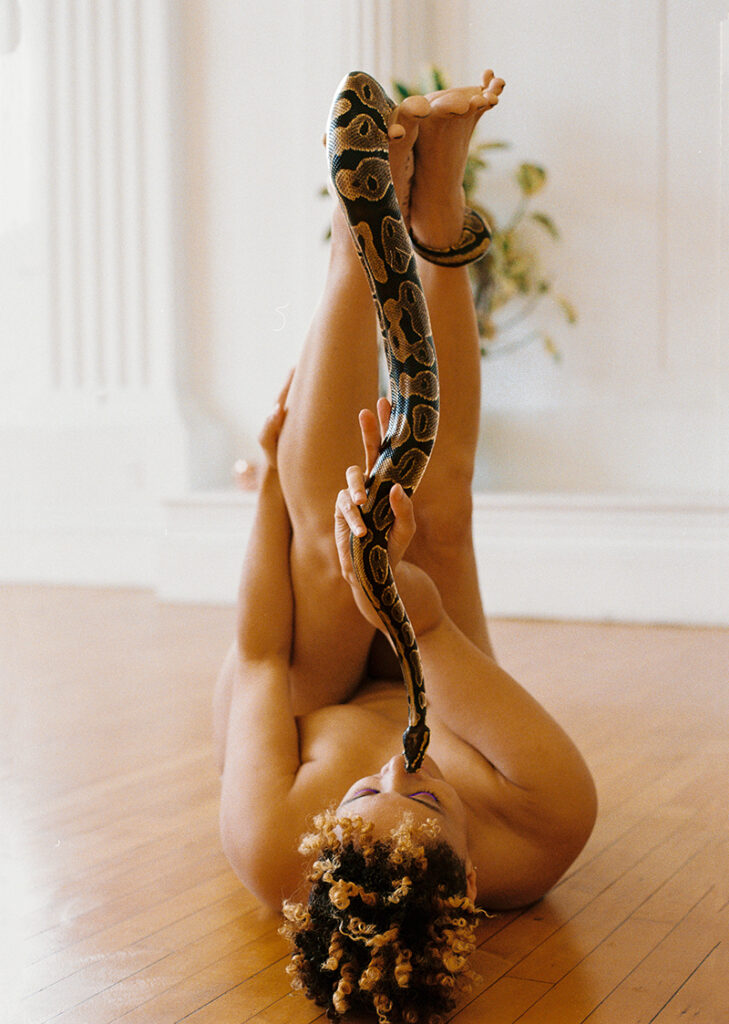
Kai Hazelwood, Photo by Liam Woods
~~
Portions of this were originally published in The Performance Philosophy Journal Special Edition On Grief, 2024
Kai Hazelwood is a multi-award-winning transdisciplinary Disabled, Black, and queer artist. Kai is the founder of Good Trouble Makers, a practice driven collaborative arts project celebrating queer identities and centering d/Disabled QTBIPOC. She is also the co-founder of Crip Crap Community Utrecht, a community by and for crips/spoonies/disabled folks for support and fun! Kai’s embodied healing practice Homebody Living combines EMDR and Somatic Therapy. To unravel embodied white supremacy she co-founded Practice Progress, a consultancy addressing structural, professional, and interpersonal white supremacy through body-based learning. She is working on her first book Shedding: A Playbook.