Finding the Mad Women of Igbo Masquerade
April 20, 2026
BY CHIBUEZE CROUCH-ANYAROGBU
Note: An abbreviated version of this article was published in Stance on Dance’s Spring/Summer 2026 print issue. To learn more, visit stanceondance.com/print-publication.
The first thing to know about Igbo masquerade is that it is “not a human being.”[1] It’s a simple truth, yet impossible to grasp until you’ve witnessed a masquerade in-person. Masquerades, like humans, come in all shapes, sizes, and appearances: scraps of jeweled ankara cloth fighting the wind, dancing raffia where there should be a torso, generations of memory elegantly embroidered onto colorful sleeves, shadows and mesh in place of a face. There is always a mask to cover the head or entire body, whether it be carved wood, draped fabric or natural materials repurposed from the land. The mask is the most important element, created to strike fear in the heart or spark admiration in the eye, turning skin cold or coaxing laughter from deep inside the throat – depending on what the moment requires.
Among the Igbos of southeastern Nigeria, masquerades are masked entities embodying spirits, ancestors, and other supernatural beings from ala mmuọ.[2] They appear during ritual performances presented by secret societies, enacted by people who are possessed by magical forces, mounted by divine beings, or channeling ancestral spirits. Masquerades dazzle through impossible feats of strength, leaping onto buildings at the urging of a drum, dancing without a trace left on dusty red soil, speaking with strange voices that silence the feet, their commands causing even titled men to bow. Watching a masquerade is “an encounter with spirit.”[3] There’s always the distinctly eerie feeling that you’re witnessing something your eyes cannot translate, an energy forcing you to stay in its spellbinding presence or causing you to flee.
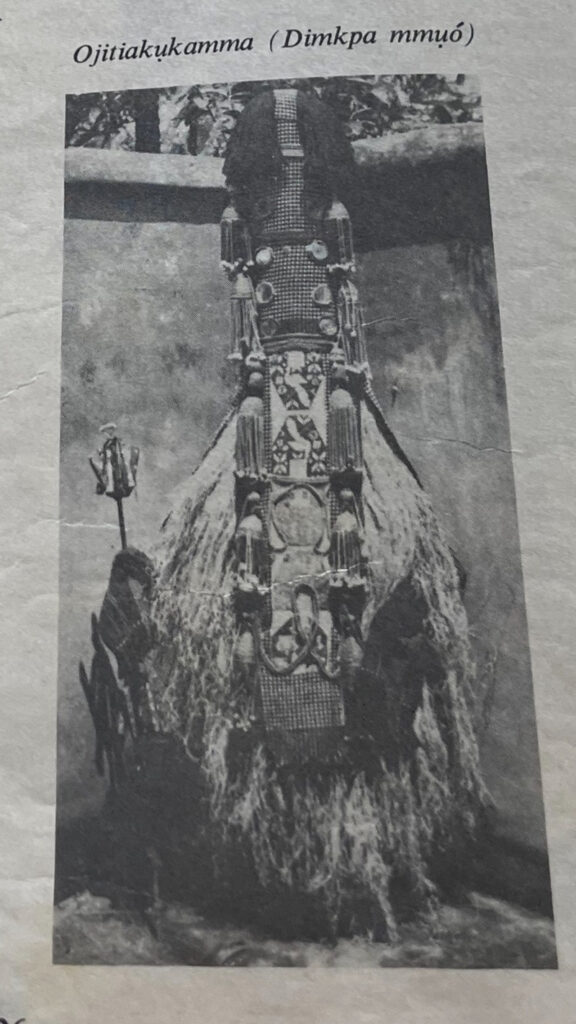
Photo of Ojitiakukamma (Dimkpa mmuo) masquerade by unknown photographer. Ugonna, Nnabuenyi. “EZEIGBOEZUE: An Igbo Masquerade Play.” Nigeria Magazine, no. 114, 1 Jan. 1974, Nigeria National Archives, Enugu, p. 27
Masking is an embodied cultural language, utilizing theatrical performance to shape the community, preserve its stories and implement rituals. Each masquerade varies based on local village influences.[4] Despite unifying cosmological beliefs, shared language, and indigenous practices, Igbo culture is heterogeneous. Independent villages have their unique customs, and different regions even speak their own dialects, with each impacted by local geography, intracommunal ancestry, and neighboring tribes.[5] Across Igboland, masquerades are “communal possessions”[6] that represent, serve, and wield authority over the village. They appear seasonally, during Christmastime, or at critical community events, like funerals of celebrated elders.[7]
Masquerade was (and still is) one of the most important influences on social, religious and political life in Igboland.[8] All “forms of the Igbo social structure [were] reenacted in the masquerade”[9] and traditionally reinforced by the practice. In a society that had no written language, masking sustained collective historical memory,[10] maintained shared social expectations, and imparted important news or information. For example, the biggest masquerade in Igboland today, called Ijele, features intricate sculptures and embroidered costumes illustrating Igbo life and history, with evolving imagery that registers cultural shifts over time. Other masquerades provide critique or amusement through popular dance and satirical performances.[11] Some help resolve disputes, exposing secrets and punishing those who disobey cultural taboos.
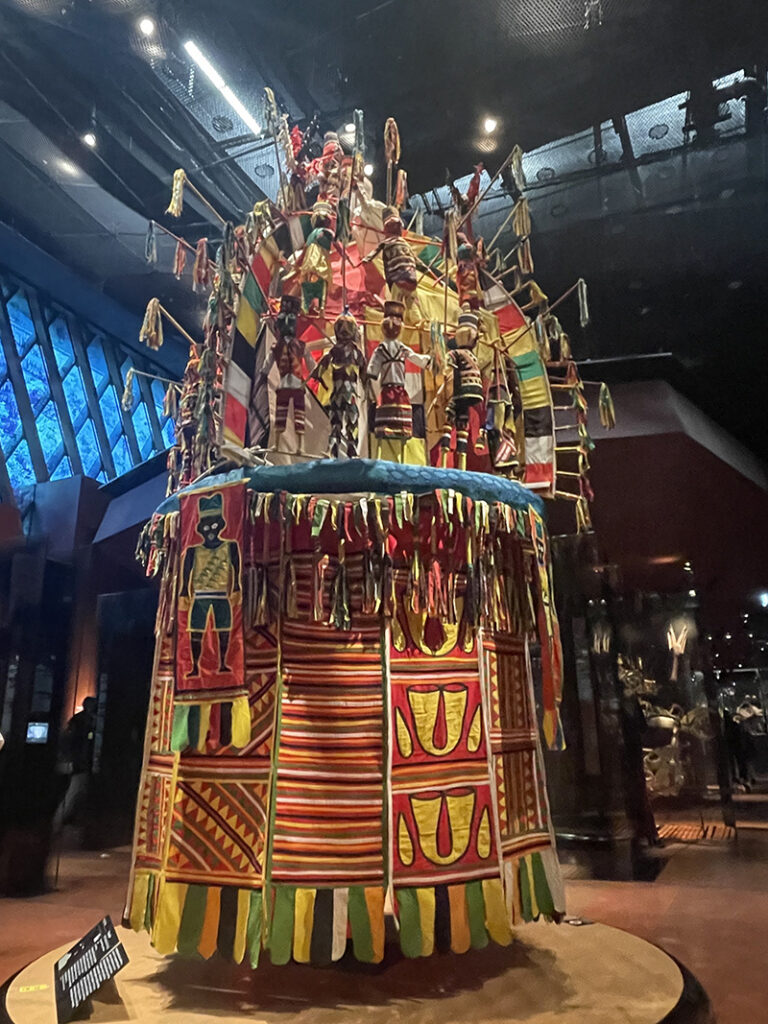
Photo of an Ijele masquerade created by Mike Chukwukelu (born 1945 in Anambra, Nigeria) at the Musée du quai Branly in Paris, France. Photo taken by Chibueze Crouch-Anyarogbu in November 2024.
Igbo masquerade derives deep prominence from its secretive spiritual power, inciting widespread fear or awe among audiences. Masks representing ancestors are accorded utmost respect as “embodiment[s] of the accumulated wisdom and authority”[13] of the entire community. Although its influence is somewhat diminished today, thanks to widespread adoption of Abrahamic religions, masquerade is still cherished as a living archive and valued cultural tradition. In predominantly Igbo states like Anambra or Enugu, where masquerade retains its indigenous spiritual significance and ritual function, “it is not considered subject to any other higher authority.”[14]
That said, masquerade’s might is maintained collectively. Each onlooker’s dual role as witness-participant helps “stage-manage” the outcome of a masking performance.[15] Unmasked human attendants guide masquerades through crowds and public space, while protecting audiences from their occasionally violent behavior. People are expected to run from masquerades that beat or chase them, or provide money, offerings, and gestures of respect to masked performers who demand it. At the same time, masquerades cannot disrespect title-holders, fellow initiated members, or leaders of the village.[16] The choreography of masking is a reciprocal performance, abiding by clear rules of mutual engagement.
The second thing to know about Igbo masquerade is that it “has no gender.”[17] This is a logical conclusion when considering the metaphysical nature of masquerade. For what is “male” and “female” to something non-human? How can gender matter to an unknowable spirit or ancestral presence that requires a mask to be seen? The inherent genderlessness of masquerade is intrinsically aligned with indigenous customs. As described in Ifi Amadiume’s groundbreaking case study Male Daughters, Female Husbands, traditional Igbo gender roles were “flexible,” meaning that “gender was separate from biological sex” assigned at birth.[18] Long before queer theorist Judith Butler famously wrote that gender is performative,[19] Amadiume described how Igbos practiced gender as a socially-dependent performance, one where participants slipped on the masks of “male” or “female” in response to different interpersonal circumstances.
In other words, “daughters could become sons and consequently male. […] Women in general could be husbands to wives and consequently males in relation to their wives.”[20] Women became “male daughters” or “female husbands” to increase their personal and patrilineal wealth. Men could become symbolically or socially female through specific ritual contexts, either during masquerade, as priests of feminine deities,[21] or as costumed attendants during spiritual ceremonies.[22] One of the best examples of men spiritually “becoming” women for the purposes of masking is the agbogho mmonwu or “maiden spirit” masquerade, which uses dance to convey the beauty, dress, and demure behavior of the idealized Igbo woman.[23] As Igbo-Tamil author Akwaeke Emezi wrote about masquerade: “You wear the mask, you are the thing.”
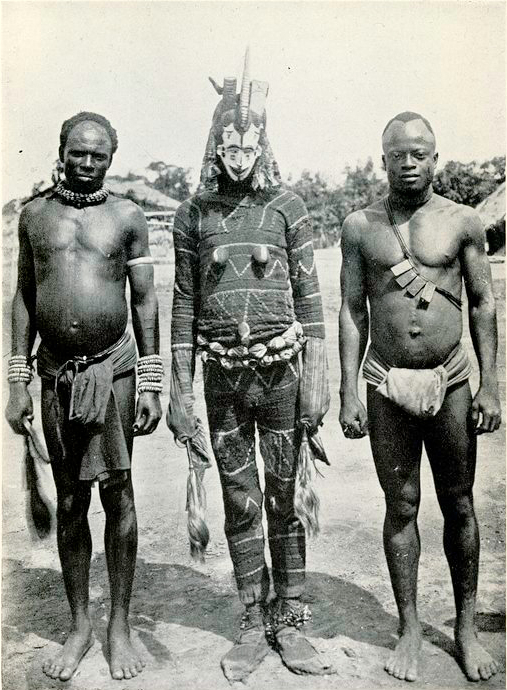
Photo of Agbogho Mmuo masquerade and two attendees by unknown photographer, possibly G. T. Basden. Basden, G. T. Among the Ibos of Nigeria. Philadelphia: J.B. Lippincott, 1921, pg. 224., Public Domain, https://commons.wikimedia.org/w/index.php?curid=6557400
These gender-fluid cultural customs challenged the premise and permanence of essentialized sexual difference, empowering anyone to cross its gendered threshold. While Igbos considered the binary between male and female sexes to be an inescapable biological reality (often exploited at the expense of anyone assigned female at birth), gender identity, roles, and performance were malleable. Individuals could modify their gender to meet and enact the social expectations of the spouses, parents, villages, and deities who claimed them, which helped society function smoothly. The versatility of Igbo gender complicated conventional power dynamics, allowing women to gain wealth, earn respect, and flaunt authority normally reserved for men. These indigenous practices also resisted the rigidity of Western gender roles later imposed by colonial cultural and legal systems. Nevertheless, as a patrilineal society, patriarchy dominated the Igbo world, and still does today. Although women held respected and powerful positions as mothers, daughters, and spiritual leaders,[25] men and sons were traditionally favored over women and daughters. This is because only men could inherit familial wealth and land. These sexist attitudes also inform masquerade.
Masquerade is largely the exclusive domain of men. In some villages, all boys join the masquerade society when they come of age, vowing to never reveal the magical charms and skills they learn in order to wear the mask. In other places, only carefully chosen men – those of high character – can earn the privilege of joining the secret society. Older men initiate youths into the society, teaching the rituals they must master in order to climb the ranks. Generally, women are forbidden from joining these secret societies, and they’re usually prohibited from performing while masked. This is because masquerade “serves the special function of differentiating the male and the female in Igbo society.”[26] Indeed, uninitiated members “are not taken to be men but are still women.”[27] Women are considered too weak to handle masking’s powers, too gossipy to keep its rituals secret, and spiritually unclean due to menstruation. There are also certain masquerades which prohibit women’s presence, especially if pregnant, lest they risk miscarriage, birthing ugly children, infertility, curses, or punishment. Sometimes women cannot touch or interact directly with certain masked performers – unless they are menopausal and therefore spiritually “clean.”[28] However in most settings, women can follow masquerades as spectators, offer musical accompaniment, and perform as background dancers.
Women have been known to join masquerade societies on rare occasions, but only as partially initiated members or for specific rituals. In some areas, titled women with impressive accomplishments or great wealth can join a masquerade society, since they’ve earned the community’s respect. Such women are considered trustworthy enough to enter special shrines housing masquerade costumes, and in some villages they can “control” or present a masquerade as its special companion.[29] Sometimes women married to high-ranking masquerade performers are initiated as a matter of convenience,[30] but they cannot publicly identify masked members. It’s generally accepted and taken for granted that women know the truth, talking privately amongst themselves about neighbors, sons, and husbands they recognize during masking rituals. Ironically, the performative silence and suspension of disbelief among women and non-initiated men are crucial to maintaining masquerade’s power.[31]
These tensions between traditional Igbo gender and the rules of masking invite challenging questions. If masquerade “has no gender” and is “not a human being,” why do only men wear the mask? What are the origins of women’s exclusion from masquerade? How did this practice take root across Igboland? Has it always been this way? There are no simple answers. But an Igbo proverb says, as quoted by iconic Igbo writer Chinua Achebe: “The world is a dancing masquerade. If you want to understand it, you can’t remain standing in one place.”[32] Like the masquerade, we must move to a different position – one grounded in indigenous realities – to uncover stories of women’s masquerade hidden in plain sight.
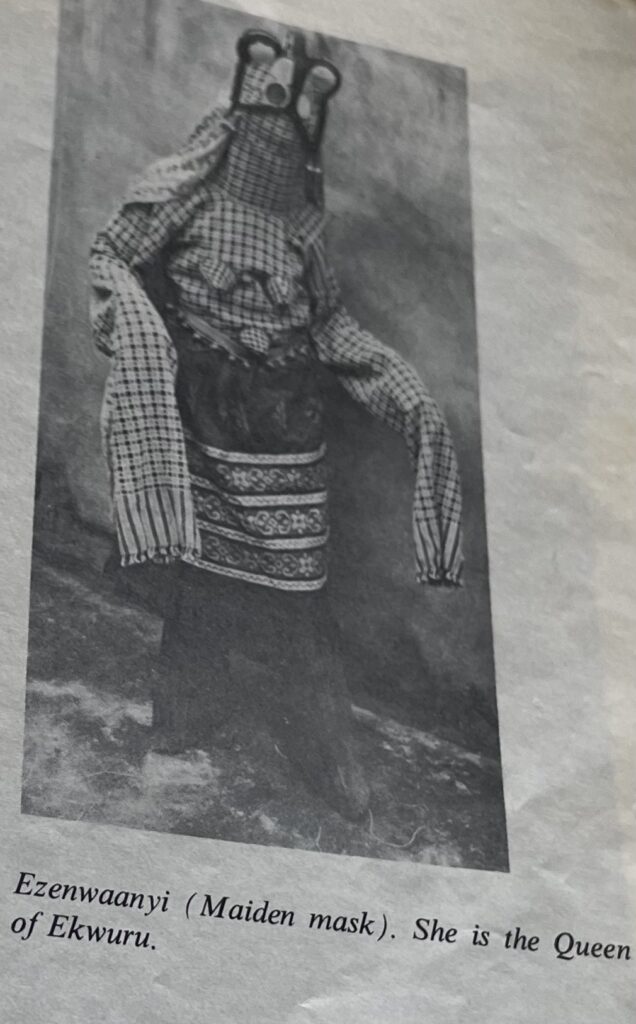
Photo of Ezenwaanyi masquerade (“Queen Woman” or maiden mask) by unknown photographer. Ugonna, Nnabuenyi. “EZEIGBOEZUE: An Igbo Masquerade Play.” Nigeria Magazine, no. 114, 1 Jan. 1974, Nigeria National Archives, Enugu, p. 26.
The dominance of Igbo patriarchal control, sweeping influence of European colonial historiographic methods, and the devaluation of indigenous oral tradition as a valid source of knowledge all helped entrench totalizing narratives about women’s seminal exclusion from masquerade. These prevailing narratives overlooked the diversity of Igbo culture and masquerade customs, rejecting or obscuring practices that contradicted the male-dominated status quo. Oral histories about women’s masking were therefore rebuffed as “myth” or “folklore,” because they weakened the dominance of men’s masking societies, and they were spoken rather than written accounts.
As a “discredited way of knowing,”[33] indigenous oral transmissions have been almost universally disregarded by the Western academy.[34] Mainstream institutions prefer “the delusion of objective historiography,”[35] which describes universally impartial ways of archiving historical events. Colonial-era British anthropologists, soldiers, and government officials “petrifie[d], solidifie[d] and immobilize[d]” the historical record of Igbo masquerade, using photography and the written word to “keep it in order”[36] in service of Empire. Often, Western archives function(ed) as incomplete secondary sources of aggregated and/or miscontextualized indigenous data, prioritizing certain accounts over others based on systemic bias fueled by racist, sexist settler-colonialism. This imperial “desire to settle”[37] upon fixed historical viewpoints impacted personal decisions about which oral histories were “reliable” enough to commit to the “official” written record.
In contrast, oral history is a spacious and dynamic practice where many voices shape a narrative. It is also vulnerable to hegemonic biases due to fallible narrators, who can misremember details or change information to suit their own agendas. But in fact, the risk of inaccuracy and partiality is inherent to all methods of recording history. The imprecise, multidimensional, even populist qualities of oral transmission make it an ideal vessel for the inconclusive details and multi-faceted stories of human history – especially among the Igbos, who didn’t use textual record-keeping systems. Oral tradition realizes nuanced and expansive historical assemblages, forged by the participatory, physicalized exchange between listener and speaker. The resulting embodied archive hews more closely to the kinetic, eclectic nature of historical truth. Indeed, history is like a masquerade, forcing one to dance in all directions or stand in different positions to grasp the entire story.
Oral history reveals that evidence of women’s masquerade is still alive today, breathing through the embodied archives of its descendents. This includes people like my uncle Jude Anyarogbu, Reverend Father Benjamin Ochiaga, and renowned masquerade performer, Duru. I interviewed them, by phone and in-person, while researching stories about women’s masquerade in Avuvu, my grandmother’s village. According to each person, Igbo women performed masquerade in their respective communities, in some cases even originating the custom.
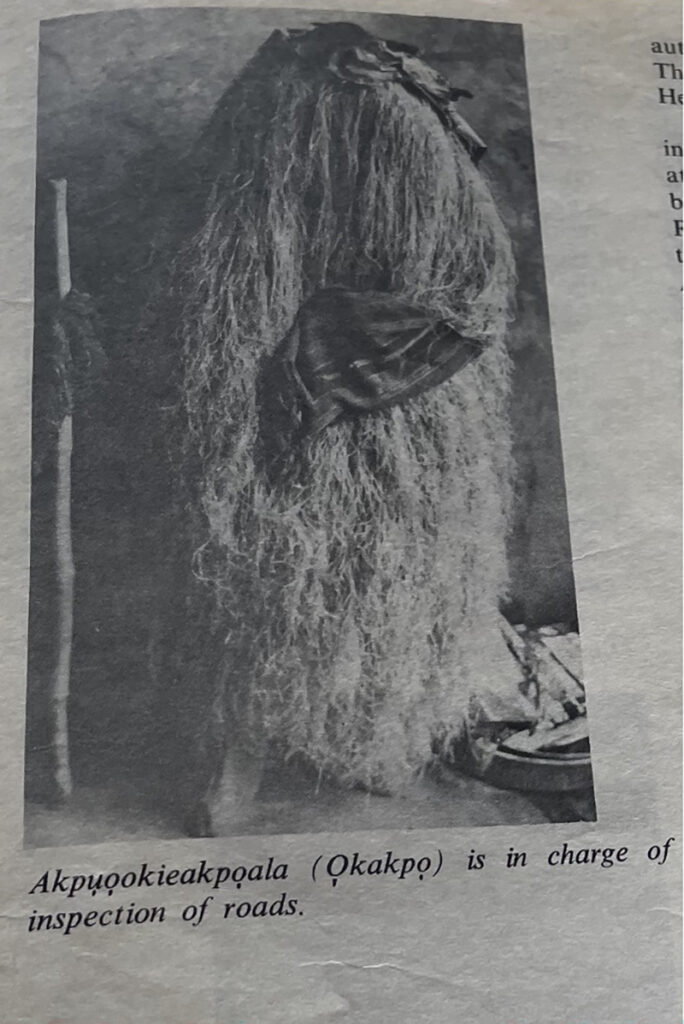
Photo of Akpuookieakpoala (Okakpo) masquerade in charge of the roads, by unknown photographer. Ugonna, Nnabuenyi. “EZEIGBOEZUE: An Igbo Masquerade Play.” Nigeria Magazine, no. 114, 1 Jan. 1974, Nigeria National Archives, Enugu, p. 25.
During interviews with my Uncle Jude, I learned that Nwańnà, my great-grandfather, told him that in the past “women actually did masquerade on their own.”[38] This happened in the Ikeduru district of Imo State, which encompasses my grandmother’s village. According to my uncle, Nwańnà said: “In those days, […] when women participated in the masquerade, they were […] a women group. Just like you have masquerade for the men, they had masquerade for women. But […] the men carrie[d] a bigger masquerade. While the women, their own masquerade [was] not that big like the men[‘s] own.”[39] These women-only groups “owned their own masquerade” and entertained villagers during the festival period “just like the male masquerade.”[40] They maintained all-women secret societies parallel to men, and only initiated women knew members’ identities and ritual preparations.[41]
At some point, the women’s masquerade stopped, and Nwańnà didn’t tell Jude why. It’s also unclear exactly what time period he was referring to, though Jude estimated that Nwańnà lived to be over 100 years old before he passed, and he was in his 90s when he shared this oral history around 1979.[42] Based on these details, it’s possible Nwańnà was referring to women performing masquerade during the colonial era, anywhere from the late 1880s to the early 1900s. When asked if Nwańnà witnessed this practice firsthand, Uncle Jude said: “Of course. Nwańnà was too old enough [sic] to know what happened then. […] I think it’s something he saw.”[43]
Reverend Father Ochiaga was a masquerade performer and society member in Awhum village before becoming a Catholic priest. During my phone interviews with Rev. Ochiaga, he said his late father told him as a boy “that it wasn’t men who originated [the] masquerade. That it was women. But men hijacked it from them, and took it from them, showing intimidation and superiority.”[44] Rev. Ochiaga said that in addition to his father, who was also a masquerade performer, other “elderly people said it” in his village. However, Rev. Ochiaga said he “dismiss[ed] it as a myth” because these stories of women originating Igbo masquerade were archived through communal oral history.[45] To him, “since there were no documentations, [sic] we looked at it as a myth, because it was not written down.”[46]
While culminating my field research, I interviewed a well-known former masquerade performer named Duru, who hailed from Avuvu. Duru spent many years living and performing in the nearby town of Emekuku. When asked about women in Igbo masquerade, Duru recalled an incident in Emekuku in 1982 or 1983, when some “mad women” spontaneously decided to perform masquerade.[47] Because Emekuku is composed of ten different villages, Duru said that “three women from each village came together and formed the women masquerade group” for the entire community.[48] When asked why they performed masquerade, he claimed “there was no special occasion for why they did it. They just did it. In those days, some women were crazy, and they just did it because they [were] hot-headed women.” When I asked what he meant by “hot-headed,” Duru told me a story about visiting a bar in Emekuku in 1978, where he saw a local woman drink six bottles of beer before he could finish one.[49] Simply put, Emekuku women were “strong women”[50]: bold, unconventional, and a little “crazy” – in defiance of the gender contract binding Igbo women at that time.
Duru shared that this incident was momentous because it was “not allowed” and therefore “not [a] common” thing to see.[51] He said this all-women masquerade “just happened once” and “never happened again,”[52] claiming that “most of the women [who participated] are dead”[53] now, save two who still live in Avuvu after marrying into the community. Duru refused to tell me their names because he felt this incident was “not a good story to revisit.”[54] He told me that they “are married women now, and they are elderly. They wouldn’t want to talk about it. They may not be proud of what they did.”
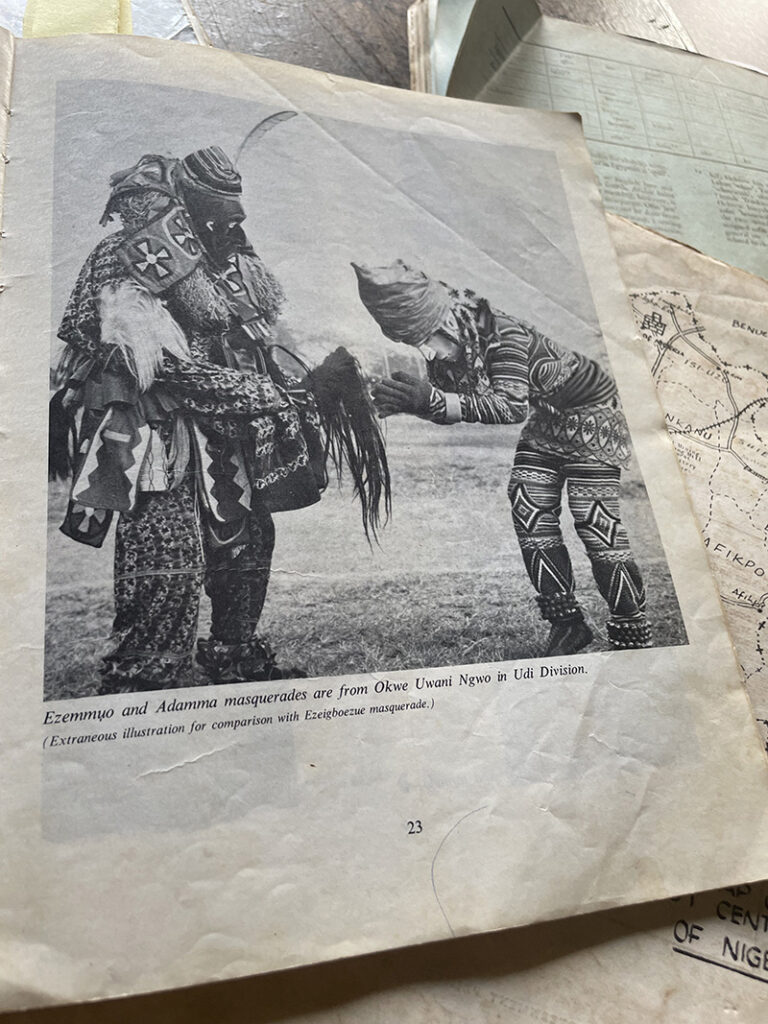
Photo of Ezemmuo (“King Spirit”) and Adamma masquerade (similar to the “agbogho mmonwu” maiden spirit masks), by unknown photographer. Ugonna, Nnabuenyi. “EZEIGBOEZUE: An Igbo Masquerade Play.” Nigeria Magazine, no. 114, 1 Jan. 1974, Nigeria National Archives, Enugu, p. 23.
Jude, Rev. Ochiaga and Duru’s respective oral histories substantiate that Igbo women’s masquerade happened in particular areas during the colonial and post-colonial periods. However, there are important differences within each account. In Awhum, the intersecting outcomes of personal confirmation bias, indigenous patriarchy, and the colonial supremacy of written history vs oral history each worked together to invalidate spoken histories of women’s masquerade.The exclusion of Awhum women from masquerade was encouraged by men who knowingly “hijacked” the tradition as an act of “intimidation,” aiming to demonstrate their inherent patriarchal “superiority.”[56] As a youth, Rev. Ochiaga rejected the indigenous oral histories embodied by his own kindred in favor of the written word, aligning with the male-dominated cultural environment that conditioned him.
Furthermore, Rev. Ochiaga carefully clarified that his community’s oral histories didn’t necessarily represent masking’s origins in other parts of Igboland; only “the masquerade that Awhum people do”[57] was originated by women. My uncle Jude also took pains to explain that my great-grandfather didn’t detail masking’s origins in his village, nor did he claim that women originated masquerade – only that local women performed masquerade, like men did.[58] Conversely, Duru only reported seeing women’s masquerade during the singular Emekuku incident in the 1980s; he’d never heard of nor witnessed women’s masquerade in any other context.
When studied through the lens of indigenous oral tradition, it’s clear that Igbo masquerade has not always been a uniformly male practice. Local oral tradition refutes these patriarchal presumptions, unveiling counterhistorical narratives of women’s masquerade, as practiced in certain villages. These narratives do not suggest that Igbo women’s masquerade was universal. Still, recontextualizing these indigenous embodied archives encourages further scrutiny of relegated oral histories, rejected because they defy established norms. These counterhistories of women’s masquerade “disinter something that has been hidden, and which has been hidden not only because it has been neglected, but because it has been carefully, deliberately and [in some cases] wickedly misrepresented”[59] as outlandish myth, lies, or sacrilege. The existence of women’s masquerade, preserved through oral history, disinherits the hegemonic powers exerted by dominant Igbo patriarchal norms and colonial written historical record.
So whose stories should I believe? The men who told me women’s masquerade never existed in Igboland? The colonial anthropologists and imperial scholars who dismissed what they interpreted as myth? Do I trust men like my uncle – the truth of my own blood – grown in the soil of my grandmother’s village? My great-grandfather, great-grandmothers, and all their descendents are crucial to the existence of my entire lineage. To deny the memories of Nwańnà as transmitted through oral history is to deny myself and my reality, for both are forever tethered to my ancestors. I believe my blood, because I believe blood doesn’t lie. I believe the mad women of Emekuku and their predecessors: the mothers of masquerade who were forgotten, misplaced, and spurned by kin who feared their power. I believe in dancing with the masquerade of history, carried across generations, compelling me to move with archives created by bodies in constant motion, speaking many truths into being.
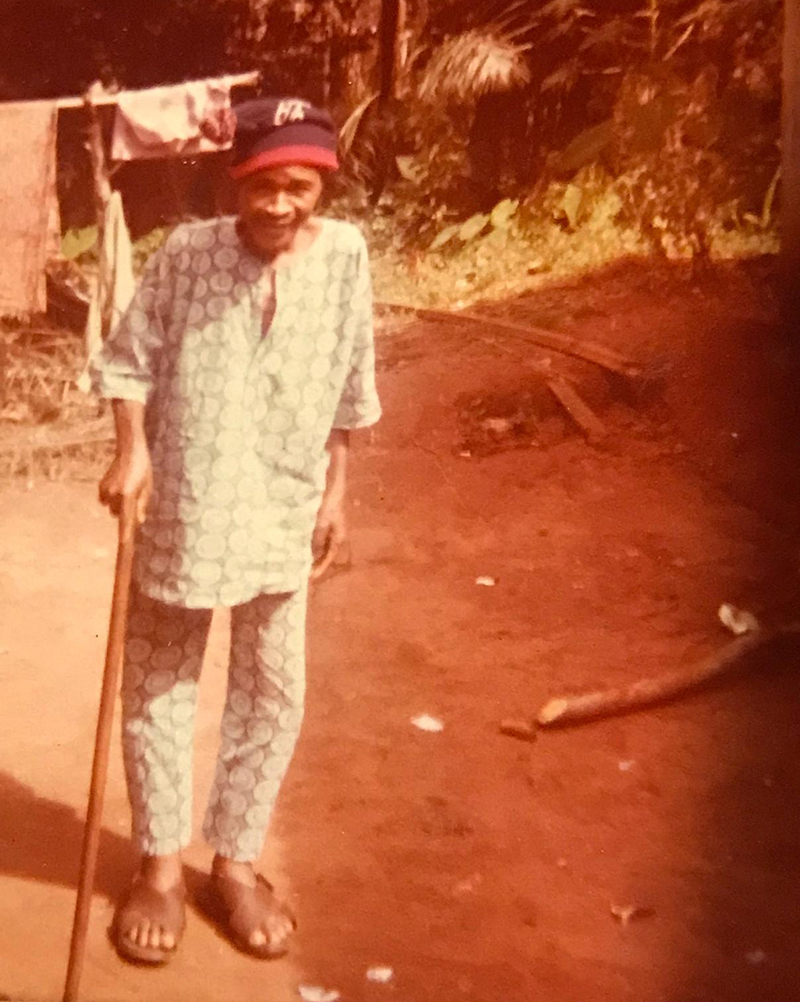
Photo of Nwańnà Anyarogbu, great-grandfather of the writer, taken by Caroline Crouch-Anyarogbu sometime in the 1970s in Avuvu, Nigeria.
Chibueze Crouch-Anyarogbu is an artist, writer, and dramaturg based in London. They make multi-disciplinary performance, film, and text-based works, and recently completed an MA with distinction from Goldsmiths, University of London. To learn more, visit www.cchibuezec.com.
~~
Works Cited
Achebe, Nwando. Farmers, Traders, Warriors, and Kings: Female Power and Authority in Northern Igboland, 1900-1960. Portsmouth, NH: Heinemann, 2005.
Afigbo, A. E. Ropes of Sand: Studies in Igbo History and Culture. University of Nigeria Press, Nsukka, 1981.
Amadiume, Ifi. Afrikan Matriarchal Foundations. London: Karnak House, 1987.
—. Male Daughters, Female Husbands. 1987. London: Zed Books Ltd., 2015.
Anyarogbu, Jude. Interview with Jude Anayarogbu. Interview by Chibueze Crouch, 15 Aug. 2025.
Anyarogbu-Crouch, Caroline. Interview with Nne: Mrs. Anyarogbu-Crouch. Interview by Chibueze Crouch- Anyarogbu, 24 July 2025.
Beier, Ulli. “The World Is Dancing a Masquerade – Chinua Achebe Interviewed by Ulli Beier.” Art Africa Magazine: A Luta Continua, edited by Kendell Geers, no. 07, May 2017, https://artafricamagazine.org/a-luta-continua-the-world-is-dancing-a-masquerade-chinua-achebe-interviewed-by-ulli-beier/. Accessed 13 Aug. 2025.
Butler, Judith. Gender Trouble: Feminism and the Inversion of Identity. Routledge, 1990.
Cole, Herbert M., and Chike C. Aniakor. Igbo Arts: Community and Cosmos. Museum of Cultural History: University of California, Los Angeles, 1984, pp. 115; 157-160; 181 – Plate 33; 186-187.
Duru. Interview with Duru of Avuvu. Interview by Chibueze Crouch-Anyarogbu, June 2025.
Emezi, Akwaeke. “In Lagos: A Visual and Literary Journey through Nigeria.” Dazed Magazine, with Harley Weir, no. Spring 2018, 9 Apr. 2018, https://www.dazeddigital.com/fashion/article/39610/1/harley-weir-akwaeke-emezi-lagos-nigeria
Enekwe, Ossie Onuora. Igbo Masks: The Oneness of Ritual and Theatre. Lagos: Department of Culture, Federal Ministry of Information and Culture, 1987.
Finnegan, Ruth. “The ‘Oral’ Nature of African Unwritten Literature.” World Oral Literature Series, 17 Sept. 2012, pp. 3-27.
Foucault, Michel. “Chapter Four: 28 January 1976.” ‘Society Must Be Defended’: Lectures at the Collège De France, 1975-76, edited by Mauro Bertani, Alessandro Fontana, François Ewald and Arnold I. Davidson, translated by David Macey, London: Penguin Books, 1997, pp. 65–85.
Ochiaga, Reverend Father Benjamin. Interview with Reverend Father Benjamin Ochiaga. Interview by Chibueze Crouch-Anyarogbu, 10 June and 13 Aug. 2025.
Okafor, Chinyere Grace. “Chapter 17: Female Power: Corner Stone or Central Subject in Igbo Mask Performance.” Emergent Themes and Methods in African Studies: Essays in Honor of Adiele E. Afigbo, edited by Toyin Falola and Adam Paddock, Trenton, NJ: Africa World Press, 2009, pp. 303–19.
Okagbue, Osita. ‘Playing with Our Ancestors: Culture and Communal Memory in Igbo Masquerade Theatre’. African Performance Review, vol. 11, no. 1, 2019, pp. 25–40. research.gold.ac.uk, https://apr.african-theatre.org/index.php/apr/article/view/172.
Onyeke, George. Masquerade in Nigeria: A Case Study in Inculturation. Bonn University and EOS Verlag Erzabtei Ottilien: Dissertationen Theologische Reihe, PhD dissertation, 1990.
Onyeneke, Augustine Onyenwe. The Dead among the Living: Masquerades in Igbo Society. Holy Ghost Congregation, Province of Nigeria, and Asele Institute, 1987.
Ottenberg, Simon. “Chapter One: Humorous Masks and Serious Politics Among the Afikpo Igbo.” Igbo Art and Culture and Other Essays. Edited by Toyin Falola, Trenton, NJ: Africa World Press, Inc., 2006, pp. 36-71.
ThamesTv. “Toni Morrison interview | American Author | Award winning | Mavis on Four | 1988.” YouTube, 6 August 2019, https://www.youtube.com/watch?v=UAqB1SgVaC4
UC Santa Cruz Arts, Lectures and Entertainment. “Hayden V. White Distinguished Annual Lecture 2025.” Fred Moten. YouTube, 18 April 2025, https://www.youtube.com/watch?v=TkqsdkNyLys
~~
[1] Anyarogbu-Crouch
[2] Igbo word for “spirit land.”
[3] Enekwe 70
[4] Enekwe 57
[5] Onyeneke 41 and 44-45; Onyeke 31; Afigbo 100
[6] Enekwe 66
[7] Onyeneke 1
[8] Onyeneke pg. v
[9] Onyeneke 63
[10] Enekwe 91; Okagbue 2
[11] Onyeneke 86; Enekwe 110-111
[12] Onyeneke 106-107
[13] Enekwe 65
[14] Ibid.
[15] Onyeneke 102
[16] Onyeneke 106-107
[17] Ochiaga
[18] pg. 111
[19] See Gender Trouble (1990)
[20] Amadiume 111
[21] Amadiume 432
[22] Cole and Aniakor 181 (see Plate 33: an image of a man in “female attendant” costume)
[23] Enekwe 98-99 and 134-135
[24] Emezi
[25] Amadiume in Afrikan Matriarchal Foundations: The Igbo Case, 17-19
[26] Onyeneke 78
[27] Onyeneke 78
[28] Anyarogbu
[29] Onyeke 182; Achebe 162
[30] Ottenberg 56
[31] Okafor 304
[32] Beier
[33] ThamesTv (1988 Toni Morrison interview via YouTube)
[34] Finnegan 4; Afigbo 205 and 141
[35] UC Santa Cruz Arts, Lecture and Entertainment (2025 lecture by Fred Moten via YouTube)
[36] Foucault 70
[37] UC Santa Cruz Arts, Lecture and Entertainment (2025 lecture by Fred Moten via YouTube)
[38] Anyarogbu
[39] Anyarogbu
[40] Ibid.
[41] Ibid.
[42] Ibid.
[43] Ibid.
[44] Ochiaga
[45] Ibid.
[46] Ibid.
[47] Duru
[48] Ibid.
[49] Ibid.
[50] Duru
[51] Ibid.
[52] Ibid.
[53] Ibid.
[54] Ibid.
[55] Ibid.
[56] Ochiaga
[57] Ibid.
[58] Anyarogbu
[59] Foucault 72