Natural Acts
January 5, 2026
At The Intersection of Crip Time and Grief Time
BY PEREL
Photos by Mayra Wallraff
Note: This article was published in Stance on Dance’s Fall/Winter 2025 print issue. To learn more, visit stanceondance.com/print-publication.
How to write a tribute to a work, to a life, to a relationship? These questions linger in my limbs, fascia, and the plethora of unknown internal spaces as I seek to describe the performance of Natural Acts. On one hand, I used the techniques that I’ve been practicing for what feels like forever: Authentic Movement™, improvisation, improvisation mixed with role-play leaning heavily on the psychological impact of the role-play, and playing with props from the dollar store that represent some kind of sentimental significance. These elements have served part of my studio practice for coming upon two decades. I’ve mixed them with historical, political, and personal narratives to shape worlds where my queer, disabled body can exist as a subject along with other marginalized bodies in real time, or on other timelines, in the US and in Europe.
On the other hand, I found myself in a territory which was completely new and through which I did not have the tools to cope: that of immediate loss. It is hard to write about even though I am grateful for the chance to do it. My mother died shortly before we were due to begin the rehearsal process, and after much deliberation, I decided to stay with the piece that would become Natural Acts.
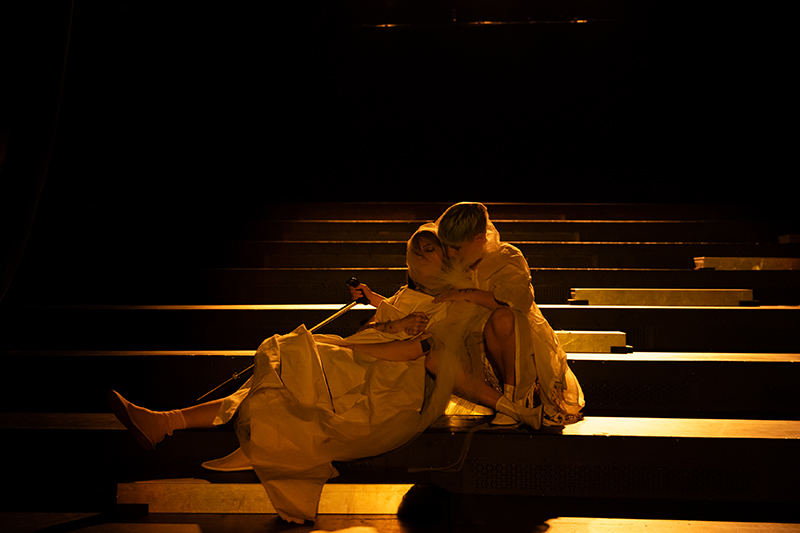
My grieving process became my studio practice, as memories, desires, and longings washed through me. I was feral, seeking out materials and music that reminded me of her: all kinds of animal printed clothing, black wigs I would spray with perfume, and 1960s-1970s folk and rock music. Meanwhile, I had a team of people, which as mostly a solo artist was also new territory. My fellow performer Rita Mazza, dramaturg and assistant director Katharina Joy Book, and producer Diana Paiva spent many studio hours with me in the wilderness of that sorrow.
I began to gather resources to support my grief, which found their way into our process. Dina Maccabee, my friend who was also the composer, introduced me to the Resonant Language teaching of Sarah Peyton. I learned about the neuroscience of grief and trauma, and what happens to the brain when we’re triggered by acute loss. I used the sculptural work of artist Itamar Gov to demonstrate this to the audience. Rita composed visual sign poetry which they performed. We called this the Amygdala Score.
The amygdala, about the size of a kidney bean, holds all our memories, and might also hold those of our mother. In the moment of trauma or loss, the amygdala prevents the hippocampus from putting a timestamp on our experience, so that acute past loss blends into the present. The nervous system loses time and falls into the sea of painful memories. It is in that timeless space that we cohabitate with our grief.
The performance unfolded in such a way that zoomed in on my immediate grief and zoomed out to reference historic grief and shared loss. I’ve been living in Berlin for a few years, which is where Natural Acts was made and where it opened, at the Hebbel- Am-Ufer (HAU) theater. Before my mother’s death, Natural Acts was meant to reveal my research into the Aktion T4 project, which was the mass killing of disabled people up to and throughout the course of World War II, and to also include Holocaust research with my family’s known and unknown diasporic history.
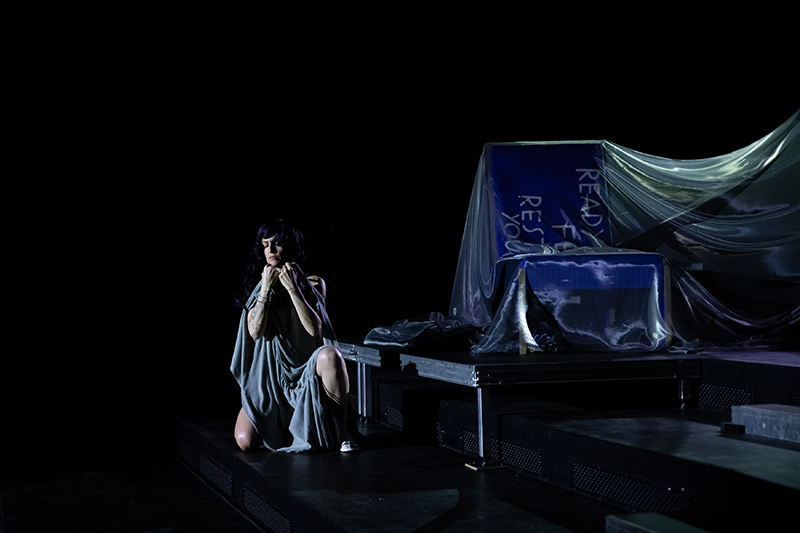
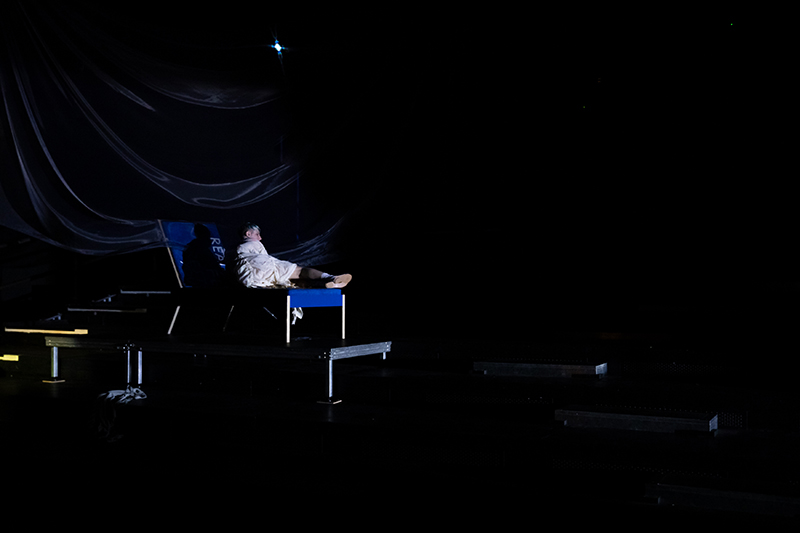
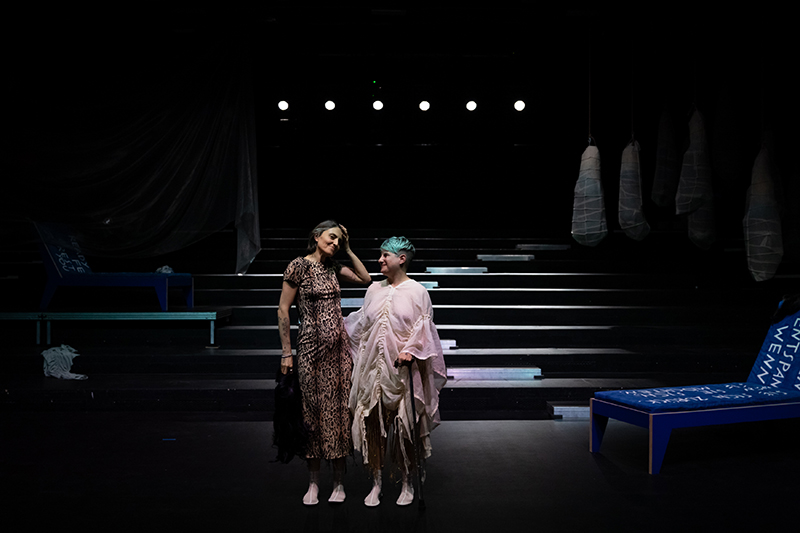
These references found their way into projected text across the stage, floor, and wall of the theater, animating empty spaces. Each projection was timed to textured and haunting musical compositions that rested between the familiar and otherworldly. The structure that housed these uncanny elements was an inverted stage, so that Rita and I were performing within the risers for the audience, and the audience was seated on the stage. Featured among the risers were lounge chairs by the artist Finnegan Shannon, on which we rested at times and watched one another perform.
In a conversation with curator Alina Buchberger, she said that the work was at the intersection of crip time and grief time, which resonated with the multiple ways that access shaped this particular world. The relaxed performance format supported the audience to leave and come back at any time, and the doors to the theater were kept open. The first rows of seating were made of cushions and mattresses. There was room for the audience to take breaks as they needed. Although I use this format for all my shows, this time there was something choreographic about the movement of the audience coming and going, Rita and I taking turns performing and laying on the lounge chairs, and the sound and text episodically emerging from the darkness.
I’ve been thinking about what Alina said, how both crip time and grief time are nonlinear measurements of time, and how stillness and rest are complex concepts within both these frameworks. Throughout the process of making Natural Acts, and even now, my body has been wrestling with the need to surrender to both chronic pain and the pain of grieving. Rest in this case is not relaxing but allows for the discomfort of what I cannot control to exist, however terrifying the fact of it feels. The continuous loss of my own body, the current loss of my mother’s body, and what has been lost to history live in the still and the empty, which looks like rest, and is anything but until it is final, which even then is never the whole story.
What is for everyone and what is not for everyone also played a role in the making of this piece and its duration. Rita’s creation of visual sign poetry came from both my own writing and reading of poetry on loss. They found the lines that struck them most and generated an embodied visual performance that incorporated DGS (German Sign Language) as sign elements.
It was never a 1:1 translation of the original text. In this sense, the Deaf audience would be able to grasp Rita’s performance in a way the hearing audience cannot completely access. This was an important part of it, that culturally we’re already not having the same experience of the world, so why not allow for that in the space of a show?
Along the lines of language, the layers of my own English spoken language where I sometimes stutter, being translated by a hearing sign language interpreter who interprets into DGS for the Deaf interpreter to sign for the audience, added another time signature, where simultaneity of translation was not always possible or even the goal, where pauses for the stutter and for signing were necessary.
These elements of access and their direction were not meant to be oblique but to have their own place, which can frustrate expectations of nondisabled or hearing or sighted audience members who might be used to one time signature or way of seeing a work. If anyone felt like anything was taking too long, there were options: go outside and smoke a cigarette, take a nap on one of the mattresses, or get curious about forms of embodiment or language that they don’t understand and settle into it, or even do all three options during the length of the show.
At one point in the show, the audio describer, who has been describing the visual elements of the show in German into headsets, speaks into the PA system of the theater in English while I am laying on my left side on a lounge chair with my back to the audience. She goes on to describe my spirit leaving my body and traveling outside of the theater, across other timelines. For a moment the space of the theater opens up to a choreography of the imagination, where the voice of the audio describer directs everyone.
I’m preoccupied with time here and all its measurements because of this question about form. Yes, Natural Acts was a production: It took place in a theater and required all that a production in a theater does. It relied on public art funding and was a ticketed event, but it was not so much a performance as it was a memorial. And memorials are not necessarily cohesive events. Everyone in attendance comes with their own experiences with varying forms of emotional presence or capacity. Some people need to laugh, others to cry, some want to talk, others want quiet, some want to participate, and others to keep a distance. This was a space that allowed for it all.
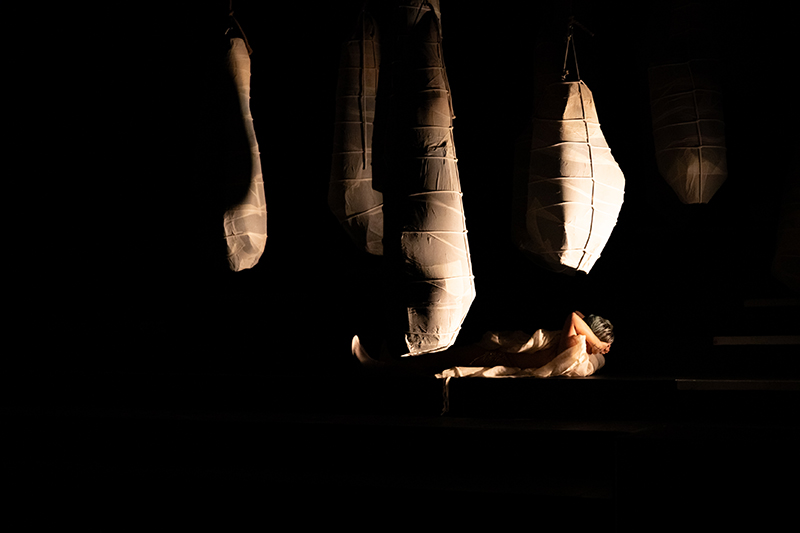
During the course of the piece, I performed three scores for participation with the audience. With each one, I was relating to my mother and her absence; holding the gaze of audience members the way she looked at me, holding an audience member as if I was holding her, and giving an improvised monologue based on prompts from the audience that included memories of her or questions about ancestral trauma in our family.
Each of these acts involved forms of dressing up or undressing: wearing make-up like she did, putting on a black wig like her hair, covering an audience member with my coat, stripping down to a golden harness while I talk about Auschwitz, ashes, my mom’s mental health history, or trying to masturbate when the room starts glowing and it feels like angels are calling.
How to place these symbolic gestures and attempts to embody the bodiless? How to account for the desire for a lost intimacy through my own queer embodiment? How can camp and kink find their ways into a memorial for a mother who might have inspired these expressions but refused to embrace them in her own child? And then, how to take the risk to present this to an audience to embrace or reject? For whom are these acts connective or cathartic, and for whom are they forced, profane, or clowning at mourning? Is there room in grief, in the heavy, inescapable weight of an absence, to risk play?
In the end, I sing Kaddish for my mother, and for all the mothers who have died from war and from genocide but have not been honored. The projected text that travels through the theater references “my dead god” and cadavers fitted to the form of nation-states. Rita then takes the stage to strip away a rhinestone-studded T-shirt with a large tiger printed on it, and removes the long, black wig from their head. They lead us both out of the view of the audience. A memorial that comments on memorialization, a porous space where not all the actions are discernible or apparent, a place where the unknown is either an invitation or a complication; Natural Acts was all of these.
~~
Many Thanks:
As I recall the memories of this work, I want to thank Katharina Joy Book, whose sensitivity as an assistant director and dramaturg, both inside and outside of the studio, held this process. I want to thank Rita Mazza for sharing in this real-life event and artistic work with me, in a queer siblinghood of nonlinear and nonbinary mourning. I want to thank Joseph Wegmann for his lighting and video design, and to thank Jonas Maria Droste for working with me on the stage and relaxed performance design. I thank Dina Maccabee for her musical composition and grief doula-ing. I am also grateful to the entire access team, totaling eight people across DGS interpretation, audio description, and for my own assistance. I am grateful to Russell Harris for designing true sacred garments, and to Rhama Corvalán for nonbinary face painting. I am also grateful to have had the administrative support of Diana Paiva and Anna von Glasenapp for the premiere. Natural Acts has since toured to Kampnagel and was produced by Carolina Brinkmann with lighting and video production by Hendrik Borowski.
To learn more about Perel, visit www. perelstudio.xyz.
Responses
There are no comments at this time.
Be the first to start the discussion by filling out the comment form.