Urgent Demands, Urgent Responses
December 15, 2025
Interdisciplinary Performance Strategies with Colectivo LASTESIS
BY MARLENA GITTLEMAN
Note: This article was published in Stance on Dance’s Fall/Winter 2025 print issue. To learn more, visit stanceondance.com/print-publication.
Colectivo LASTESIS understands the power of movement in both senses of the word, from potent gestures to massive protests. Their artistic performance work exemplifies how to traverse the spaces between those meanings and scales. They lead accessible workshops across their home country of Chile and worldwide, both in person and online. Here, I share some of my direct experience with what LASTESIS terms “three-dimensional feminist collage” as a way to “translate feminist concepts into concrete language,” fomenting communities of solidarity, resistance, and care. (Hence their name, which translates to “the theses” and suggests this process of accessible and embodied translation of feminist ideas.)
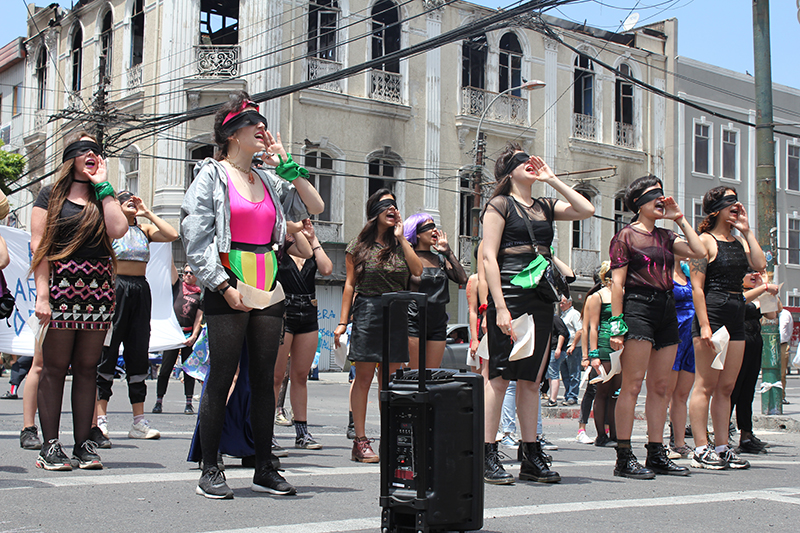
2019 Valparaíso performance of un violador en tu camino, Photo courtesy Colectivo LASTESIS
I was lucky to attend a workshop they held at La Peña Cultural Center in Berkeley, California, this past May. The structure of this article mirrors that of the workshop itself. La Peña is a political and movement home for many Bay Area residents and visitors alike through their salsa, bachata,and merengue classes and parties, among other music, art, and community workshop offerings. (LASTESIS’ workshop was held in Spanish, so all translations of quotes from that day are my own.) Community links had brought LASTESIS to La Peña, and the connection was fitting: La Peña was founded 50 years ago as a “direct response” to the Pinochet dictatorship, in the words of the center’s director, Consuelo Tupper. The intersectional feminist work of LASTESIS responds in part to the effects of that US-backed regime (1973-1990) whose legacy can still be felt in Chile.
LASTESIS consists of Daffne Valdés Vargas, Sibila Sotomayor Van Rysseghem, and Paula Cometa Stange, and is best known for the viral performance un violador en tu camino (the rapist in your path). They first performed it in 2019 in Valparaíso, Chile, to protest the links between sexual violence, patriarchy, coloniality, the neoliberal state, and police violence. They brought un violador en tu camino to the streets of Santiago some days later. The performance consisted not only of the collective’s founding members but also hundreds of other women, queer people, and disidencias (a Southern Cone term that describes those with dissident sexual and gender identities). In the performance, a mass of performers stands together, wearing black blindfolds across their eyes, and many also wear the green handkerchief that symbolizes the fight for legal abortion. They chant words as they step-touch to the beat, and they accompany them with movements and gestures like squatting with hands behind the head and elbows bent. The repetition of the chorus builds, “Y la culpa no era mía, ni dónde estaba ni cómo vestía” (“And it wasn’t my fault, not of where I was or how I was dressed”), as they tread their knees back and forth and curl alternating biceps in. Each time the chorus repeats, the performers seem to pick up momentum, rooting into firm belief in what they are saying. The chorus resolves with “El violador eras tú, el violador eres tú” (“the rapist was you, the rapist is you”), accompanied by a pointing accusatory finger with each “you.” Thanks to social media circulation, un violador en tu camino was taken up and translated, the same gestures with different words performed in more than 50 countries across the world, including here in the US as a response to the Harvey Weinstein sexual assault trial. (Search “the rapist in your path” on YouTube and you’ll find adaptations in Mexico, Tunisia, Colombia, France, and many other places.)
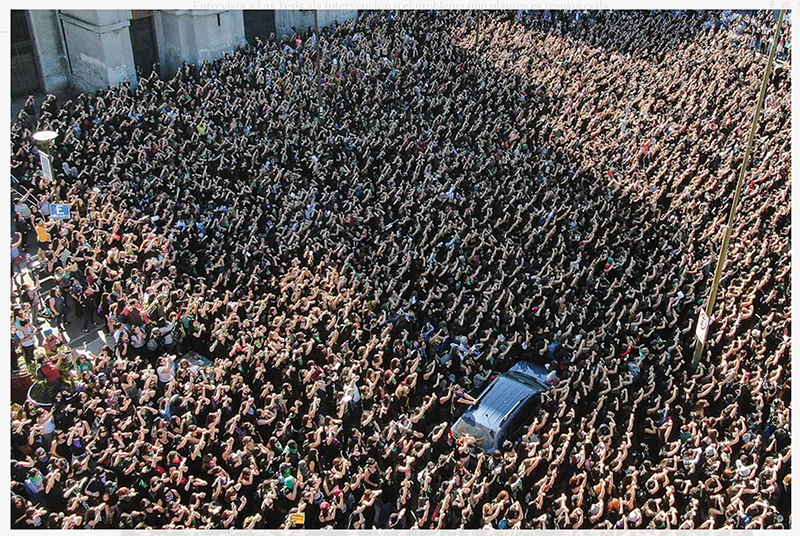
2019 Santiago performance of un violador en tu camino, Photo courtesy Colectivo LASTESIS
The massification of LASTESIS’ anthem suggests that the need for embodied, collective feminist resistance is shared across sociopolitical contexts. The sociopolitical context here in the US could be felt acutely, too, at the May La Peña workshop: some collective members’ visa statuses and travel plans had been affected, which led to a hybrid format via Zoom livestream. Participants hailed from Mexico, Argentina, the US, Chile, and Colombia and ranged in age from 20s to 60s. There was a young baby in a stroller as well as two older gentlemen who stopped in from their work at La Peña. The workshop was donation based and therefore financially accessible to anyone who wanted to attend, democratizing the activist offering.
For LASTESIS, performance art doesn’t only come about through dance and bodily movements, but also through reading, writing, discussion, visual art, and scenic design. Their workshop process acted as a window into their interdisciplinary approach, exposing us participants to the technique of collage beyond the purely visual and two-dimensional sense of the word. As a feminist mover myself, I could also sense how much our bodies — what they face and what they are capable of — were present even during moments of supposed stillness in the workshop.
Warm Up
There was jumpy energy in the room before the workshop began, but after some brief introductions we warmed up with some movement. An embodied approach, done in a circle, set the tone and opened up space for the rest of the workshop. LASTESIS put on dance music from Chile and Argentina and had us:
Groove and dance to the music.
Move your hips in a circle. (Dancers: you know the classic isolations and rotations!)
Shake your arms.
Shake your legs.
Shake your whole body all at once.
Massage the shoulders of the person in front of you.
Turn the other way and do the same thing.
Lightly tap and hit the back and limbs of the person in front of you.
Brush bad energy off the person in front of you, and shake that bad energy off into the center and up and out into the air.
After connecting through movement, these small offerings we made to strangers and friends, we sat down at a horseshoe-shaped set of tables and talked. LASTESIS asked: “What seems urgent to you?” That simple question generated a wide range of concerns, including:
Safety in existing as a woman
Biological essentialisms and the conservatisms that uphold them
Partner violence
Fascism worldwide
Paying rent
Disability access
Women in war zones, from Gaza to Colombia
Apathy despite genocide being nearly livestreamed
Politics of hate that aim for death and protect only cisgender, heterosexual men
And questions like:
How to act politically in ways that matter, when voting isn’t enough (you have to be a citizen, after all) or isn’t enough to make change?
How to protest in the Global North in ways that have the impact of marches in the Global South?
LASTESIS summed up and echoed back — synthesized — what they heard. Two main questions arose:
How do we frame state violence and its constituent colonial, patriarchal, structural, and everyday violence?
And what do we (“nosotras” — in the feminine) do about it?
Each aspect of the three-dimensional collage that followed built on this discussion. It was a continual reconcentration of ideas, a distillation — what LASTESIS calls “synthesis.”
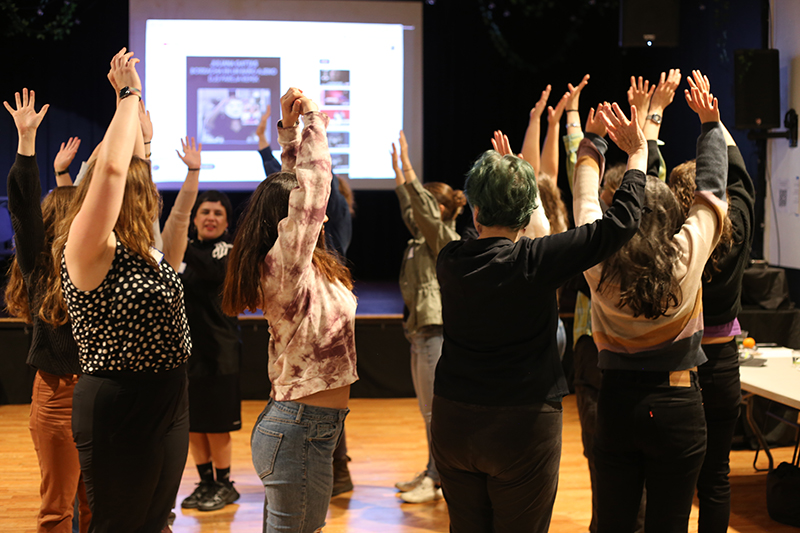
May 2025 Workshop at La Peña, Photo by Christina Azahar
Writing
After the conversation, LASTESIS guided us to each write down a list of memorable keywords. Each person read their list aloud, creating a kind of mini poem, a litany of both concerns and aspirations. Some words I read, some words I heard:
North/South
Collectivize
Will
Hope
Time
March
Frustration
Masses
Care
Burning
Love
Systems
War
Genocide
Violence
Solidarity
Survival
Then each person picked three words, made a short sentence, and read it aloud. Each person then created their own synthesis. Next, we worked in small groups to make a group phrase, and read that aloud, a continual voicing and reframing of understandings and shared concerns.
Bodily Movement
In small groups, we were told to “bring the sentence to the body.” In other words, create an embodied translation or movement to encapsulate the phrase we’d just composed. My group squatted down low, facing each other. We started to move our hands faster and to rise up onto our feet, arms like flames fanning overhead that moved outwards.
Another group’s movement started by covering their faces and ended by holding hands in a circle.
Synthesis: The gesture or movement didn’t have to correspond exactly to each word of the written phrase in order to be powerful. Just witnessing groups of women-identified people moving in unison had a certain feminist power, too.
Visual Art
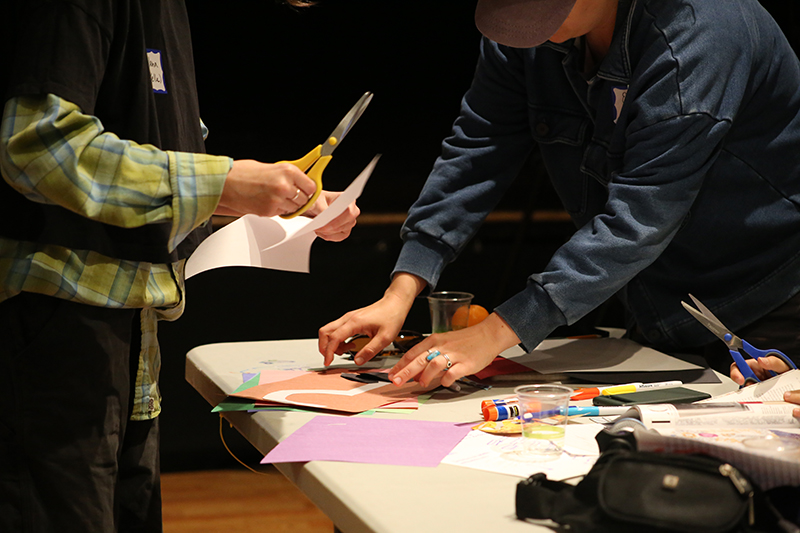
From there, we all grabbed scissors and markers, stood and sat around tables. We brainstormed, debated, cut, arranged, and pasted. Even this was quite physical. There was an energetic impulse that came not just from the fact that we were running out of time. Someone in my group cut flames out of an orange peel, a mother rocked her child in a stroller with her foot while pasting magazine cutouts onto construction paper, an older woman and a younger woman discussed what images to cut out.
Each group shared their visual collage. I saw images of leaves and flowers and butterflies, women with fists raised, words like “together” and “mobilize” and “honor rage.” I saw spirals and circles and a big white question mark. The collages were hastily made, modestly constructed, but no less thoughtful: I heard the resonance, felt the residue of everything that had just transpired, distilled into this final-but-not-really-final stage of three-dimensional collage.
May 2025 Workshop at La Peña, Photo by Christina Azahar
Cool Down
We cooled down, but never cooled off! LASTESIS reminded us: here you are, all feminists; this in itself is an in-the-moment collective.
Ultimately, I was most struck by how this collective collage model, even just from a two-hour workshop of mostly strangers, could be so efficient in forming the basis of social and political action that amplifies participants’ needs and demands. Was there awkwardness? Some. Was there ambivalence? At times. But it felt like the workshop process could hold space for all that. I think certain types of activism get flak (whether justified or not) for being belabored, all talk, and no action. By contrast LASTESIS, through their feminist work and workshop strategies, offers the potential to identify the urgency and to address it urgently, through a range of interdisciplinary and collective movements.
~~
Learn more about Colectivo LASTESIS at www.colectivolastesis.com.
Marlena Gittleman (she/they) completed a PhD in Comparative Literature at UC Berkeley, where she taught writing and literature and researched gestures in US and Latin American queer and feminist literature and performance art. Marlena’s writing has been published in Feminist Studies, In Dance, and Life as a Modern Dancer, and their translations have been published in Critical Times and The Common. Marlena is a dancer who has performed in NACHMO SF and with 4Fish x RedEye Productions. They are a Postdoctoral Fellow at the Center for Interdisciplinary Critical Inquiry at UC Berkeley.